Jump to a question in this guide
- What does a rotary lawnmower do beneath its cover?
- How do the engine, vertical shaft, deck and wheels fit together?
- Why do petrol, battery and corded mowers need different preparation?
- How does the cutting system affect the lawn's appearance?
- How do air movement and the grass bag work together?
- How do mulching, bagging and discharge differ?
- Why do blade control and wheel-drive control need separate names?
- How do wheels and cutting-height support affect the result?
- What can the sound, clippings and finished cut tell you?
- How should the work area and nearby objects change the plan?
- Why are hot equipment, fuel and storage separate care questions?
- What can an owner safely put in a service request?
- What should a mower service report establish and leave open?
- Work through a fictional uneven cut after a path-edge strike
- How do local conditions and source editions limit the advice?
- What should the next person using the mower understand?
- Wheels support the deck; the powered cutting system rotates inside it, and the intended route handles clippings.
- Bag fabric passes air while retaining grass; collection is not simply material falling into a container.
- Blade control and wheel-drive control can have different stopping consequences; the actual model determines them.
- An impact or vibration concern needs an appropriate scope beyond a guessed sharpening job; never reach beneath or defeat a guard/control.
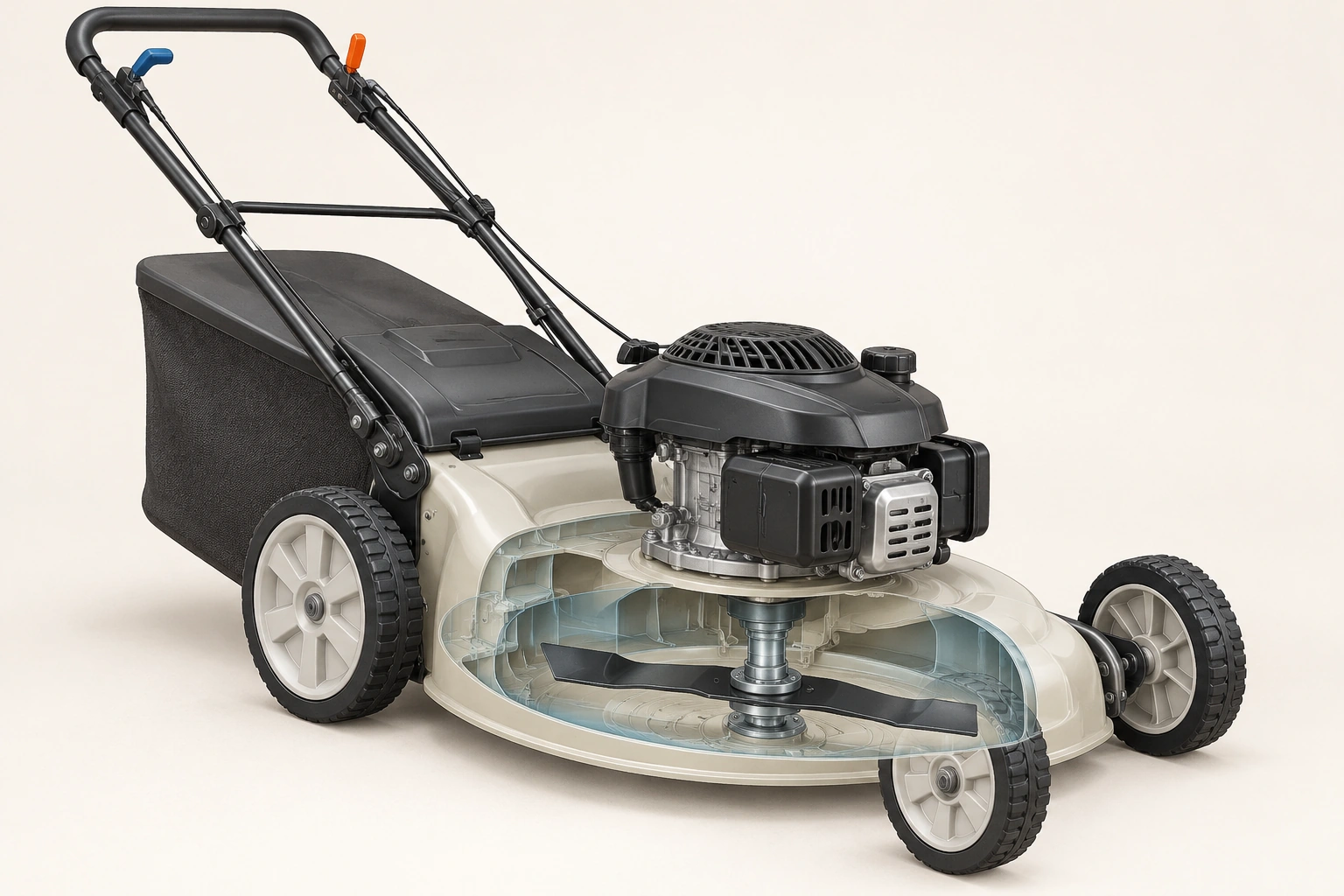
The engine supplies rotation to a cutting system inside the supported deck. Wheels support that relationship while the handle guides movement.
About this illustration
Single-blade concept, whereas named Honda example has twin blades; no exact mounting or safe-access procedure. This is a conceptual teaching model, not an assessment of your home.
9 picture lessons appear beside the questions in this guide. Use them to understand the explanation, then consider what it means for your home.
What does a rotary lawnmower do beneath its cover?
A walk-behind rotary mower uses a rotating cutting system inside a deck to cut grass as the machine moves across the lawn. Wheels support the deck, an engine or motor supplies power, controls manage different functions, and a discharge or collection arrangement handles the cut material. Understanding those jobs helps explain changed results without treating the deck as a place an owner should reach to investigate.
Keep hands and feet away from the cutting area. Never lift or tilt a running mower, reach beneath it, defeat a control or remove a guard for use. Keep people, especially children, and pets away from the mowing area. Health Canada and CCOHS warn about thrown objects, wet conditions and machine hazards. This guide supplies no blade-access, unclogging, sharpening, start-up or energized inspection procedure.
The distinct subject is the mower itself: cutting motion, clipping movement, blade versus wheel-drive controls, changed cut results and the information needed for appropriate service. The irrigation guide owns water supply and yard distribution; the tree and deck guides own different property systems. A neatly cut lawn does not establish those systems' condition, and a mower's poor result does not diagnose a soil, irrigation or plant-health problem.
The named product example is Honda's HRN216VKAA/VKPA manual, ©2020–2022, with Canadian Health Canada and CCOHS safety education. The manual's own features, numerical settings and service procedures are not adopted as universal rules for Canadian mowers. Battery, corded, reel, robotic and ride-on machines differ. Use the actual model and serial-specific instructions, with appropriate training and service help, before handling unfamiliar equipment.
How do the engine, vertical shaft, deck and wheels fit together?
On the named petrol example, the engine supplies rotation to a vertical cutting arrangement beneath it. The blade system rotates within the deck, while the four wheels keep the assembly supported above the lawn. The handle guides the machine; it is not the cutting surface. A separate self-propulsion arrangement can assist movement across the ground without changing the basic purpose of the blade system.
The deck is more than a decorative cover. Its relationship with the cutting system and intended openings affects clipping movement and containment. Guards and shields help protect people from moving parts, hot components and thrown material. Keep them in place and in appropriate condition. A missing flap is not merely a cosmetic defect to accept because the engine still starts.
The skeleton view shows a conceptual single cutting element so that the shaft-to-deck relationship is easy to follow. Honda's named example actually uses an upper and lower blade set. That difference is deliberate and stated: the picture is not a parts catalogue or a substitute blade selection. The actual manual determines the cutting assembly and compatible components for the real mower.
Do not tip the real machine or remove its deck to compare it with the cutaway. The actual equipment can contain sharp parts, hot surfaces, fuel and energy sources even after use stops. A service provider can identify and assess the cutting assembly under an appropriate scope. An owner can learn its function and preserve externally accessible identity information while keeping hazardous access separate from the lesson.
The cutting system stays within the deck
The engine supplies rotation to a cutting system inside the supported deck. Wheels support that relationship while the handle guides movement.
Numbers identify the parts explained below.
- Power unit
Supplies cutting-system rotation.
- Shaft
Connects the driven cutting relationship.
- Deck
Surrounds cutting and material movement.
- Wheels
Support the deck relative to the ground.
What does this illustration leave out?
Single-blade concept, whereas named Honda example has twin blades; no exact mounting or safe-access procedure. This illustration explains an idea. It is not an installation guide.
Which actual cutting assembly, guards and supports apply to the identified mower?
Explore this with HomeAI ↗Opens an editable question. Nothing is sent until you choose to send it.Why do petrol, battery and corded mowers need different preparation?
A petrol engine burns fuel to produce rotation and also produces hot exhaust, including carbon monoxide. Never run fuel-burning garden equipment in a garage or shed; Health Canada explicitly includes lawnmowers in that warning. An open garage door is not an appropriate substitute for outdoor use. Fuel handling, storage and maintenance have their own model-specific requirements and should not be improvised from a generic mowing article.
A battery mower supplies its motor from an intended battery system. Compatibility includes the actual mower, battery and charger instructions, not merely a connector that fits. The portable-lithium-battery guide explains the separate pack, charging and response questions. Do not remove a protective feature, adapt a pack or infer that no cutting hazard remains because a petrol engine is absent.
A corded mower brings a supply cord into the work area. Health Canada warns against frayed cords and wet operation; CCOHS discusses the actual equipment's electrical protection requirements. The appropriate cord, supply and use arrangement need their complete instructions. This guide gives no electrical connection, extension-cord gauge or circuit recommendation and does not approve a lawn route that crosses a cord.
All three can have moving cutting parts and require their applicable shutdown and isolation precautions. Releasing one control or removing one apparent source is not a generic maintenance procedure. Keep the question specific: which energy sources and controls apply to this model, and who will perform the required task appropriately? A conceptual power comparison helps distinguish systems without teaching a risky one-size-fits-all preparation sequence.
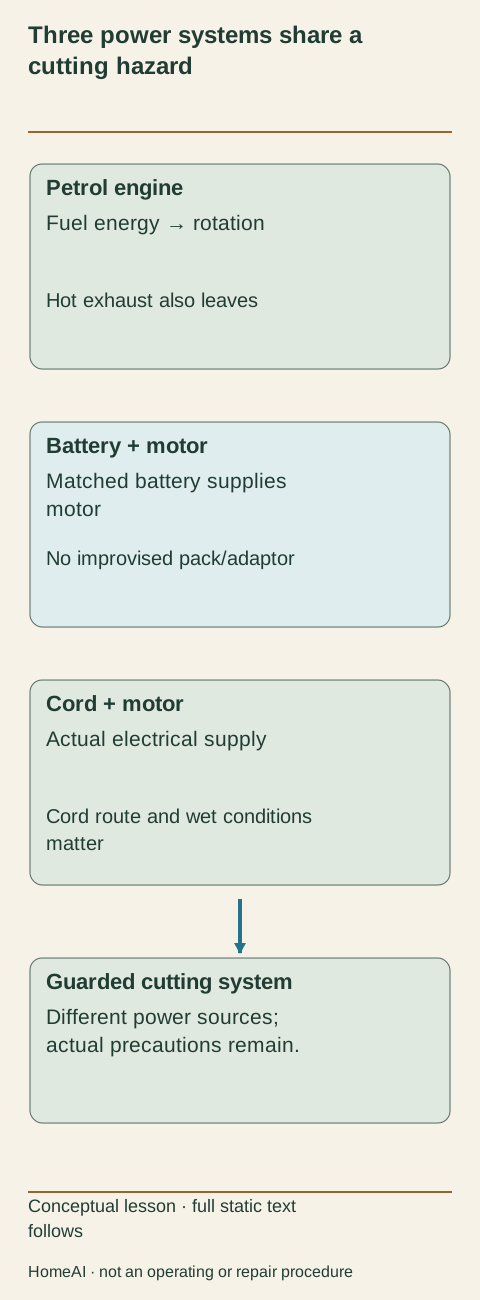
Three power systems share a cutting hazard
Petrol, battery and corded systems supply power differently, but a cutting system remains a hazard. Preparation and isolation belong to the actual complete instructions.
Numbers identify the parts explained below.
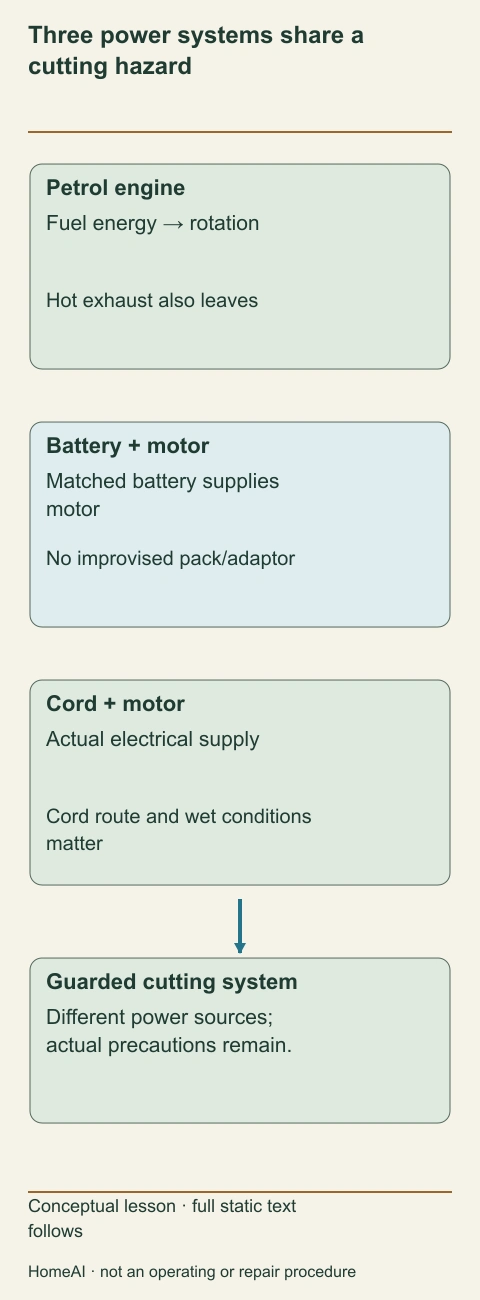
- Petrol engine
Fuelled rotation also produces hot exhaust.
- Battery and motor
A matched electrical system supplies motion.
- Cord and motor
A supply lead joins the electrical work arrangement.
- Cutting system
Still needs guards, controls and appropriate precautions.
What does this illustration leave out?
Conceptual comparison; no wiring, start, isolation or battery-adapter instructions. This illustration explains an idea. It is not an installation guide.
Which energy sources and model-specific controls apply to this machine?
Explore this with HomeAI ↗Opens an editable question. Nothing is sent until you choose to send it.Three power systems share a cutting hazard
Petrol, battery and corded systems supply power differently, but a cutting system remains a hazard. Preparation and isolation belong to the actual complete instructions.
- Petrol engine
- Fuelled rotation also produces hot exhaust.
- Battery and motor
- A matched electrical system supplies motion.
- Cord and motor
- A supply lead joins the electrical work arrangement.
- Cutting system
- Still needs guards, controls and appropriate precautions.
Figure scope: Conceptual comparison; no wiring, start, isolation or battery-adapter instructions.
A useful question: Which energy sources and model-specific controls apply to this machine?
Full wording shown in this figure
- Three power systems share a
- cutting hazard
- Petrol engine
- Fuel energy → rotation
- Hot exhaust also leaves
- Battery + motor
- Matched battery supplies
- motor
- No improvised pack/adaptor
- Cord + motor
- Actual electrical supply
- Cord route and wet conditions
- matter
- Guarded cutting system
- Different power sources;
- actual precautions remain.
- Conceptual lesson · full static text
- follows
- HomeAI · not an operating or repair procedure
How does the cutting system affect the lawn's appearance?
A sharp, suitable cutting edge cuts grass differently from a worn or damaged one. Honda's named manual explains that a dull edge can tear grass and leave shredded ends that later look brown. That gives a plausible mechanical explanation for one observation, but a photograph of brown grass is not a blade diagnosis. Plant condition, growing conditions and the actual timing can raise different questions.
The amount and condition of material entering the deck also matter. Tall or thick grass, ground speed and the width of the pass can affect the work asked of the cutting system. The manual lists excessive cutting load among reasons for reduced performance. This guide does not provide a universal cutting height, pass width or schedule; the actual mower instructions and local grass advice need to agree.
Separate edge condition from the entire rotating assembly. A damaged, loose or incorrectly fitted component can create hazards beyond an untidy cut. Honda warns that damaged blades can become dangerous projectiles. Do not reach under the deck to decide whether sharpening is enough. A qualified mower service assessment can distinguish wear, damage, incorrect parts and other mechanical findings.
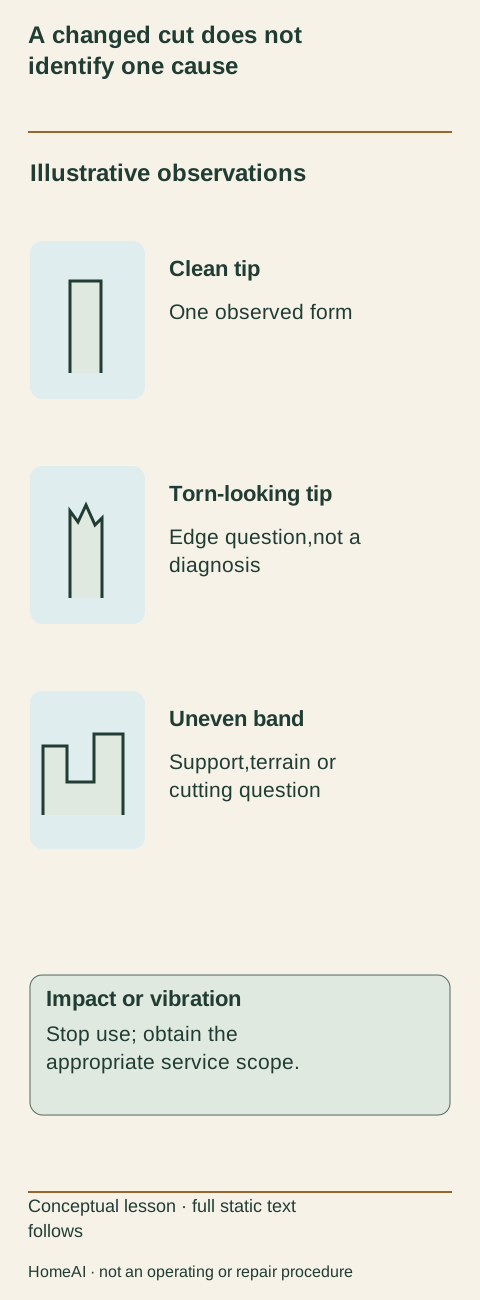
The native cutting-result figure contrasts cleanly cut tips, torn-looking tips and an uneven finished band as conceptual observations. It supplies no diagnostic key or claim that an illustration predicts the cause. Its useful question is which part of the cutting and support system was actually assessed, and which lawn conditions were present, before choosing blade service, another repair or non-equipment advice.
How do air movement and the grass bag work together?
The cutting system also moves air and clippings through the intended deck and collection route. In Honda's named explanation, air passes through the grass-bag fabric while the bag retains cut grass. The fabric is therefore part of the airflow arrangement, not merely a container into which grass falls. A collection result can change when that route, its selected configuration or the bag's condition changes.
The rear-route picture makes the deck-to-bag relationship visible and keeps the outgoing air separate from retained clippings. It does not establish actual filtration performance or a dust-free breathing environment. Health Canada recommends appropriate protective gear, and the named manual notes that fine material can pass through the fabric. An attached bag is not respiratory protection or permission to mow unsuitable material.
The manual identifies a full or obstructed bag and deck conditions among possible causes of poorer bagging. A handful of clippings left behind does not tell the owner which cause applies. Record the ordinary circumstances, selected mode and actual result without opening a guard or deliberately clogging the route. A useful service discussion can then distinguish a collection issue from cutting performance or a mismatched component.
Never remove the bag or reach into a discharge route while the cutting system is moving. Follow the complete actual instructions for any permitted handling, and obtain help if the safe method or condition is uncertain. This guide supplies no emptying, cleaning or installation procedure. Understanding the air path should make the owner less likely to treat a concealed opening as a harmless place to investigate.
Air passes through the bag while grass is retained
Airflow carries clippings into the intended collection bag; air can pass through its fabric while the bag retains grass. Collection depends on the whole route and compatible components.
Numbers identify the parts explained below.
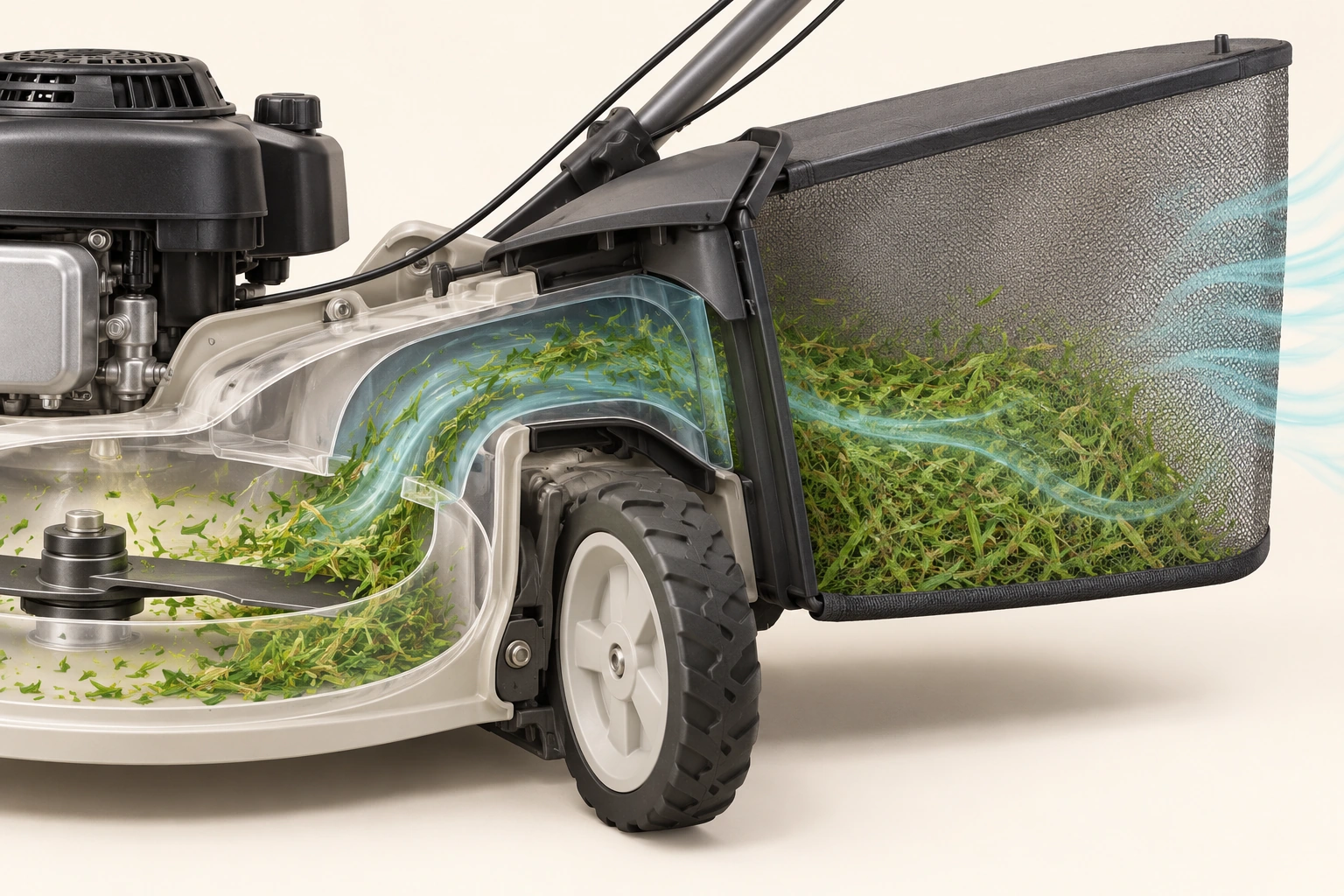
- Deck route
Moves material toward the intended rear passage.
- Bag entry
Connects collection to that route.
- Fabric
Passes air while retaining intended clippings.
- Guard
Remains part of the supported protective arrangement.
What does this illustration leave out?
Conceptual clipping and air paths, not measured airflow, filtration, dust exposure, exact assembly or permitted bag-handling procedure. This illustration explains an idea. It is not an installation guide.
Which bag, guard, selected mode and route were actually assessed?
Explore this with HomeAI ↗Opens an editable question. Nothing is sent until you choose to send it.How do mulching, bagging and discharge differ?
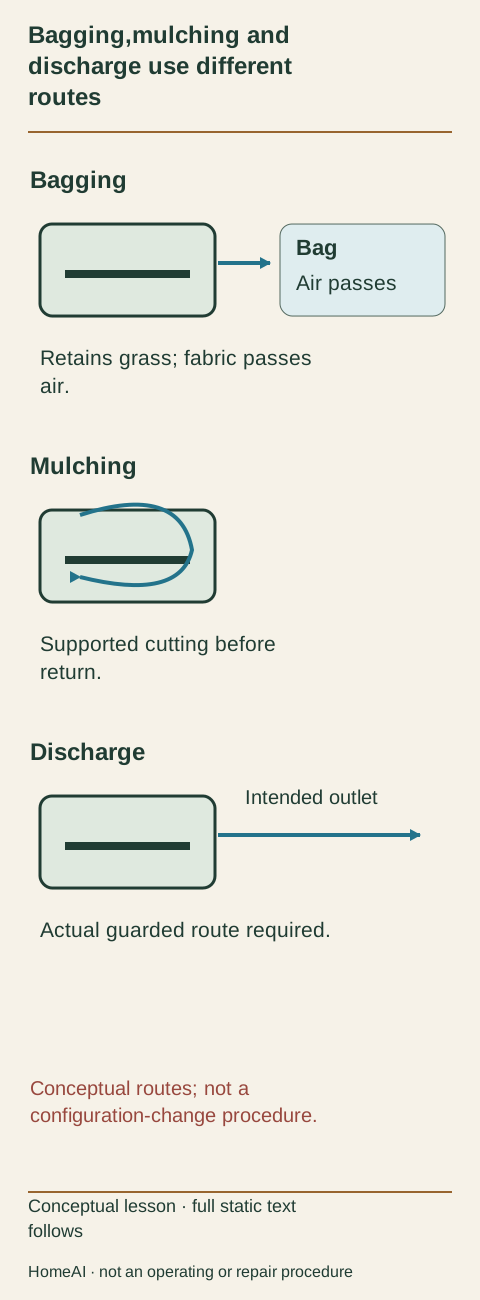
Bagging carries clippings into the intended collection container. Discharging sends material through a product's permitted outlet arrangement. Mulching keeps material within the intended cutting process for further cutting and returns it to the lawn. These functions change the clipping route; they are not interchangeable labels for the same attachment, and actual mower designs may support only particular combinations.
In the named Honda example, a shutter changes the rear route for bag or mulch selection. That is a model-specific mechanism. Another mower may use a different plug, blade or control arrangement. The native diagram therefore labels a conceptual route open to collection and a separate route retaining material under the deck, rather than tell every owner to move one lever into a named position.
Do not remove a guard, improvise a discharge opening or fit an unidentified blade to create a mode the product does not support. A claimed mulching accessory needs the actual compatibility instructions, including the complete required assembly. A bag from a similar-looking model is not confirmed suitable merely because it can be hooked onto the rear frame.
The useful comparison includes the intended result, the actual supported route and the work conditions. Honda's manual explains that grass condition and how much material is cut can affect the result. This guide gives no universal fertilizing benefit, clipping-size promise, municipal collection rule or instruction to change configuration while equipment is operating. Keep mode selection and any handling with the matching complete manual.
Bagging, mulching and discharge use different routes
The supported mode changes where cut material goes:collection, continued cutting before return, or an intended discharge route. Components and configuration must match the actual mower.
Numbers identify the parts explained below.
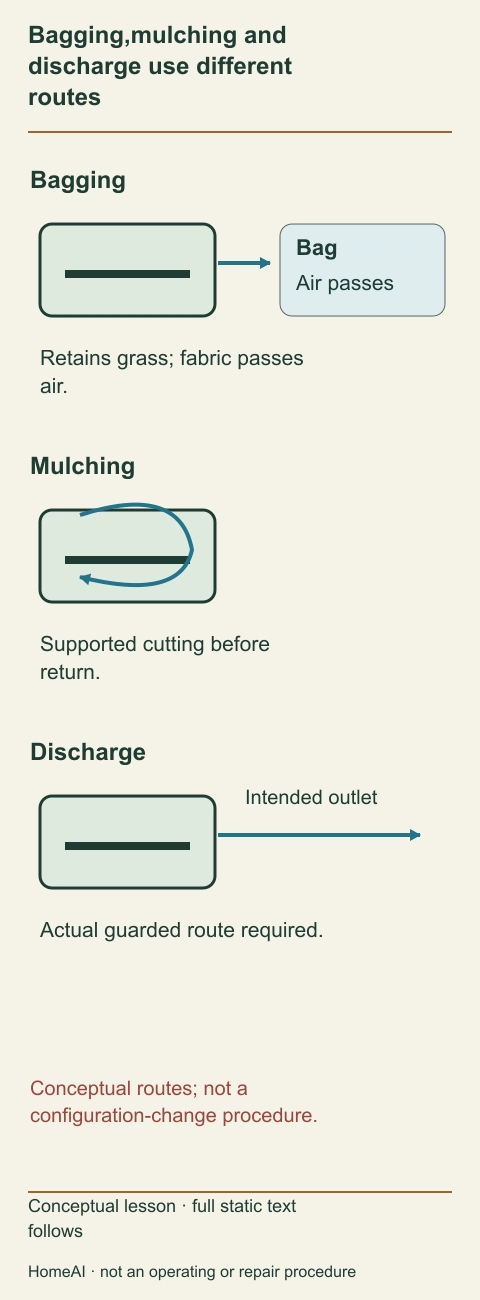
- Bagging
The intended bag receives clippings and passes air.
- Mulching
The supported cutting process retains material before return.
- Discharge
Material leaves through the intended guarded arrangement.
- Compatibility
The actual mower determines available modes and required parts.
What does this illustration leave out?
No lever position, blade substitution, changeover or operating procedure is supplied. This illustration explains an idea. It is not an installation guide.
Which complete supported configuration matches the intended result?
Explore this with HomeAI ↗Opens an editable question. Nothing is sent until you choose to send it.Bagging, mulching and discharge use different routes
The supported mode changes where cut material goes:collection, continued cutting before return, or an intended discharge route. Components and configuration must match the actual mower.
- Bagging
- The intended bag receives clippings and passes air.
- Mulching
- The supported cutting process retains material before return.
- Discharge
- Material leaves through the intended guarded arrangement.
- Compatibility
- The actual mower determines available modes and required parts.
Figure scope: No lever position, blade substitution, changeover or operating procedure is supplied.
A useful question: Which complete supported configuration matches the intended result?
Full wording shown in this figure
- Bagging,mulching and
- discharge use different
- routes
- Bagging
- Bag
- Air passes
- Retains grass; fabric passes
- air.
- Mulching
- Supported cutting before
- return.
- Discharge
- Intended outlet
- Actual guarded route required.
- Conceptual routes; not a
- configuration-change procedure.
- Conceptual lesson · full static text
- follows
- HomeAI · not an operating or repair procedure
Three clipping routes
- BaggingMaterial path: Clippings enter the intended bag while air passes through its fabricWhat to verify: Compatible bag, guard and route
- MulchingMaterial path: Clippings remain in the supported cutting process before returning to lawnWhat to verify: Actual model’s supported configuration
- DischargeMaterial path: Clippings leave through an intended outlet arrangementWhat to verify: Actual permitted guarded arrangement
Conceptual functions, not a changeover procedure.
Why do blade control and wheel-drive control need separate names?
The blade-related control and the wheel-drive control can have different consequences. In the named Honda example, releasing the blade control stops the engine and cutting rotation, while releasing the Smart Drive control disengages powered rear-wheel movement. The machine's stopping functions are therefore not described adequately by one generic stop lever. Other mowers may use a different blade-stop or motor-control arrangement.
A drive control can influence ground speed without being the blade's safety control. A machine no longer propelling itself may still have an active cutting system. Conversely, a blade-stop system on another design may allow an engine to continue running. Identify the exact arrangement through its instructions and suitable training; do not infer it from the number of paddles or a generated picture.
Never tie, tape, clamp or otherwise defeat a presence or stopping control. A control that fails to perform its required function is a reason to stop use and obtain repair. Do not stage a test while people or pets are near the mower or use repeated operation to see whether a fault returns. The service provider can assess controls within the appropriate protected scope.
The handle close-up shows separate levers and cable routes without an operating person or a successful stopping result. It is a vocabulary lesson, not proof of control effectiveness. Ask the provider to explain what each control does on the actual machine, which stopping functions were checked and what the report covers. Keep that explanation with the manual for anyone taking over household mowing.
Drive control and cutting control can differ
A cutting-related control and a wheel-drive control can affect different functions. The named Honda example distinguishes stopping cutting/engine from disengaging powered wheel movement.
Numbers identify the parts explained below.
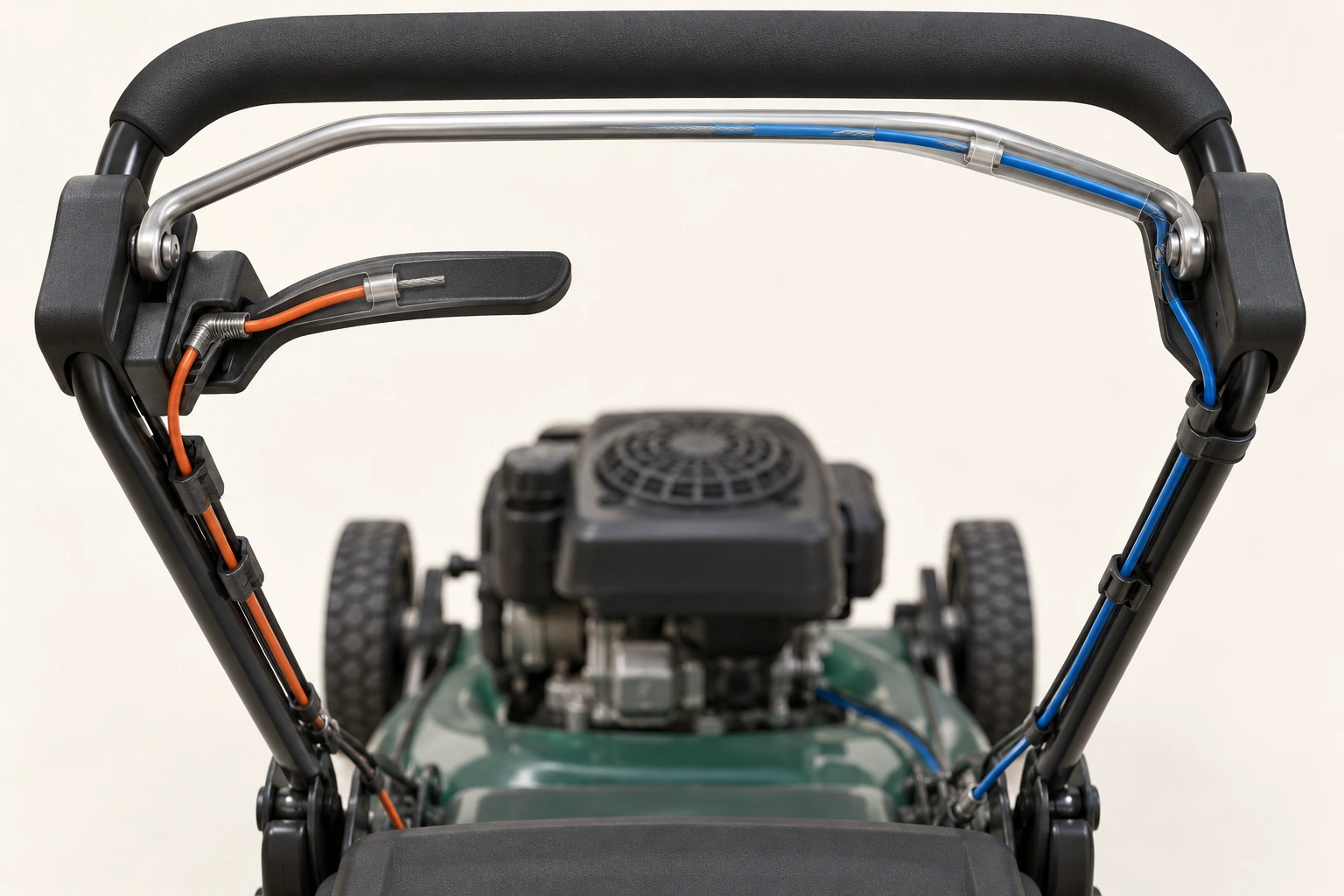
- Blade-related lever
Its exact function comes from the matching manual.
- Drive control
Concerns powered ground movement.
- Separate cables
Introduce different control paths, not a wiring specification.
- Actual handover
Needs model-specific instruction, not colour or shape inference.
What does this illustration leave out?
Generic unoperated handle with coloured teaching cables; colour does not prove function. No exact Honda geometry, demonstrated stopping effectiveness, bypass or test. This illustration explains an idea. It is not an installation guide.
Can the actual user explain what each control stops and what remains active?
Explore this with HomeAI ↗Opens an editable question. Nothing is sent until you choose to send it.Stopping movement and stopping cutting differ
- Blade controlNamed example job: Releasing stops engine and cutting rotationDo not infer: That every mower uses this arrangement
- Drive controlNamed example job: Releasing disengages powered rear-wheel movementDo not infer: That cutting has stopped
- Guard or shieldNamed example job: Protects against defined moving/material hazardsDo not infer: That it can be removed because a control exists
HondaHRN216VKAA/VKPA©2020–22 example; no owner test or bypass.
How do wheels and cutting-height support affect the result?
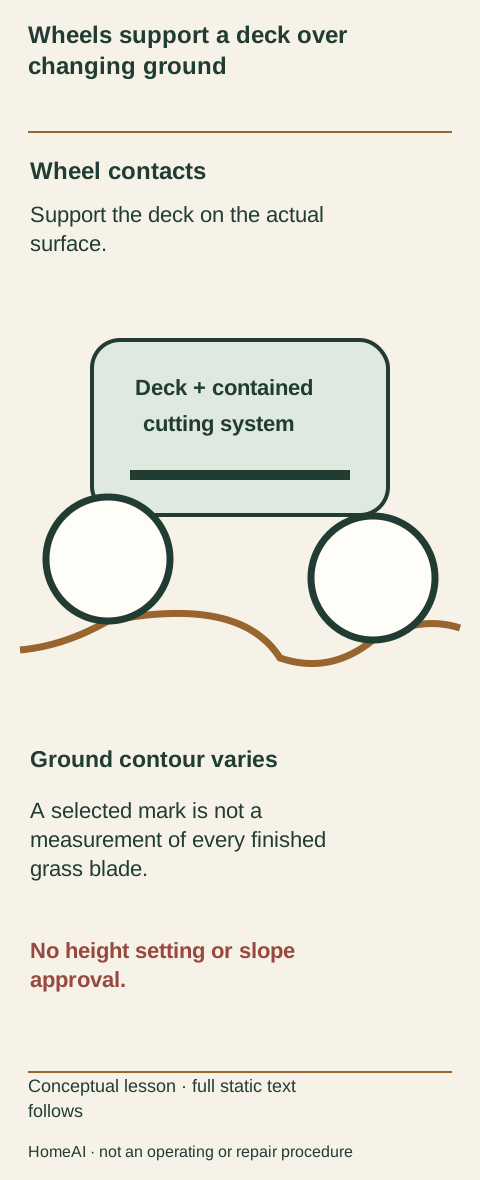
Wheels support the deck and establish its relationship to the ground through the actual adjustment system. The named manual distinguishes the selected setting from the exact height of cut grass, which can vary with lawn and soil conditions. A number on a lever is therefore not a measurement of every blade of grass or proof that the mower travels level over an uneven yard.
An uneven-looking band can raise questions about support settings, terrain, the cutting assembly or the way the pass was made. Do not immediately identify a bent blade from the finish. Equally, do not assume matching-looking wheel positions resolve a suspected mechanical impact. A service provider can distinguish adjustment, wear and damage, while local lawn advice can address the grass and growing conditions.
The native support diagram shows wheel contact, deck position and a varying ground surface. It deliberately has no numerical cutting-height scale or recommendation. The useful mechanism is that a supported deck travels relative to the ground beneath it. This explains why a model's adjustment marks and the actual finished lawn are related but different pieces of information.
Any permitted adjustment belongs with the complete instructions for the real product, with its required stopped and isolated condition. Do not reach near the cutting area, lift a running machine or improvise spacers to make the diagram fit the lawn. If the route includes an unsafe slope, drop or obstacle, a different work method or appropriate professional service may be the better answer than changing a height setting.
Wheels support a deck over changing ground
The support arrangement relates the cutting deck to the ground. A selected height mark is not an exact measurement of every finished grass blade over varying terrain.
Numbers identify the parts explained below.
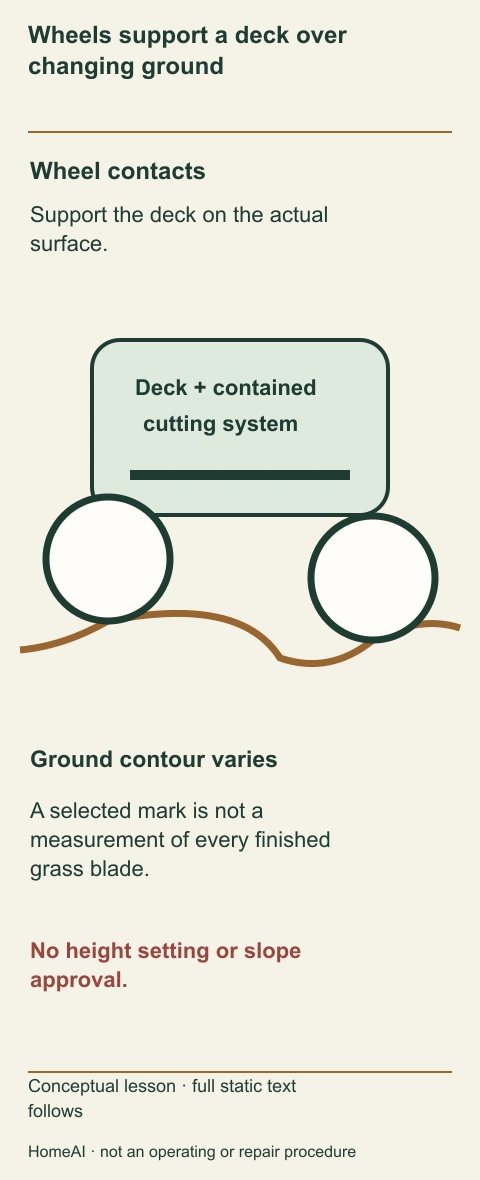
- Wheel contacts
Support the machine on the actual surface.
- Deck position
Relates the contained cutting assembly to those supports.
- Ground contour
Can differ along the route.
- Finished result
Needs context; it is not a blade diagnosis alone.
What does this illustration leave out?
No cutting-height value, slope approval, spacer or adjustment instruction. This illustration explains an idea. It is not an installation guide.
Does the observed result need equipment-support assessment, landscape advice, or both?
Explore this with HomeAI ↗Opens an editable question. Nothing is sent until you choose to send it.Wheels support a deck over changing ground
The support arrangement relates the cutting deck to the ground. A selected height mark is not an exact measurement of every finished grass blade over varying terrain.
- Wheel contacts
- Support the machine on the actual surface.
- Deck position
- Relates the contained cutting assembly to those supports.
- Ground contour
- Can differ along the route.
- Finished result
- Needs context; it is not a blade diagnosis alone.
Figure scope: No cutting-height value, slope approval, spacer or adjustment instruction.
A useful question: Does the observed result need equipment-support assessment, landscape advice, or both?
Full wording shown in this figure
- Wheels support a deck over
- changing ground
- Wheel contacts
- Support the deck on the actual
- surface.
- Deck + contained
- cutting system
- Ground contour varies
- A selected mark is not a
- measurement of every finished
- grass blade.
- No height setting or slope
- approval.
- Conceptual lesson · full static text
- follows
- HomeAI · not an operating or repair procedure
What can the sound, clippings and finished cut tell you?
An engine sounding more heavily loaded during an attempted pass can be consistent with a demanding cutting load, but sound alone does not quantify speed or engine condition. Honda's manual includes tall grass, deck obstruction, air restriction, fuel and other engine problems among different performance possibilities. Retain the actual circumstances instead of turn every change in sound into an engine-repair diagnosis.
Clumps, poor collection and uneven results also need context. Was the grass wet, was a different supported mode selected, was the bag already substantially filled, or did the change begin after an impact or service? These are ordinary-history questions, not invitations to operate in a prohibited condition. Health Canada and CCOHS advise against wet mowing; an observed poor result is not a reason to repeat it for comparison.
New vibration, a strike against a hard object, abnormal control behaviour or visible damage belongs in a stop-use and service discussion. Do not keep mowing to see whether the result improves or run the machine with a guard open to locate the sound. An impact can affect more than the edge: the named manual identifies cutting-assembly, shaft and deck damage as possibilities needing appropriate assessment.
A useful account separates event, symptom and finding. The mower hit an exposed edge, then vibration was noticed is an event and report. The shaft is bent is a finding that requires an appropriate assessment. Preserving those distinctions helps the provider choose a scope and protects the owner from an unsupported sharpening order that might leave a more serious issue unaddressed.
A changed cut does not identify one cause
Edge condition, material load, support, collection and a reported impact can raise different questions. A lawn photograph supplies an observation, not a complete equipment finding.
Numbers identify the parts explained below.
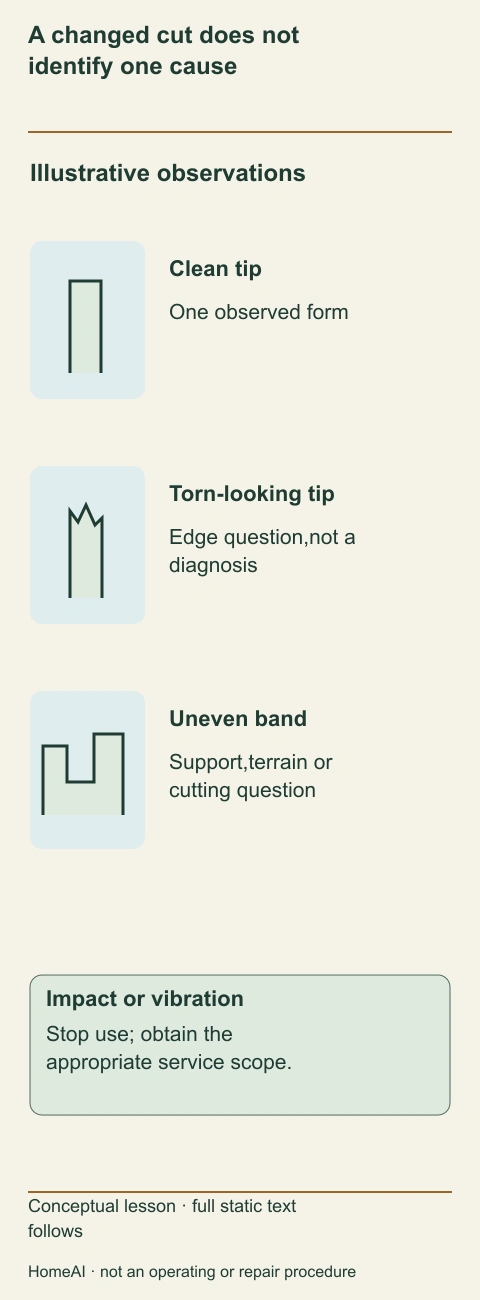
- Torn-looking tip
May raise an edge-condition question.
- Clumps or missed material
Can raise collection and work-condition questions.
- Uneven band
Can raise support, terrain or cutting questions.
- Impact or vibration
Changes the safe stop and appropriate service scope.
What does this illustration leave out?
Illustrative forms, not a diagnostic key or actual plant/shaft/blade assessment. This illustration explains an idea. It is not an installation guide.
What event and actual conditions distinguish the plausible causes?
Explore this with HomeAI ↗Opens an editable question. Nothing is sent until you choose to send it.A changed cut does not identify one cause
Edge condition, material load, support, collection and a reported impact can raise different questions. A lawn photograph supplies an observation, not a complete equipment finding.
- Torn-looking tip
- May raise an edge-condition question.
- Clumps or missed material
- Can raise collection and work-condition questions.
- Uneven band
- Can raise support, terrain or cutting questions.
- Impact or vibration
- Changes the safe stop and appropriate service scope.
Figure scope: Illustrative forms, not a diagnostic key or actual plant/shaft/blade assessment.
A useful question: What event and actual conditions distinguish the plausible causes?
Full wording shown in this figure
- A changed cut does not
- identify one cause
- Illustrative observations
- Clean tip
- One observed form
- Torn-looking tip
- Edge question,not a
- diagnosis
- Uneven band
- Support,terrain or
- cutting question
- Impact or vibration
- Stop use; obtain the
- appropriate service scope.
- Conceptual lesson · full static text
- follows
- HomeAI · not an operating or repair procedure
How should the work area and nearby objects change the plan?
Before mowing, identify material or objects the cutting system could encounter. Health Canada and CCOHS name debris such as stones, sticks, toys and tools. The named Honda manual also discusses raised irrigation heads, edging and roots. Their presence matters to the route and the intended task; a lawn's familiar appearance does not mean its surface is free of hazards after wind, yard work or children's play.
People and pets need to remain away from the work area. A child can move unexpectedly from behind a shrub or gate, and thrown material need not follow a convenient narrow arrow. A closed-looking bag or guard does not make nearby bystanders acceptable. Arrange the activity and access so another person's arrival is addressed without relying on a last-second reaction beside a cutting machine.
Different mower types have different slope guidance. Health Canada distinguishes walk-behind and ride-on equipment and directs owners to actual instructions; a direction or maximum from one model is not a national permission for every lawn. Wet ground, uneven footing, embankments and poor visibility can change the decision. This guide supplies no slope-measuring test or universal acceptable-angle chart.
The garden picture includes a path and obstacles as discussion points, with the mower stationary. It certifies no safe route, clearance or property condition. The practical next step may be to clear the area appropriately, postpone the task, choose another supported method or obtain suitable help. It is not to use the machine to discover which hidden object will cause the next impact.
The route must account for objects and access
Debris, hard edges and access to the work area matter before mowing. The cutting system can encounter or throw material, and people and pets must remain away.
Numbers identify the parts explained below.
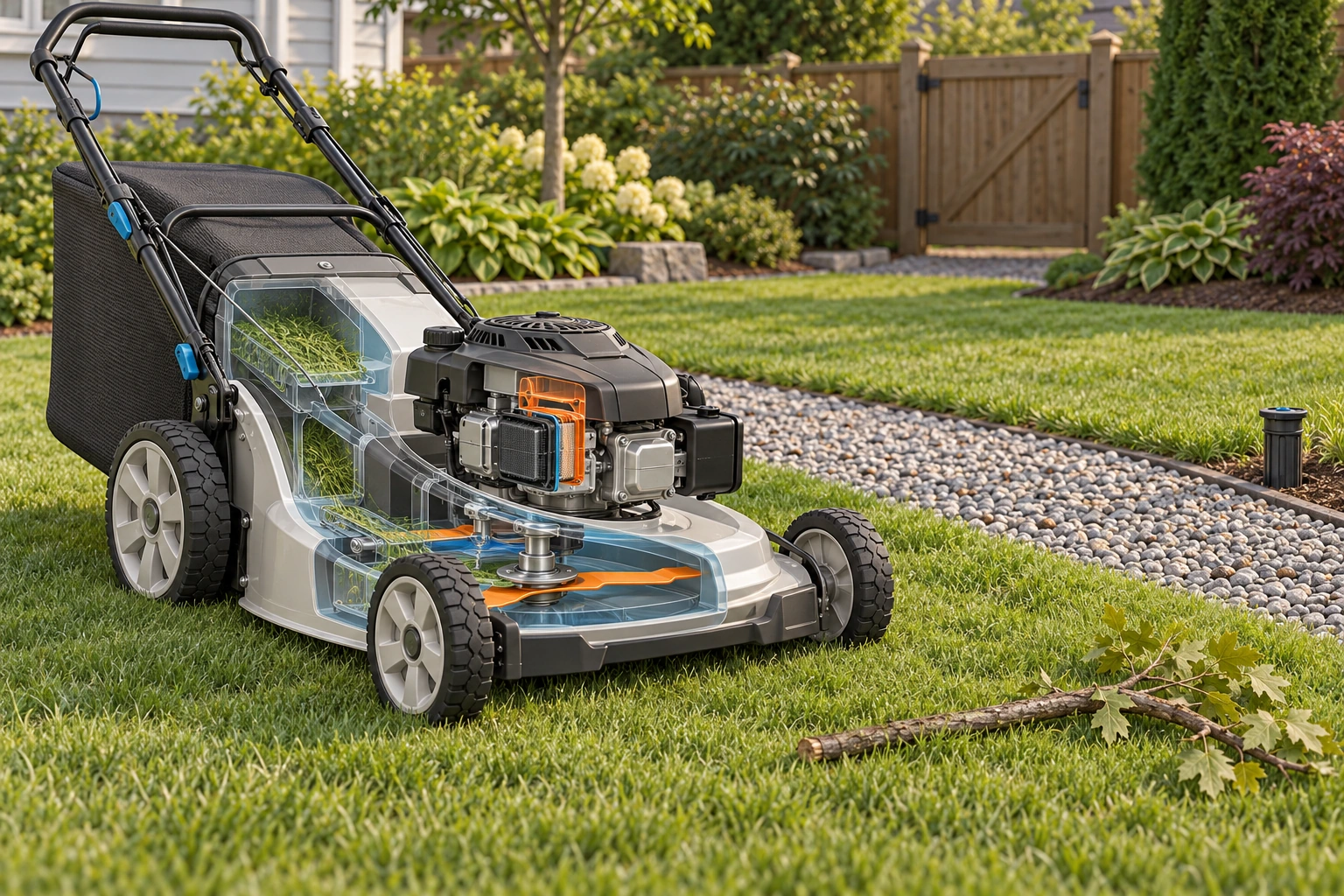
- Lawn debris
An ordinary pre-task area concern.
- Gravel crossing
A different surface from the intended cutting area.
- Raised feature
Can matter to route and impact planning.
- People and pets
Need an arrangement that keeps them out of the work area.
What does this illustration leave out?
Illustration-only cutaway; no verified engine/blade stop state, actual route clearance, slope, guard inspection or safe property approval. This illustration explains an idea. It is not an installation guide.
Which objects and access conditions need resolution before this particular task?
Explore this with HomeAI ↗Opens an editable question. Nothing is sent until you choose to send it.Why are hot equipment, fuel and storage separate care questions?
A petrol mower produces hot surfaces and combustible-fuel concerns as well as cutting hazards. Health Canada warns against running fuelled yard equipment in a garage or shed. The named Honda manual requires cooling and careful outdoor refuelling and describes storage concerns near ignition sources. A stopped engine does not instantly become a cool object or a suitable neighbour for stored fuel vapour.
Follow the actual fuel and storage instructions rather than a generic mixture or interval. Honda's named manual explains that deteriorated fuel can contribute to starting and running problems and that conditions vary. This guide adopts the relationship, not its specific additive, draining, run-dry or filling sequence. Do not siphon fuel, open a carburetor or run an engine for a storage experiment based on this lesson.
Keep washing and cleaning within the matching instructions too. The manual warns that pressure washing can force water into its air filter and engine route. That matters when the new pressure-washer guide makes powerful cleaning look convenient. A surface that appears robust is not automatically a permitted target, and a clean external finish cannot establish the condition of controls or concealed parts.
For battery equipment, the corresponding pack, charger, temperature and storage instructions belong with that system instead. The shared principle is to preserve actual product identity and applicable precautions; it is not to transfer petrol procedures to a battery machine or vice versa. If the correct storage preparation or condition is uncertain, ask the appropriate service provider before the long idle period and record the task actually completed.
What can an owner safely put in a service request?
Provide the externally accessible mower and engine identity information, matching manual, service history and a precise account of the complaint. The named Honda example has separate frame and engine serial numbers. Different products may identify themselves differently. Do not remove panels, reach below the deck or rotate a cutting assembly to locate a hidden marking for a photograph.
Describe the ordinary event: when the change was first noticed, what happened just before it, the supported mode then selected, and which result changed. Already available photographs of a finished lawn or an intact exterior may help. They do not establish blade balance, shaft condition, fastener torque or the effectiveness of a stopping system. Those are assessment questions, not obligations for the owner to prove before asking for service.
Keep suspected causes separate from actual findings. A note that says suspected worn blade is different from a technician's identified cutting-assembly damage. An old sharpening receipt does not establish current compatibility or the absence of a later impact. Ask which possibilities the provider will address and what should happen if their assessment identifies work outside the original scope.
Do not perform a run, tipping manoeuvre, blade inspection or restart solely to improve the record. If the mower is damaged or has abnormal vibration, control behaviour, fuel leakage or electrical damage, stop use and obtain appropriate advice. A useful service request reduces uncertainty through accurate history while leaving hazardous examination, isolation and repairs to the suitable person and method.
What should a mower service report establish and leave open?
A useful report identifies the machine and complaint, records the assessed components and describes findings and work. For an impact or vibration concern, the scope may need to go beyond sharpening. For a collection complaint, it may include the intended bag, route and supported configuration. Ask the provider to explain which relationships were assessed rather than simply attach the word tune-up to every problem.
The report should distinguish an appropriate replacement part from one that merely fits. Honda's named manual specifies a matched cutting assembly and warns about mounting and damaged components. This guide supplies no blade part number, fastening torque, removal recipe or permission to substitute an aftermarket shape. The provider should resolve the actual model's requirements and explain the work and remaining limitations.
A limited assessment does not have to answer every lawn question. A sound equipment result may leave soil, grass, irrigation or terrain questions requiring different advice. Conversely, a difficult lawn does not erase a real equipment defect. Keep mechanical service and landscape care scopes separate enough that each useful finding is preserved without being expanded into a whole-property approval.
For ongoing care, use the actual manufacturer's schedule and the equipment's conditions. The named Honda manual distinguishes time, hours and severe-use considerations. This guide gives no universal sharpening interval or annual package. Record actual tasks and parts, not only payment dates. A clear handover helps the next user understand what was done and which condition remains unresolved before use.
Work through a fictional uneven cut after a path-edge strike
Fictional owner Sara notices vibration and an uneven strip after the mower contacts a raised path edge. She stops use rather than make another pass to confirm the pattern. A friend suggests sharpening because the lawn also has torn-looking tips. The earlier sharpening receipt predates the reported impact and says nothing about current shaft, mounting or deck condition.
Sara gives the service provider that sequence and requests an assessment of the cutting assembly and relevant impact concerns, with a separate look at the collection complaint. The fictional report identifies a damaged cutting component and records the corresponding approved-model replacement and mounting work. It states what was examined and does not claim that a photograph alone established the damage or that every landscape cause was eliminated.
The same fictional report notes that the collection bag's condition needs attention and identifies the actual compatible replacement route. Sara does not treat the cutting repair as proof that bagging will be satisfactory under every grass condition. She resolves the identified equipment tasks, obtains the required handover and keeps a separate lawn-care question about an uneven ground area. No restart or successful real-world cut is invented here.
The decision improves because the service scope follows the event rather than the cheapest guessed task. Sharpening alone would not have answered the impact or bag questions. The worked case supplies no actual repair, approval to operate, property finding or promise of a perfect lawn. It shows how an owner can move from a concrete observation to an appropriately complete equipment decision.
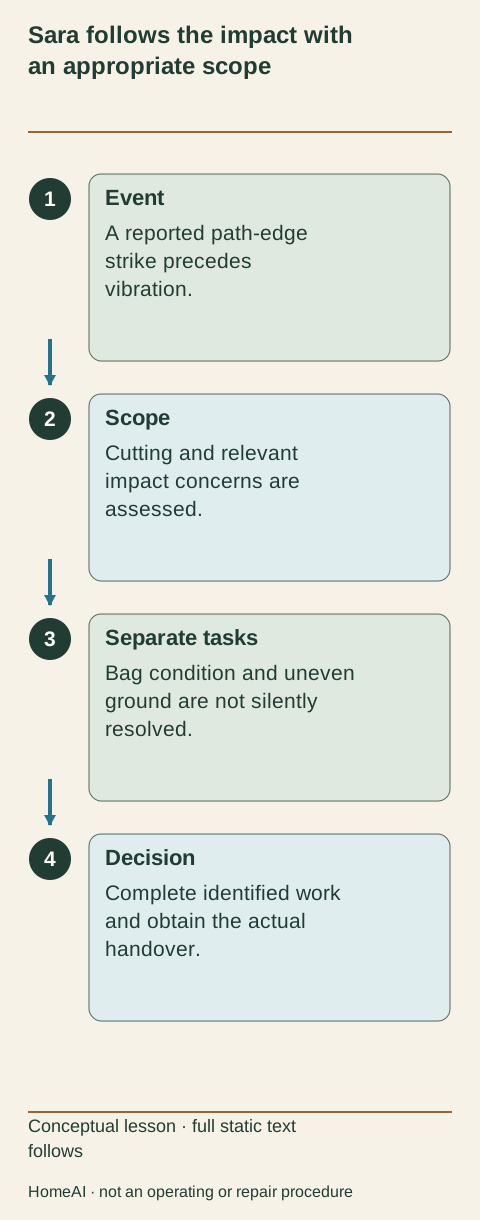
Sara follows the impact with an appropriate scope
Sara stops use and commissions an impact-related scope rather than assuming sharpening is enough. Separate bag and ground questions remain distinct after the fictional cutting-component work.
Numbers identify the parts explained below.
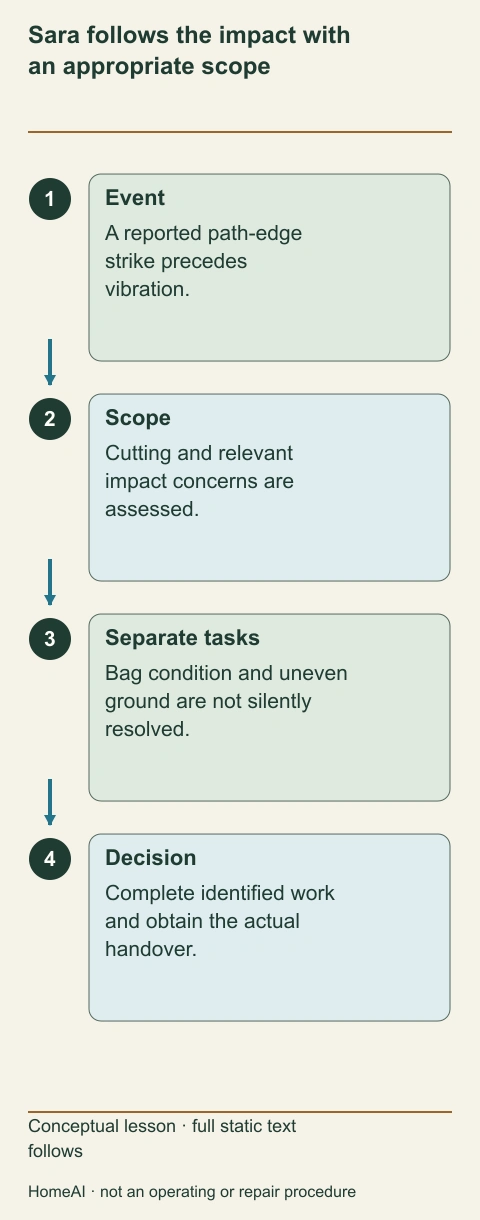
- Event
A reported path-edge strike precedes vibration.
- Scope
Cutting and relevant impact concerns are assessed.
- Separate tasks
Bag condition and uneven ground are not silently resolved.
- Decision
Complete identified work and obtain the actual handover.
What does this illustration leave out?
Fictional case, no actual repair, successful cut or permission to operate. This illustration explains an idea. It is not an installation guide.
Which parts of the original complaint did the report actually resolve?
Explore this with HomeAI ↗Opens an editable question. Nothing is sent until you choose to send it.Sara follows the impact with an appropriate scope
Sara stops use and commissions an impact-related scope rather than assuming sharpening is enough. Separate bag and ground questions remain distinct after the fictional cutting-component work.
- Event
- A reported path-edge strike precedes vibration.
- Scope
- Cutting and relevant impact concerns are assessed.
- Separate tasks
- Bag condition and uneven ground are not silently resolved.
- Decision
- Complete identified work and obtain the actual handover.
Figure scope: Fictional case, no actual repair, successful cut or permission to operate.
A useful question: Which parts of the original complaint did the report actually resolve?
Full wording shown in this figure
- Sara follows the impact with
- an appropriate scope
- 1
- Event
- A reported path-edge
- strike precedes
- vibration.
- 2
- Scope
- Cutting and relevant
- impact concerns are
- assessed.
- 3
- Separate tasks
- Bag condition and uneven
- ground are not silently
- resolved.
- 4
- Decision
- Complete identified work
- and obtain the actual
- handover.
- Conceptual lesson · full static text
- follows
- HomeAI · not an operating or repair procedure
How do local conditions and source editions limit the advice?
Canadian yards differ in grass, season, soil, available space, slopes and local restrictions. A manufacturer can explain its machine without selecting the right grass-care plan for every region. Obtain appropriate local advice where that question matters. No general cutting-height number, calendar schedule, noise permission or green-bin acceptance is supplied by this guide, and a current website footer is not a new technical edition.
The adopted Honda manual is ©2020–2022 and names HRN216VKAA/VKPA. It supplies mechanisms and product-specific examples, including twin blades, collection airflow and separate controls. It does not prove current sale availability, a Canadian warranty entitlement or the configuration of another mower. CCOHS's rotary-mower fact sheet is revised January25, 2021; Health Canada's backyard page is dated October6, 2022. Their current accessible bodies retain those dates.
Where an older manual's suggestion conflicts with broader safety advice or would require hazardous owner access, this guide does not reproduce it as an instruction. In particular, it does not adopt damp-grass bagging advice, blade access, compressed-air filter cleaning, fuel draining or a control test sequence. The mechanism can be explained without turning every procedure in a retained source into recommended household work.
The next useful action is to match the exact machine, intended work, actual condition and responsible provider. That can mean service, training, another work method or postponing the task. A sophisticated picture should make the boundaries easier to understand, not make a reader confident to reach into an unfamiliar mower. Preserve that distinction when using the illustrations or sharing the guide with another household member.
What should the next person using the mower understand?
They should be able to name the power source, cutting system, deck, supports, collection route and distinct controls, then explain how those parts work together. They should know the applicable stop and no-use boundaries from the actual instructions and training, and how to seek help. Familiarity with one household mower does not establish competence with another design or make a child's participation appropriate.
Keep the actual manual, identity, service and parts records, recall information and outstanding tasks together. A handover should identify the intended supported configuration and the conditions that need a different decision. A service label does not by itself teach the controls; a brief lesson in controls does not certify the cutting assembly. These are related but independent parts of responsible equipment care.
The pictures and native figures teach real questions: how rotation reaches the cutting area, how air and clippings separate at the bag, why drive and blade controls differ, and why an impact changes the service scope. They supply no blade-handling procedure or actual performance finding. Their complete text remains available so understanding does not depend on tiny details baked into a cutaway.
The practical outcome is a more precise owner decision. Explain the mechanism, preserve the actual event, compare plausible causes and commission the appropriate scope. That approach can prevent an unsupported repair order and recognize when the work area or another landscape issue needs attention. It does not promise that every problem can be diagnosed from the lawn's appearance or solved by one familiar maintenance task.
Keep learning about the connected parts
- In-ground irrigation: understand zones, sprinklers and watering changes
- Portable lithium-ion batteries: connect charging, storage and response
- Pressure washers: follow the supply, pump, controls and cleaning target
- Trees beside a house: understand roots, canopy and the site before deciding
- Build a home-care record that the next person can understand
Canadian context and authorities · Visual atlas · Learning labs
Practice the distinction.
Sara’s path-edge strike and uneven strip
Fictional learning example:vibration and an uneven result follow a reported impact; an old sharpening receipt predates it.
Reported observations
- Sara stops use rather than recreates the symptom.
- The fictional service later identifies a damaged cutting component and records matching replacement/mounting work.
- The bag needs a separately identified task, and an uneven ground area remains a landscape question.
Compare the explanations
Expand each possibility to see the evidence needed to distinguish it. Similar symptoms can have different mechanisms.
The impact changed equipment condition
The event supports an appropriate cutting/impact assessment, but a photograph alone does not establish the finding.
Actual qualified assessment, identified parts, scope and resulting report.
Collection and ground conditions also affect the result
A cutting repair need not resolve a bag concern or the lawn support conditions.
Supported collection configuration and separate equipment or landscape findings.
A useful next question
Sara resolves the identified cutting and compatible-bag tasks, obtains the required handover, and retains the uneven-ground question for separate advice.
Fictional example; no actual repair, blade inspection, successful cut or permission to operate a real machine.
Know what the words mean.
- Rotary mower
- A mower using a powered rotating cutting system within a deck.
- Deck
- The surrounding mower structure related to cutting, material movement and containment.
- Cutting assembly
- The model-specific blade system and its intended mounting and driven components.
- Grass-bag airflow
- Air passing through the collection fabric while the intended bag retains clippings.
- Mulching route
- A product-supported arrangement that retains clippings in the cutting process before returning them to the lawn.
- Discharge guard
- A protective part associated with an intended outlet; not an optional cosmetic flap.
- Blade control
- A model-specific control affecting the cutting system or engine/motor, distinct from ground drive.
- Self-propulsion
- Powered assistance for movement across the ground, which is a different function from cutting.
- Cutting-height setting
- A product adjustment related to deck support; not an exact measurement of every finished grass blade.
- Impact assessment
- An appropriate examination following a strike, whose scope may extend beyond sharpening.
Questions to bring
to the conversation.
- Which exact mower, power system and matching instructions identify its controls?
- What actual mode, conditions and event preceded the changed result?
- Which cutting, drive, support or collection components were actually assessed?
- What service, training, work-area or landscape question remains before the task?
Separate a showing observation, an existing record and a new professional assessment. Unknown means a question remains; it does not automatically mean a defect.
Use the evidence planner ↗Go to the source.
Original HomeAI explanation informed by these public references. Sources support the underlying guidance; they have not reviewed or endorsed HomeAI. Diagrams are conceptual, and calculator outputs depend on your inputs.
Read October20, 2026 in America/Edmonton. HondaHRN216VKAA/VKPA©2020–2022 is a named product example; CCOHSJanuary2021 and Health CanadaOctober2022 pages retain their dates. No universal height, slope, service interval, blade-access, compressed-air-cleaning, damp-grass or fuel procedure. Generated single-blade skeleton differs expressly from named manual’s twin cutting assembly. No actual mower, site or repair finding; worked household fictional.
Publication & source review
First published .
Sources reviewed .
Have a question about your home?
Start with the symptom, timing and what you have observed.
Ask HomeAI