- Water supply, valve operation and controller requests have separate jobs.
- Record the affected zone, actual timing, weather and recent changes before choosing a cause.
- Match protection, seasonal work and any professional tests to the actual model and local water supplier.
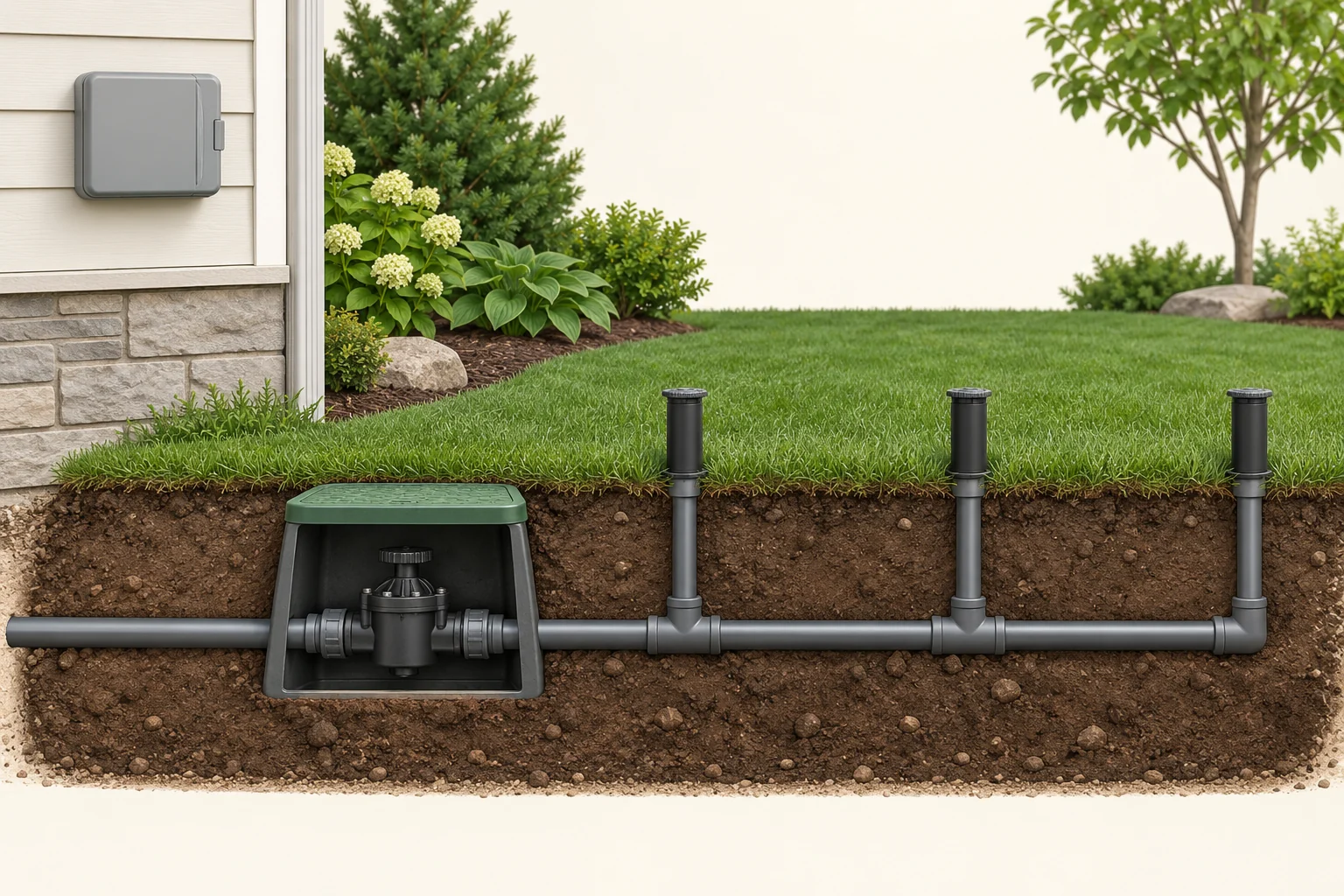
The controller requests watering. A zone valve controls water into a branch, and its pipes carry water to the heads. This cutaway shows those familiar parts separately enough to follow their jobs.
About this illustration
Upstream supply, backflow protection and control wiring are not drawn. No burial depth, valve operation, measured flow or installed condition is established. This is a conceptual teaching model, not an assessment of your home.
6 picture lessons appear beside the questions in this guide. Use them to understand the explanation, then consider what it means for your home.
What carries the water, and what tells it to start?
An in-ground irrigation system brings water to selected parts of a yard through buried pipes and watering heads. A controller tells a valve when to let water into a group of those pipes. The water route and the electrical instruction have different jobs: a timer is not a pump, and a message on its screen is not a flow measurement.
Follow the familiar parts. The supply brings water to the system. Any applicable backflow protection has a drinking-water protection job. A zone valve controls a branch. Buried pipes carry its water to sprinkler heads or other distribution devices. The controller provides the watering request; installed sensors may affect that request.
The actual supply might differ from the example in a diagram. Ask the provider to identify where yours comes from, whether a master valve or pump arrangement is present, and which records describe it. A municipal-water example cannot establish the equipment or permissions for a different supply.
Begin with existing records and an ordinary look from dry, stable ground. Do not open electrical compartments, lift buried equipment out, dig for pipes or operate unfamiliar valves to discover the route. A significant active water problem needs prompt help from the responsible provider or utility, rather than a longer observation exercise.
The controller requests watering; pipes carry the water
The controller requests watering. A zone valve controls water into a branch, and its pipes carry water to the heads. This cutaway shows those familiar parts separately enough to follow their jobs.
Numbers identify the parts explained below.
- Controller
Requests watering according to its instructions. The pictured box is closed and has no visible control connection.
- Zone valve
Controls water into the branch. Its visible body does not establish the actual model or operating condition.
- Pipe and heads
The continuous conceptual pipe joins three head bodies. Actual supply, distribution and depth need their own records.
What does this illustration leave out?
Upstream supply, backflow protection and control wiring are not drawn. No burial depth, valve operation, measured flow or installed condition is established. Read the part names and jobs below the picture.
Which station, valve and heads are recorded as one zone in this yard?
Explore this with HomeAI ↗Opens an editable question. Nothing is sent until you choose to send it.What is a zone, and how is it different from a programme?
A zone is a group of watering outlets served through a controlled branch. On a controller, a station is the numbered output associated with a valve. A programme is a set of watering instructions. These names connect the equipment to the schedule, but do not tell you which patch of lawn a handwritten number actually serves.
In the named Rain Bird ESP-TM2 manual, each station terminal supports one valve solenoid: the electrical part of that valve control. The manual separately describes programmes, start times, station run times and watering days. This is a useful model example, not a wiring instruction or a promise that another controller uses the same arrangement.
Ask for a zone map that links each controller station to the corresponding valve and watering area. Keep uncertain labels marked uncertain. “Front lawn” on an old controller card may describe a former arrangement after a planting bed, head or valve was changed.
A zone is therefore a useful unit for describing a complaint: which recorded area changed, and when? It is not a guarantee of even coverage or proof that every buried connection was documented. Ask the provider whether the map reflects the installed system now.
A zone is a yard group; a programme is a set of instructions
The zone groups the watering outlets. The station identifies the controller output associated with valve control. The programme supplies the watering instructions; it does not locate the buried pipe.
Numbers identify the parts explained below.
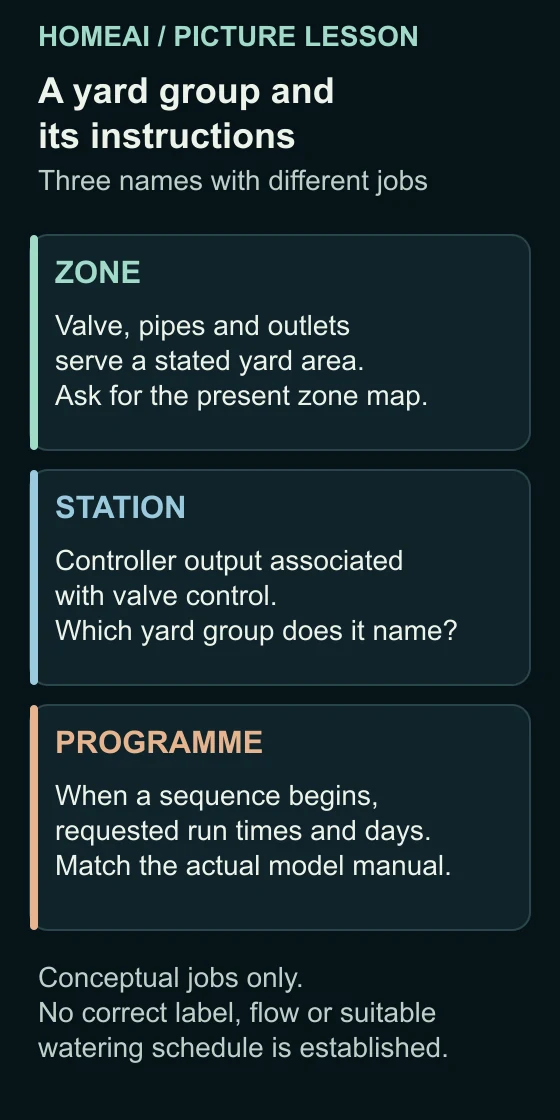
- Zone
Ask which valve and watering area belong to the group.
- Station
Match the controller label to the actual valve and zone map.
- Programme
Match start times, run times and days to the correct model and actual record.
What does this illustration leave out?
The actual zone map, labels, controller model, field connections and suitable schedule remain unknown. Compare the three names and their jobs below.
Does the present zone map match the controller labels?
Explore this with HomeAI ↗Opens an editable question. Nothing is sent until you choose to send it.Read the complete diagram
A zone is a yard group; a programme is a set of instructions
- Zone: the physical watering group
- A controlled branch serves a group of watering outlets. Ask which valve, pipes and yard area the actual zone map describes; a number alone does not locate the group.
- Station: the controller association
- A station names a controller output associated with valve control in the identified model. The ESP-TM2 manual gives a named example. This lesson supplies no electrical terminal connection or owner wiring step.
- Programme: the watering instructions
- Start times, station run times and watering days have different jobs. Match their meanings to the correct manual and actual programme; they do not establish the delivered water volume or a suitable schedule.
Conceptual names and jobs only. A present zone map, installed model and qualified assessment are needed to connect the records to the yard.
What remains unknown: The actual zone map, labels, controller model, field connections and suitable schedule remain unknown.
Keep the yard group separate from the schedule
- ZoneA controlled group of pipes and watering outlets · Match it to the present yard map.
- StationAn identified controller output for valve control · Ask which valve and area its label currently names.
- ProgrammeWatering instructions, including when a sequence begins · Use the correct model manual and actual programme record.
Conceptual roles. No terminal connection, working valve, accurate label or suitable schedule is established.
Further reading: City of Calgary · Efficient irrigation; Rain Bird · ESP-TM2 controller user manual.
Why can the controller show watering while nothing sprays?
The controller starts the chain by requesting valve operation. Water still needs an available supply and a functioning route through the relevant equipment. Separating those jobs helps explain why a lit screen and a dry lawn can occur together without immediately choosing a failed controller.
The ESP-TM2 troubleshooting table lists a supply issue or loose, incorrect or damaged wiring when its watering symbol flashes but the system does not water. It lists sensor and valve-related possibilities for other no-start complaints. Those alternatives belong to that manual; the guide does not turn them into a diagnosis of your equipment.
Record the exact visible message, station name if shown, date and area affected during ordinary permitted operation. Include whether the event involved one area or the whole yard, without starting additional runs to compare them. A screen photograph preserves the message; it cannot show a concealed valve opening or available flow.
Ask the qualified provider what they will assess on the instruction side and the water side. Sensor, controller, field connection, valve and supply questions may require different access. Do not bypass a sensor, open a controller, follow another model’s reset sequence or manually force a valve to test a theory.
A watering request and water reaching the heads are separate jobs
The request lane explains what the controller asks for. The water lane explains what must reach the heads. A screen message alone cannot measure the second job.
Numbers identify the parts explained below.
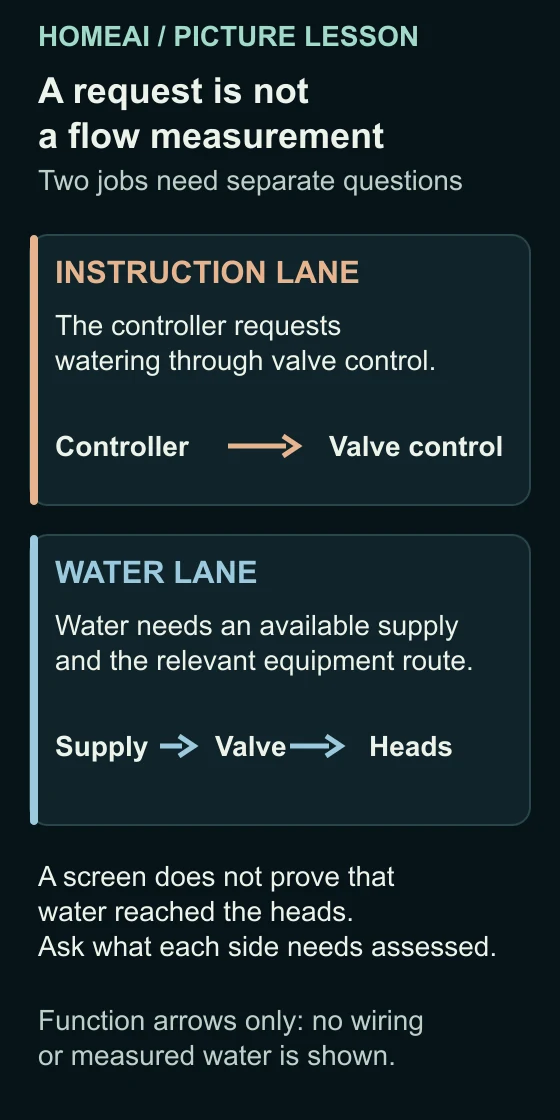
- Controller request
The message concerns the watering request, not a measured water quantity.
- Water route
Supply and the route through the relevant valve and equipment still matter.
- Assessment
Ask what the provider will check on both sides without owner bypasses or test runs.
What does this illustration leave out?
No working signal, valve movement, available supply, measured flow or diagnosis is established. Follow the request and water lanes separately.
What will the provider assess on the instruction side and the water side?
Explore this with HomeAI ↗Opens an editable question. Nothing is sent until you choose to send it.Read the complete diagram
A watering request and water reaching the heads are separate jobs
- Instruction lane: controller request → valve control
- The controller requests watering. A screen symbol describes that request. It does not measure a working field connection, valve movement or water delivered to a head.
- Water lane: supply → zone valve → pipes and heads
- Water needs an available supply and the relevant route through the equipment. These are simplified function arrows, not electrical conductors, approved device order or a drawing of an installed supply connection.
- Why both lanes matter
- The named ESP-TM2 manual lists supply and wiring possibilities when its watering symbol flashes without watering. Other complaint rows identify sensor or valve-related possibilities. Those alternatives do not diagnose a real system.
- Useful safe question
- Record the existing message and watering event that were actually noticed. Ask what the provider will assess on each side; do not bypass a sensor, force a valve or start extra test runs.
Conceptual mechanisms only: no measured flow, tested device, model compatibility, wiring or owner troubleshooting procedure.
What remains unknown: No working signal, valve movement, available supply, measured flow or diagnosis is established.
Why might the same area seem to water again?
A repeated watering event can be a schedule question before it is a broken-pipe question. Start time means when a programme begins; run time concerns how long a station is requested to water. Confusing those two can make an apparent sequence hard to interpret.
The named ESP-TM2 manual identifies unintended multiple programme start times as one possible cause of excessive watering. A start time is not required separately for each valve in that model’s programme. This explanation does not instruct you to edit settings, or prove that repeated watering in another system has the same cause.
Keep a simple chronology of the events you actually noticed. Separate “the head sprayed again” from “the grass stayed wet.” Record any existing programme information supplied by the provider, a recent service visit and a reported change in who manages the controller.
Ask the provider to match the observed sequence to the present programmes and the correct manual. Also ask whether water continued outside that sequence and whether a valve or other water-route question remains. A programme review can explain a request without proving that the valve opened and closed as intended.
What does backflow protection do here?
Backflow means water moves in the unwanted reverse direction toward a drinking-water system through a connection. Normal irrigation sends supplied water toward the yard. Backflow protection has a separate job from deciding when a zone waters: it addresses that reverse-flow connection.
Calgary’s FAQ describes two mechanisms. Backsiphonage involves lowered pressure or a vacuum on the supply side. Backpressure involves pressure downstream that exceeds the supply pressure. You do not need to create either condition to understand why an irrigation connection deserves its own protection question.
The Calgary programme names several protection types, while its irrigation page gives local examples for in-ground systems. Have the local utility and qualified provider identify the appropriate requirement and actual device for your address. A device name, photograph or another city’s example cannot select or approve yours.
This device is not the wastewater backwater valve that addresses reverse sewer flow. Ask for identification, relevant local records and any actual test report, keeping its date, device and findings together. Calgary notes that internal parts can wear; an installed-looking assembly or a paid visit alone is not a current functioning test.
Zone control, drinking-water protection and sewer protection are different
The zone valve controls watering. Applicable backflow protection addresses unwanted reverse flow toward drinking water. A wastewater backwater valve concerns the separate sewer route.
Numbers identify the parts explained below.
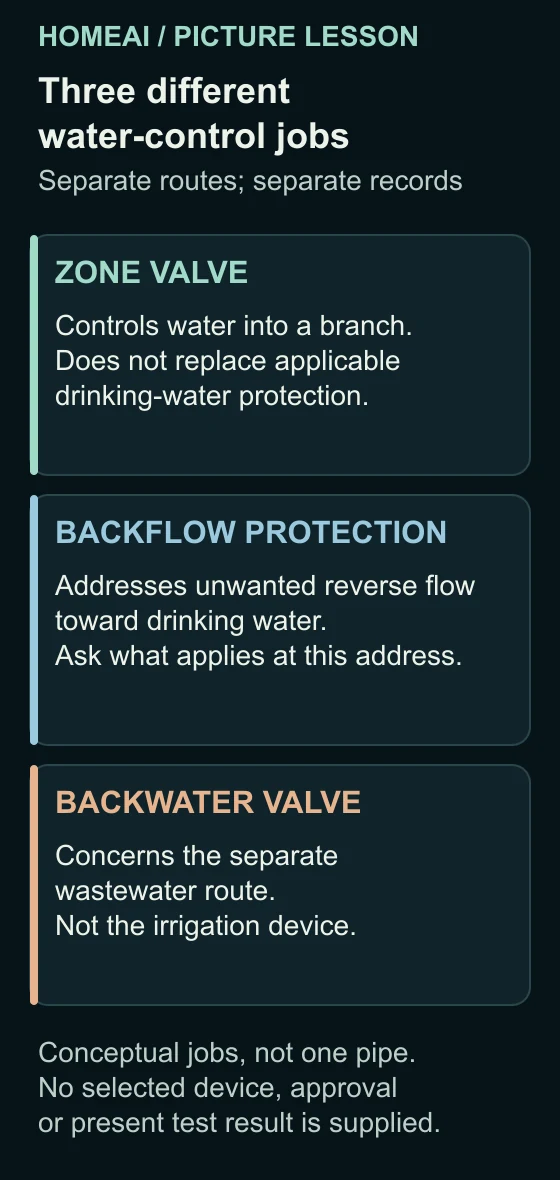
- Zone control
Decides which branch receives water; it does not replace applicable backflow protection.
- Drinking-water protection
Identify the actual protection device and local assessment records.
- Wastewater protection
A backwater valve belongs to a different water route and question.
What does this illustration leave out?
The actual device, local requirement, test result and suitability are not supplied. No device-selection rule applies nationally from this picture. Read these separate jobs; the cards are not connected pipes.
Which device, local requirement and actual report apply to this address?
Explore this with HomeAI ↗Opens an editable question. Nothing is sent until you choose to send it.Read the complete diagram
Zone control, drinking-water protection and sewer protection are different
- Zone valve: control a branch
- The zone valve controls water reaching its branch. The watering schedule and applicable drinking-water protection remain separate jobs.
- Irrigation backflow protection: address unwanted reverse flow
- Calgary’s named FAQ explains reverse movement toward drinking water through a connection, including supply-side backsiphonage and downstream backpressure. Identify the actual local requirement and device with the utility and qualified provider; no national selection rule is given.
- Wastewater backwater valve: a separate route
- Calgary explicitly distinguishes a cross connection control device from a wastewater backwater valve. Do not substitute a sewer record or basement valve photograph for an irrigation protection assessment.
- Keep the actual assessment attached
- A protection-device report needs its actual device identity, date, findings and applicable local scope. A visible assembly, controller label or general service invoice does not provide that result.
These unconnected cards compare functions only. They do not show one pipe, a selected device, a local approval, drinking-water quality or present working protection.
What remains unknown: The actual device, local requirement, test result and suitability are not supplied. No device-selection rule applies nationally from this picture.
These devices solve different water questions
- Zone valveControls water into a watering branch · Not a substitute for the required drinking-water protection.
- Irrigation backflow protectionAddresses unwanted reverse flow at the relevant drinking-water connection · Identify the actual device and applicable local assessment.
- Wastewater backwater valveAddresses reverse wastewater flow · A different route and task from the irrigation protection device.
Function comparison only. No national selection rule, local approval or present test result is supplied.
Further reading: City of Calgary · Cross connection frequently asked questions; City of Calgary · Efficient irrigation.
Why has one sprinkler’s coverage changed?
A sprinkler head distributes water into an area. Its nozzle and surroundings matter to the visible pattern. Some distribution devices spray over turf; other arrangements deliver water closer to plant roots. Identify the equipment in the actual zone before comparing it with a general lawn-sprinkler picture.
Calgary’s irrigation guidance identifies broken or clogged heads, leaks and other operating problems as maintenance concerns. It also discusses changing landscape needs and runoff. A short, uneven or redirected spray is useful to report, but does not establish which component caused it.
From an ordinary safe position, describe what you already see: water reaching a path, a head leaning, foliage in the spray path, or a changed area of coverage. Include recent mowing, planting or landscaping history as context. Do not pull up the head, remove its nozzle or clear it while it is operating.
Ask the provider to compare the head, its distribution task and the zone’s present landscape. A new planting bed may raise a design question even when a head still sprays. A photograph cannot measure flow, pressure, even distribution or whether the current equipment suits the plant and soil needs.
Nearby planting can change where a spray reaches
A sprinkler distributes water into an area. The left example shows foliage in the depicted spray path; the right shows a more open grass patch. Compare what changed around the real head before choosing a cause.
Numbers identify the parts explained below.
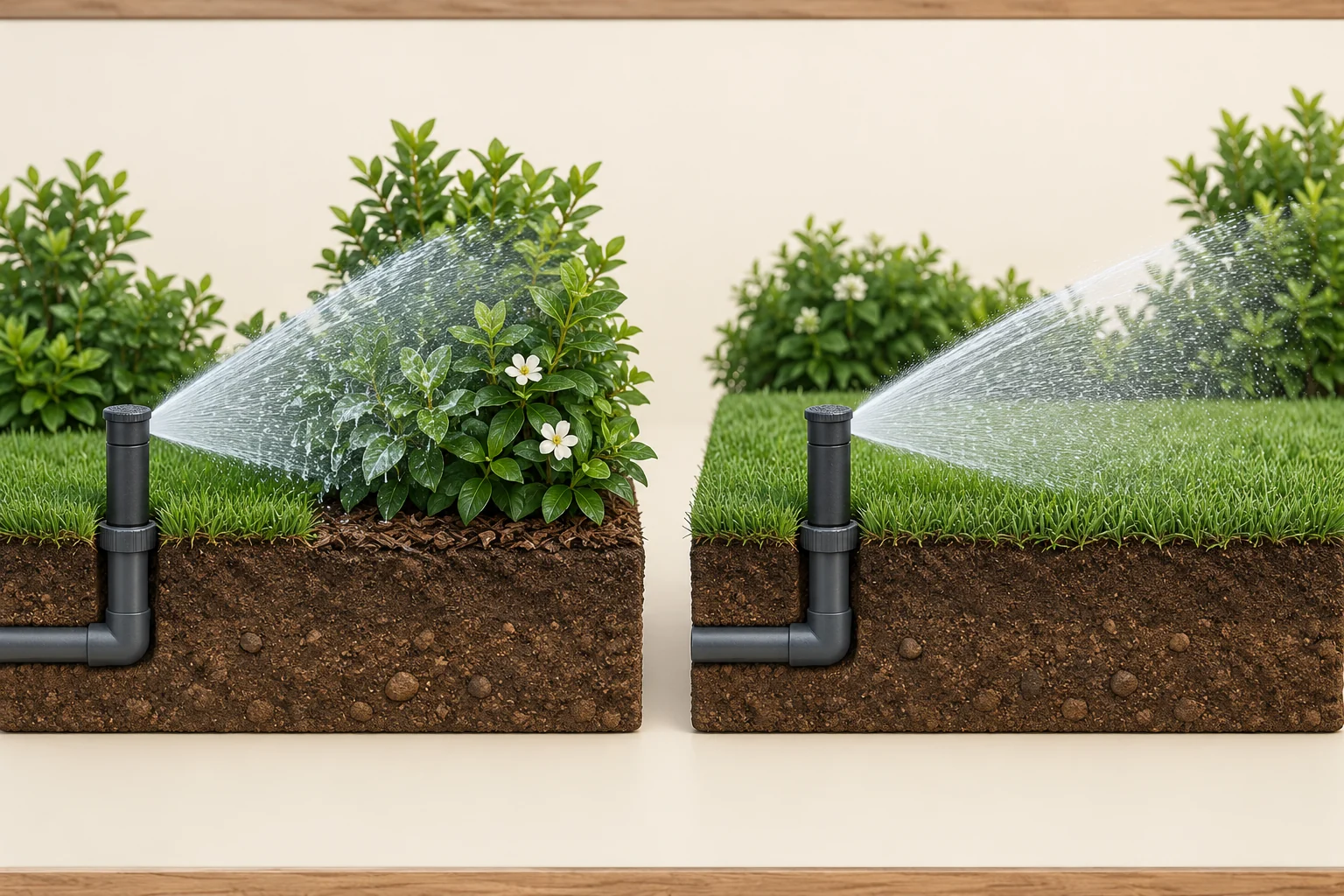
- Sprinkler head
Distributes water from its connected branch. The generic form does not identify an installed nozzle or rating.
- Planting in the path
Foliage meets the left example’s spray. Ask what changed around the actual head.
- More open patch
The right example shows a different setting. It does not prove suitable watering or a repair.
What does this illustration leave out?
The spray shapes give no measured reach, pressure, volume, even distribution or suitable head spacing. No real dry patch is diagnosed. Compare the two garden examples without treating them as measurements.
What changed around the head, and what should the provider compare with the original zone plan?
Explore this with HomeAI ↗Opens an editable question. Nothing is sent until you choose to send it.Does a wet patch or dry patch prove a buried leak?
A wet patch tells you where water is visible, not necessarily where it started. Irrigation, rainfall and surface drainage can all matter to the story. A dry patch likewise does not identify a failed pipe: the distribution pattern and the landscape’s ability to receive and retain water are separate questions.
Calgary identifies installation problems, construction damage, freezing and thawing, and improper winterization as possible leak causes. These are alternatives for an assessment, not a conclusion from the season or a nearby building project. Record the changed area and the timing of relevant work without assigning blame.
The historical BC agricultural manual explains that soil texture, structure and ground cover affect infiltration: how water enters soil. Its water-storage discussion also distinguishes soils and roots. Those basic mechanisms help explain why water application and soil condition both matter; its farm rates and calculations are not a prescription for your lawn.
Report whether the patch was noticed after rain, during ordinary watering, or when no watering was known to be taking place. Keep uncertainty about that timing visible. Do not excavate, pressurize, run extra watering or use a whole-home bill to declare one zone’s leak rate. The provider chooses the appropriate investigation.
How do rain, soil and the season change the question?
Plants use water, and moisture also evaporates from plant and soil surfaces. The BC manual calls that combined process evapotranspiration. Weather changes water demand, while soil and roots affect storage. These mechanisms explain why one fixed schedule is not automatically suitable throughout a Canadian growing season.
Calgary describes controllers that respond to weather or environmental information. The ESP-TM2 manual separately describes an optional rain/freeze sensor and controller choices that affect whether its signal is followed. A sensor-shaped object or a “smart” label cannot establish which information the installed controller currently receives or uses.
Ask the provider which sensor or weather service is actually connected, what it is intended to do and how its operation was assessed. Keep a rain observation separate from a confirmed sensor finding. Do not disconnect a sensor or deliberately water in unsuitable conditions to see what the controller does.
Watering permission is another question. Check current rules with the municipality or water supplier for the address and date, including temporary restrictions. A permitted day does not determine plant need; a weather-based request does not override a local restriction. This guide gives no Canada-wide calendar or timer-setting recipe.
What should spring and freeze-season care cover?
Seasonal preparation concerns more than the controller’s calendar. Water remains part of the physical system, including its valves, pipe routes and distribution devices. Calgary’s guidance recommends professional maintenance and winterization, while identifying freeze-related and improper-winterization damage among possible problems.
Ask the provider to match the seasonal work to the actual equipment, supply and local conditions. Request what was prepared, what was inspected or found, and any remaining access or repair question. A winterization invoice describes its stated visit; it cannot establish the condition of every buried pipe or a later spring assessment.
Keep any required protection-device records separate from the watering schedule. Local programmes and actual models determine their own duties. Do not copy a compressed-air blowout, drainage, isolation, valve or electrical sequence from a generic article. Arrange the appropriate professional scope rather than treating this guide as a shutdown checklist.
Use the existing freeze-preparedness guide for the wider household planning question. This page stays focused on understanding yard watering and preparing a clear irrigation service request.
What changes after landscaping or a new-build handover?
A finished lawn can hide the irrigation route as effectively as an older one. Ask for the zone map, equipment identification and work records while the builder or landscape provider can still explain what was installed. A fresh controller and new sod do not establish complete documentation or an assessed system.
Later planting, fences, paths and ground work can change the setting around heads or introduce a question about buried equipment. Calgary includes construction damage among possible leak causes. A nearby truck or a new walkway is context to investigate, not proof that a pipe was damaged.
Before proposed ground work, have the responsible parties establish which buried services and private irrigation routes need locating and protection. Keep supplied plans and actual locating or assessment records distinct. Do not use this conceptual cutaway or a remembered head position to decide a safe digging route.
Irrigation documentation does not replace the home’s drainage or site records. Link a grading concern to new-home grading stages and a rainwater question to rain and foundation drainage. Where a septic system is present, keep its separate yard-use and location records with the project team.
What could a changed-watering service request look like?
Fictional homeowner Maya notices the front-lawn heads spraying again later in the morning. A separate wet patch appears beside a recently changed planting bed. She has an old controller card but no current zone map. These are invented observations, with no known failed component, measured flow or repair result.
Maya records the events she actually noticed and keeps the two observations separate. She supplies the controller model, old card, landscaping invoice and available seasonal-care record. She does not add watering runs, open a valve box or change settings to produce a clearer demonstration.
She asks two questions. Does the present programme explain the repeated watering request? Separately, what assessment would distinguish water distribution, a pipe or valve concern, and rainfall or surface-water context near the wet patch? Neither the controller label nor the planting invoice answers both.
A useful written report would attach findings to the assessed parts and conditions: the matched programme, identified zone, actual observed operation, any professional measurements and inaccessible areas. This example deliberately ends at the service scope. It supplies no diagnosis, passing backflow test, builder responsibility decision, cost or promised repair.
Maya’s fictional spray event and wet patch need separate questions
Maya’s invented repeated spray leads to a programme question. The separate wet patch leads to a water-route and site-context question. One observation does not answer both.
Numbers identify the parts explained below.
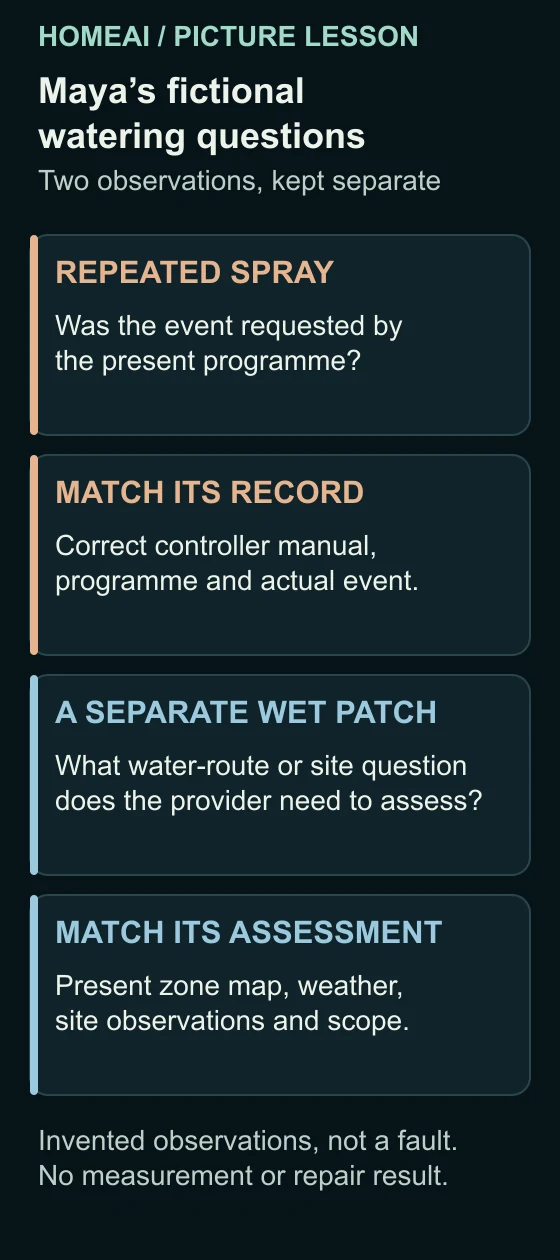
- Repeated spray
Match the actual event to the correct model and programme record.
- Wet patch
Keep rainfall, site context and the stated watering timing visible.
- Useful records
Request a scope and findings for each question; do not run extra watering to investigate.
What does this illustration leave out?
All observations and records are fictional. No fault, measured quantity, test result, responsibility decision or successful repair is supplied. This is an invented service request, not a property finding.
Which assessed finding would answer each question, and what would remain unknown?
Explore this with HomeAI ↗Opens an editable question. Nothing is sent until you choose to send it.Read the complete diagram
Maya’s fictional spray event and wet patch need separate questions
- Invented observation: repeated front-lawn spray
- Fictional Maya noticed another spray event. She asks whether the correct model and present programme explain the request; she has not measured a full watering sequence.
- Invented observation: a separate wet patch
- Maya records the stated location, weather and landscaping context. Distribution, buried-equipment and other water-route questions remain for the provider; none is diagnosed from wet ground.
- Records assigned to their jobs
- The model/manual and programme help explain a request. A current zone map helps connect labels to areas. A scoped site assessment supplies only its actual observations, measurements, findings and access limits.
- Safe next question
- Ask which finding would answer each of the two questions and what remains unassessed. Maya does not run extra watering, dig or operate unfamiliar equipment to choose a cause.
All people, events and records in this example are fictional. No measured timeline, volume, repair price, fault, approved system, builder liability or successful repair is supplied.
What remains unknown: All observations and records are fictional. No fault, measured quantity, test result, responsibility decision or successful repair is supplied.
Who should assess it, and what should the record keep?
Ask an appropriately qualified irrigation provider about the watering route, equipment and landscape task. A backflow question may require the locally recognized tester or plumbing scope; electrical work may require a different qualified trade. Confirm actual credentials and local acceptance for the proposed work, rather than treating one job title as permission for every task.
Request a written scope before the visit: which zone and concern, what access is needed, which existing records will be reviewed, and what testing or measurement is proposed. A pressure or flow result needs its units, location and operating conditions. The household pressure guide explains why an impression of weak flow is a different kind of evidence.
Keep the model/manual edition, zone map, dated observation, task description, findings and remaining questions together. If equipment or programming changes, ask what the updated record should show. The home-care record guide helps retain that history without converting an invoice into an unrestricted condition finding.
For a purchase or sale, ask the actual realtor and technical team how they will coordinate records, access and unresolved irrigation questions. Confirm any claimed HAUSE training and available specialist scope. A knowledgeable adviser helps connect the documents and decisions; they do not replace the provider’s assessment or promise concealed pipes are sound.
Which record answers which question?
- Model manual and zone mapExplain equipment and the stated connection between labels and yard areas · Not a condition finding or proof that the map is current.
- Observation and programme recordDescribe what was noticed and what watering was requested · Not a measurement of actual delivered water or valve response.
- Professional assessment or test reportStates the specific assessed task and findings under recorded conditions · Retain device/zone identity, units, date, access limits and unfinished work.
A receipt, screen or diagram cannot establish every concealed component, water-quality question or local requirement.
Further reading: Rain Bird · ESP-TM2 controller user manual; City of Calgary · Cross connection frequently asked questions; City of Calgary · Efficient irrigation.
Keep learning about the connected parts
- Prepare exposed plumbing for a cold spell
- Low water pressure: build a useful observation log
- Follow rain away from your foundation
- New-home grading: understand the yard through the seasons
- Build a home-care record that the next person can understand
Explore the whole-home map · Understand the Canadian context · Open the visual atlas · Explore the evidence labs · Build a Home Plan
Keep learning about the connected parts
Practice the distinction.
Two observations, two useful assessment questions
Fictional Maya notices repeated front-lawn watering and a separate wet patch after landscaping. Her old controller card has not been checked against the installed zones.
Reported observations
- One repeated spray event was noticed; no full programme history was measured.
- The wet patch is in a different stated location.
- An old controller card and a landscaping invoice are available.
- No current zone map, professional flow measurement or device test result is supplied.
Compare the explanations
Expand each possibility to see the evidence needed to distinguish it. Similar symptoms can have different mechanisms.
The repeated request relates to the programme
The model manual identifies multiple start times as one possible explanation, but the present programme has not been assessed.
Correct model/manual, actual programme review and a record matched to the noticed event.
The wet area needs its own water-route assessment
Distribution, buried equipment, soil, rain and surface-water context remain separate possibilities.
A scoped site assessment with stated access, observations, any measurements and unresolved limits.
A useful next question
Give the provider the model, zone information and two separate observations; agree the assessment scope without owner experiments.
Fictional only. No actual leak, device approval, contamination result, builder liability, repair cost or successful repair.
Know what the words mean.
- Irrigation zone
- A group of watering outlets served through a controlled branch of the irrigation system.
- Station
- A controller output associated with a valve in the identified model; a numbered label does not establish the actual yard area.
- Irrigation programme
- A set of watering instructions, separate from the physical group of pipes and heads.
- Start time
- When a watering programme is requested to begin; its meaning should be matched to the actual controller manual.
- Run time
- How long watering is requested for a station; it does not measure delivered water volume.
- Zone valve
- The valve controlling water into a particular irrigation branch.
- Master valve
- A valve controlling the irrigation supply in an arrangement that includes one; it is not assumed present in every system.
- Backflow
- Unwanted reverse movement through a connection toward a drinking-water system, distinct from reverse wastewater flow.
- Infiltration
- Water entering soil; the soil and ground cover affect how water is received.
- Evapotranspiration
- Water transpired by plants plus moisture evaporated from plants and soil surfaces.
Questions to bring
to the conversation.
- Which supply, valve, station and heads belong to this zone?
- Does the controller request match the watering you actually noticed?
- Could changed planting, weather, distribution or another water route explain the observation?
- Which protection device and dated local records apply at this address?
- What will the qualified provider assess, measure and leave unassessed?
Separate a showing observation, an existing record and a new professional assessment. Unknown means a question remains; it does not automatically mean a defect.
Use the evidence planner ↗Go to the source.
Original HomeAI explanation informed by these public references. Sources support the underlying guidance; they have not reviewed or endorsed HomeAI. Diagrams are conceptual, and calculator outputs depend on your inputs.
Canadian overview with a Calgary municipal example, the named Rain Bird ESP-TM2 manual and historical BC agricultural soil/climate context. Actual equipment, local water-supplier rules and qualified scope must be identified separately. No national watering calendar, backflow-device selection or owner installation/winterization procedure is supplied.
Publication & source review
First published .
Sources reviewed .
- City of Calgary · Efficient irrigation
Where this reference applies
Jurisdiction: Calgary, Alberta; municipal irrigation education
Edition: No substantive publication or revision date established; the 2026 footer and dated price examples are not an edition date.
Source reviewed: 2026-10-06 · America/Edmonton
Complete substantive body read. Automatic-system parts, controller signals, sprinkler distribution, changing weather, possible damage and professional seasonal care. Calgary device examples remain local. Owner start-up/shutdown, catch-container experiments, numerical watering schedules, test intervals and cost figures are excluded.
- City of Calgary · Cross connection frequently asked questions
Where this reference applies
Jurisdiction: Calgary, Alberta; named local drinking-water programme
Edition: No substantive publication or revision date established; capture time is not a publication date.
Source reviewed: 2026-10-06 · America/Edmonton
Complete substantive body read. Cross connection, unwanted reverse flow, backsiphonage/backpressure, mechanical protection and qualified testing roles. A wastewater backwater valve is distinct. No national device selection, code adoption, permit requirement or testing interval is supplied.
- Rain Bird · ESP-TM2 controller user manual
Where this reference applies
Jurisdiction: Named manufacturer controller; North American manual with Canadian support and interference statement
Edition: 690299-01 Rev.05/16; ©2016. This exact copy is currently linked by the support page; URL folder dates are not its edition.
Source reviewed: 2026-10-06 · America/Edmonton
All 11 English text pages read; actual pages 3, 10 and 11 inspected. Station/valve relationship, separate programme/start/run-day roles, optional master valve, optional rain/freeze sensor and stated alternative explanations. Installation, wiring, jumpers, owner test runs, reset sequences, settings and numerical ratings are excluded. Does not describe every controller or the accessories fitted in a home.
- B.C. Sprinkler Irrigation Manual · Chapter 4, Crop, Soil and Climate
Where this reference applies
Jurisdiction: British Columbia agricultural design reference; historical qualitative context only
Edition: 2014 ISSUE on the actual chapter cover; current access does not make it a current residential code or climate forecast.
Source reviewed: 2026-10-06 · America/Edmonton
Complete 22-page chapter text read, including covers and printed pages 33–52; actual PDF pages 3, 4, 9 and 10 inspected. Soil water storage, infiltration and evapotranspiration explain why water application and plant need differ. Agricultural tables, crop prescriptions, historical climate estimates, calculations, licensing statements and design instructions are excluded. No residential watering recipe is transferred.
- B.C. Sprinkler Irrigation Manual · Title page and preface
Where this reference applies
Jurisdiction: British Columbia; agricultural professional manual
Edition: 2014 ISSUE. The current directory says July 2, 2024; that webpage update does not revise this PDF edition.
Source reviewed: 2026-10-06 · America/Edmonton
All 10 front-matter text pages read, including blank pages, preface and contents; actual title-page pixels inspected. Establishes historical edition and agricultural professional scope only. Listed linked chapters are not treated as read.
Have a question about your home?
Start with the symptom, timing and what you have observed.
Ask HomeAI