Jump to a question in this guide
- What has to connect between the two transactions?
- Why is the sale price different from usable proceeds?
- What can you know if you sell before buying?
- What changes when you buy before selling?
- What can bridge financing actually bridge?
- Why does porting the mortgage need a separate answer?
- Can matching completion dates remove the gap?
- How do conditions change what the household can rely on?
- How should you compare workable sequences?
- What does a fictional two-home plan reveal?
- Which professionals answer which unresolved questions?
- What should remain in the final moving record?
- Usable sale proceeds are the price less the actual settlements and included selling amounts.
- A timing gap and a shortage in total funds are different problems; moving a date cannot cure both.
- Bridge finance and portability need separate actual lender approvals and conditions.
- Put deposits, completions, overlap costs and the physical move on one cash calendar.
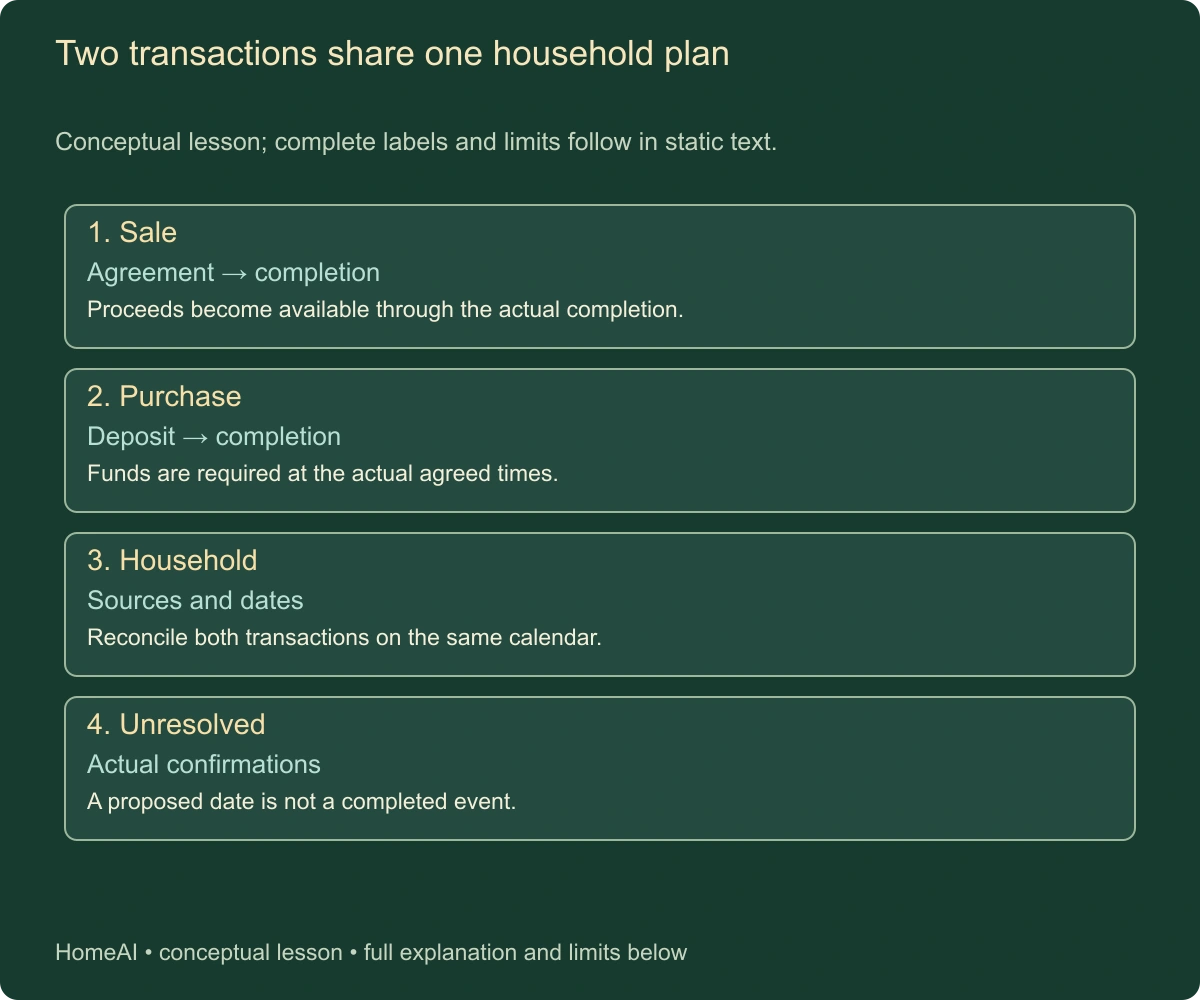
Four separate boxes compare the sale, purchase, household plan and unresolved confirmations. Sale proceeds and purchase funds have their own dates; one does not transfer automatically into the other.
About this illustration
No actual dates, contracts or available funds. This is a conceptual teaching model, not an assessment of your home.
6 picture lessons appear beside the questions in this guide. Use them to understand the explanation, then consider what it means for your home.
What has to connect between the two transactions?
A sale and a purchase are two separate transactions that the household hopes to connect. The sale produces money only after its own completion requirements, debt settlements and charges are reconciled. The purchase needs money at its own required times. A planned sale price therefore cannot be treated as cash already available for a purchase deposit or completion.
The familiar parts have different jobs. A listing invites offers; an accepted agreement records the negotiated transaction; conditions identify matters still to be resolved under that agreement. A mortgage approval addresses borrowing under stated conditions. The legal completion process deals with the required documents, funds and property interests. One part can progress while another remains unfinished.
Start by drawing the two transactions side by side. Put the expected sale completion, purchase deposit requirement, purchase completion and household move on the same calendar. Beside each event, write the document or professional confirmation supporting it. Keep a proposed date, an agreed contractual date and confirmation that an event actually occurred distinct. They can look identical on a casual moving checklist while carrying different consequences.
This guide concerns the connection between transactions: proceeds, shortfalls, overlapping obligations and changes in timing. The closing-cash guide explains the detailed purchase statement, and the mortgage-change guide explains actual porting or breaking proposals. Here those enquiries feed one household decision. Can the household complete each required step with confirmed funds and a workable place to live, including if the preferred sequence changes?
Two transactions share one household plan
Four separate boxes compare the sale, purchase, household plan and unresolved confirmations. Sale proceeds and purchase funds have their own dates; one does not transfer automatically into the other.
Numbers identify the parts explained below.
- Sale
Agreement → completion. Proceeds become available through the actual completion.
- Purchase
Deposit → completion. Funds are required at the actual agreed times.
- Household
Sources and dates. Reconcile both transactions on the same calendar.
What does this illustration leave out?
No actual dates, contracts or available funds. This illustration explains an idea. It is not an installation guide.
Which actual records and qualified advice answer this distinction?
Explore this with HomeAI ↗Opens an editable question. Nothing is sent until you choose to send it.Two transactions share one household plan
Conceptual lesson; complete labels and limits follow in static text.
- Sale
- Agreement → completion. Proceeds become available through the actual completion.
- Purchase
- Deposit → completion. Funds are required at the actual agreed times.
- Household
- Sources and dates. Reconcile both transactions on the same calendar.
- Unresolved
- Actual confirmations. A proposed date is not a completed event.
Four separate boxes compare the sale, purchase, household plan and unresolved confirmations. Sale proceeds and purchase funds have their own dates; one does not transfer automatically into the other.
What remains unknown: No actual dates, contracts or available funds.
A useful question: Which actual records and qualified advice answer this distinction?
Why is the sale price different from usable proceeds?
The sale price is the agreed amount for the property under the transaction. Usable proceeds are what remains for the seller after relevant borrowing and transaction amounts are dealt with. FCAC identifies selling costs such as real-estate, legal and mortgage-related charges. Their actual amounts depend on the agreement, providers and circumstances. This guide does not supply a standard commission or universal cost percentage.
Ask the legal professional for an appropriate estimate of net proceeds, identifying which figures are quotations and which remain assumptions. Start with the assumed sale price and deduct the identified settlements and costs consistently. Include amounts owed against the property that the professional says must be addressed. Do not subtract a mortgage balance once in the sale estimate and then subtract the same payout again from the money being transferred to the purchase.
A mortgage statement and a dated payout answer different questions. The statement records the account at its date. The payout addresses what is required for the proposed settlement, including the lender's treatment of interest, early repayment and other relevant charges. A proposed completion change can change that enquiry. Request an updated explanation rather than carrying an old net-proceeds figure through a revised calendar.
Keep money reserved for other purposes visible. Moving, temporary accommodation, ongoing household bills and identified property work may require funds beyond the two completion statements. A sale surplus can be real while still being insufficient for every planned use. The useful figure is the amount available for a particular purpose at a particular time, with its assumptions and unresolved items stated.
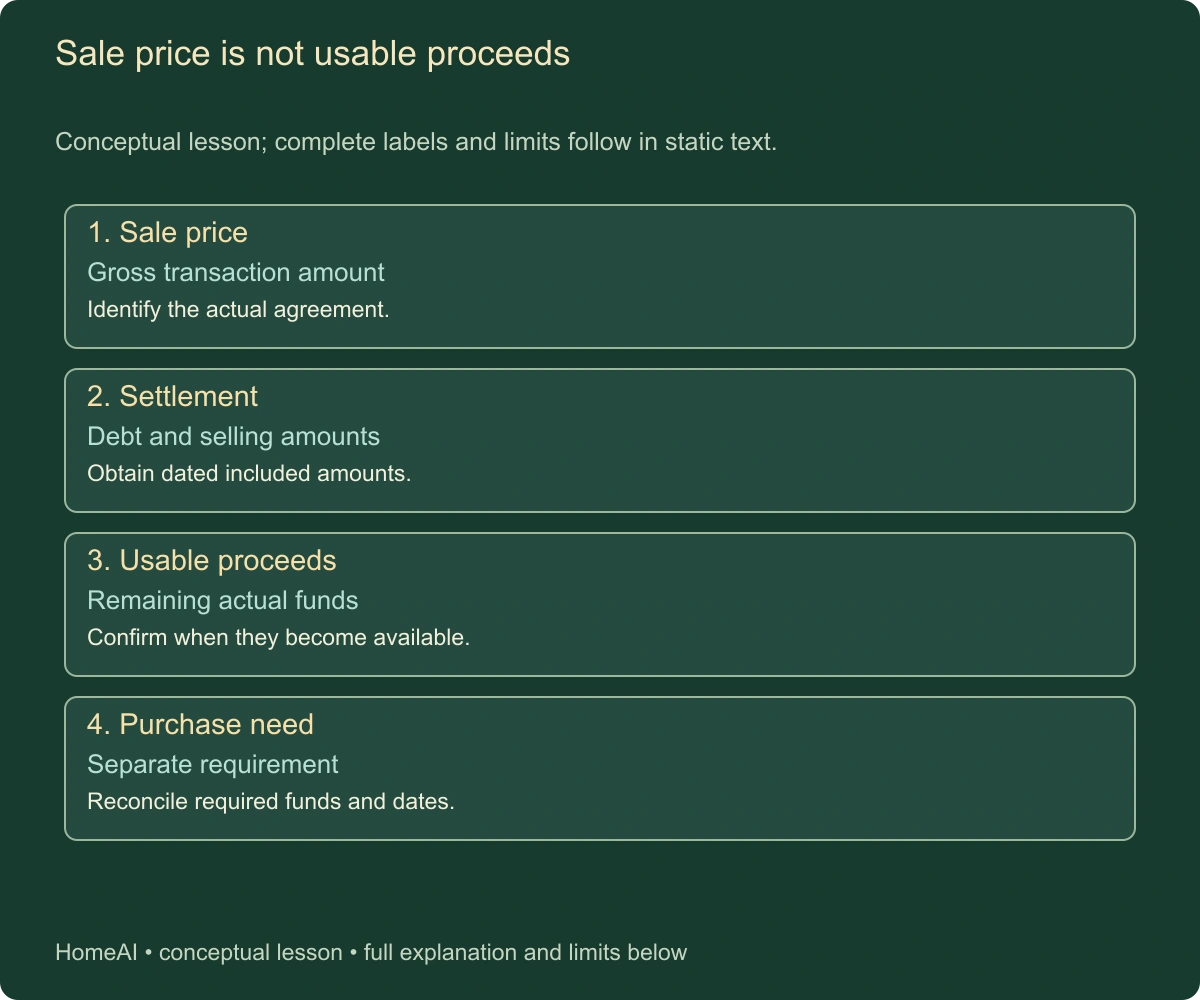
Sale price is not usable proceeds
Read from gross price through the actual settlements to usable proceeds, then compare the separate purchase requirement.
Numbers identify the parts explained below.
- Sale price
Gross transaction amount. Identify the actual agreement.
- Settlement
Debt and selling amounts. Obtain dated included amounts.
- Usable proceeds
Remaining actual funds. Confirm when they become available.
What does this illustration leave out?
No universal deductions or quoted fees. This illustration explains an idea. It is not an installation guide.
Which actual records and qualified advice answer this distinction?
Explore this with HomeAI ↗Opens an editable question. Nothing is sent until you choose to send it.Sale price is not usable proceeds
Conceptual lesson; complete labels and limits follow in static text.
- Sale price
- Gross transaction amount. Identify the actual agreement.
- Settlement
- Debt and selling amounts. Obtain dated included amounts.
- Usable proceeds
- Remaining actual funds. Confirm when they become available.
- Purchase need
- Separate requirement. Reconcile required funds and dates.
Read from gross price through the actual settlements to usable proceeds, then compare the separate purchase requirement.
What remains unknown: No universal deductions or quoted fees.
A useful question: Which actual records and qualified advice answer this distinction?
What can you know if you sell before buying?
Selling first can make the sale agreement and eventual proceeds clearer before the household commits to its next purchase. That can improve the information behind a budget. It does not guarantee the final amount until the transaction completes, and it does not guarantee that a suitable replacement home will be available at the desired price or time.
Follow the actual sale status. An offer that still has conditions is different from an agreement whose applicable conditions have been resolved as advised by the legal professional. Even an agreed sale has a completion process ahead. Ask what remains to be done, when the proceeds are expected to become usable and what practical plan applies if the household has to leave before the next home is available.
Temporary accommodation is part of the comparison rather than evidence that the sequence failed. Ask about the real cost and availability of a rental, storage, additional moves and accommodation suitable for the household. A short stay described by a friend is not a quotation for the dates, pets, accessibility needs or school arrangements involved here. Keep any accommodation contract separate from the property contracts.
Selling first also changes how urgently the household may feel it must buy. Decide the essential features and evidence requirements before that pressure develops. A known sale price should not become a reason to waive a technical enquiry or assume a future lender will accept every replacement property. The next purchase still needs its own condition, legal and financing work within the agreed timetable.
What changes when you buy before selling?
Buying first may secure the preferred replacement home while the current home remains unsold. It also creates a funding question before the expected sale proceeds exist. An optimistic sale estimate is not an approved source of money. Ask the lender or mortgage adviser to assess the actual sequence, existing borrowing and proposed property rather than relying on a general borrowing conversation.
Separate three situations. The current home may be unlisted, listed without an accepted sale, or subject to an actual sale agreement. These are different evidence positions for a funding assessment. The lender needs the real facts and may impose specific requirements. Do not describe an unsold home as effectively sold merely because similar homes have recently attracted offers.
The household may also carry obligations for both properties during an overlap. Ask for a cash-flow illustration covering the relevant debt payments, ownership expenses and other commitments under the proposed dates. Identify which expenses continue after a physical move and when any account actually ends. A vacant old home still has obligations that require confirmation with the appropriate providers and insurer.
Test a less convenient sale outcome before signing the purchase. Consider a later sale, lower proceeds or a longer period carrying both homes. These are hypothetical sensitivity cases, not forecasts. Ask which cases remain financially workable and which would require a different plan. If no confirmed funding route meets the purchase obligation without an assumed sale, that missing route belongs at the centre of the decision.
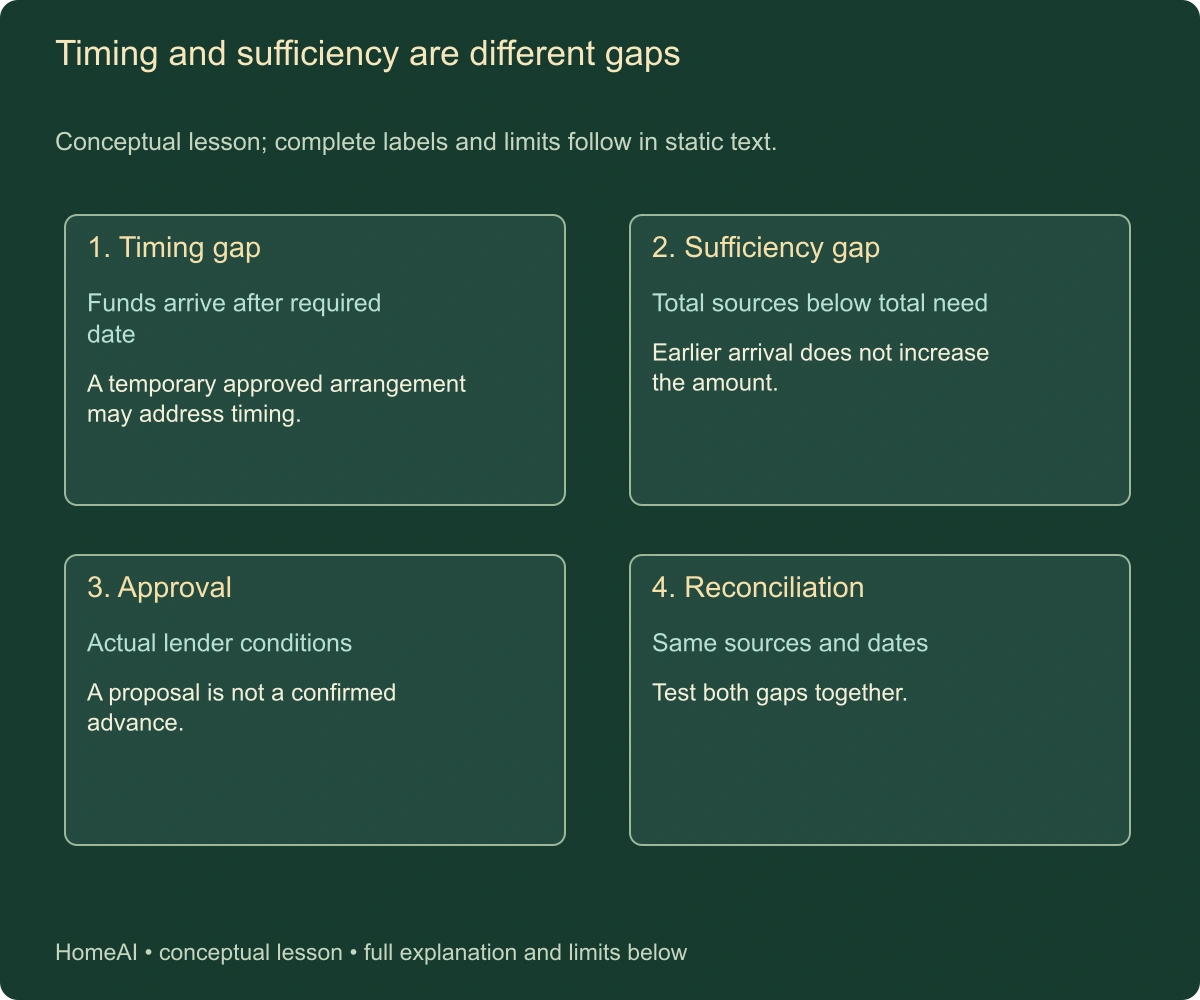
Timing and sufficiency are different gaps
The timing and amount boxes are parallel questions. Resolving one does not automatically resolve the other.
Numbers identify the parts explained below.
- Timing gap
Funds arrive after required date. A temporary approved arrangement may address timing.
- Sufficiency gap
Total sources below total need. Earlier arrival does not increase the amount.
- Approval
Actual lender conditions. A proposal is not a confirmed advance.
What does this illustration leave out?
No bridge approval, eligibility or rate. This illustration explains an idea. It is not an installation guide.
Which actual records and qualified advice answer this distinction?
Explore this with HomeAI ↗Opens an editable question. Nothing is sent until you choose to send it.Timing and sufficiency are different gaps
Conceptual lesson; complete labels and limits follow in static text.
- Timing gap
- Funds arrive after required date. A temporary approved arrangement may address timing.
- Sufficiency gap
- Total sources below total need. Earlier arrival does not increase the amount.
- Approval
- Actual lender conditions. A proposal is not a confirmed advance.
- Reconciliation
- Same sources and dates. Test both gaps together.
The timing and amount boxes are parallel questions. Resolving one does not automatically resolve the other.
What remains unknown: No bridge approval, eligibility or rate.
A useful question: Which actual records and qualified advice answer this distinction?
What can bridge financing actually bridge?
Bridge financing addresses a timing gap between buying and receiving sale proceeds in an arrangement accepted by the lender. It is additional borrowing with its own approval, repayment and cost conditions. It does not turn a hoped-for sale into completed proceeds. The question is which documented future money the lender accepts and how the temporary borrowing will be repaid.
RBC's current bridge-financing page describes a firm sale agreement as a requirement for its product. That is a named lender's description, not a rule for every lender or a promise of personal approval. The page also contains broad marketing language about buying before selling. Use the stated product requirement and obtain actual written approval; do not interpret the marketing wording as financing an unsold home without a sale agreement.
Ask what money the proposed bridge advance provides, on what date, and whether it covers the full required gap. Separate it from the new long-term mortgage and from the household's own funds. Ask about interest, fees, security, repayment arrangements and the consequences if the sale date changes. Obtain the actual terms instead of applying an advertised product range to a different transaction.
Bridge borrowing may address completion timing while leaving other cash needs unresolved. A deposit due earlier, moving costs or household reserves may sit outside the approved advance. Trace each required payment to its confirmed source and timing. A professional can then explain whether the proposed combination works; the word bridge alone cannot establish that every amount is covered.
Why does porting the mortgage need a separate answer?
A portable mortgage may allow an existing borrowing arrangement to move to another property under the lender's conditions. FCAC describes portability as a feature to investigate when choosing a mortgage. It does not establish that a particular move, property, loan amount or pair of completion dates will qualify. Ask the lender about the actual transaction before treating porting as the funding plan.
Compare the existing borrowing, the amount required for the next home and the lender's proposed treatment of any difference. Ask how a smaller or larger purchase changes the arrangement. Keep the possible portability benefit separate from a commitment for any additional borrowing. An existing rate that the household likes is useful only within a feasible approved proposal.
Timing deserves its own written enquiry. Ask what happens if the sale and purchase complete on different dates, whether any temporary repayment or later reimbursement is involved, and which conditions must be met. Record the provider's actual answer and dates. Do not assume that a portable label means no prepayment charge, no up-front cash or unlimited flexibility between transactions.
The legal-security work remains relevant. FCAC distinguishes repayment of borrowing from discharge of registered mortgage security and identifies other products that may be secured by a charge. Ask the legal professional and lender how related borrowing, the old property's release and the new property's security will be handled. The mortgage-change guide explores these alternatives; this guide places the confirmed answer back into the two-transaction calendar.
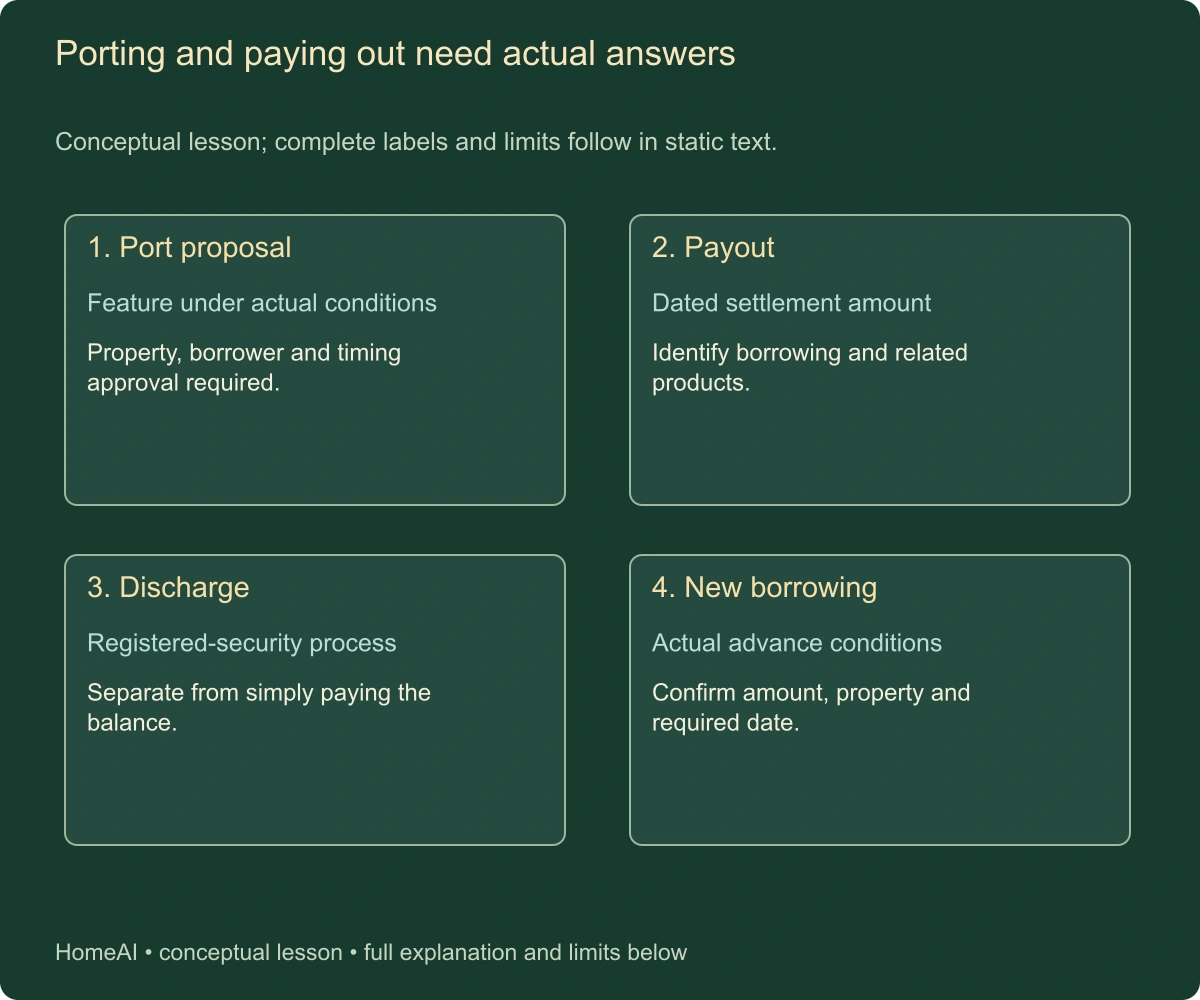
Porting and paying out need actual answers
These four enquiries can overlap but are not interchangeable completion records.
Numbers identify the parts explained below.
- Port proposal
Feature under actual conditions. Property, borrower and timing approval required.
- Payout
Dated settlement amount. Identify borrowing and related products.
- Discharge
Registered-security process. Separate from simply paying the balance.
What does this illustration leave out?
No actual lender approval or fee. This illustration explains an idea. It is not an installation guide.
Which actual records and qualified advice answer this distinction?
Explore this with HomeAI ↗Opens an editable question. Nothing is sent until you choose to send it.Porting and paying out need actual answers
Conceptual lesson; complete labels and limits follow in static text.
- Port proposal
- Feature under actual conditions. Property, borrower and timing approval required.
- Payout
- Dated settlement amount. Identify borrowing and related products.
- Discharge
- Registered-security process. Separate from simply paying the balance.
- New borrowing
- Actual advance conditions. Confirm amount, property and required date.
These four enquiries can overlap but are not interchangeable completion records.
What remains unknown: No actual lender approval or fee.
A useful question: Which actual records and qualified advice answer this distinction?
Can matching completion dates remove the gap?
Two agreements can name the same date while their funds and documents still move through separate completion processes. Ask the legal professional how sale proceeds are expected to reach the purchase and what dependencies remain. A shared calendar date does not, by itself, prove that the money will be available at the exact point it is needed.
Distinguish legal completion, possession and the physical move. The agreement and regional process determine their meaning and requirements. Ask when keys and access can actually be provided, what confirmation the mover should await and whether the household needs a short accommodation or storage plan. A truck booking cannot establish a right to enter the replacement home.
Ask about the effect of a change in either transaction before a problem arises. Who should be told, what documents would need review, and which financing or other quotations would need updating? Keep contact information for the relevant legal professionals, lenders and transaction representatives accessible. The professional response must follow the real agreement and facts; this guide supplies no automatic extension or remedy.
A same-day plan can still be the household's chosen arrangement when its advisers confirm the requirements and contingency. Compare it fairly against a short overlap or a sell-first sequence using real quotations and approval conditions. Do not assume that removing an overnight gap removes every risk, or that adding an overlap is always more expensive after all relevant consequences are considered.
How do conditions change what the household can rely on?
FCAC explains that a buyer may make an offer conditional on matters such as financing or inspection. The wording, deadlines and process in the actual agreement control what has to happen. Ask the legal and transaction professionals to explain each condition's job, the required evidence and the household's remaining decisions. A familiar condition name is not a substitute for reading its terms.
A financing condition and an inspection condition address different enquiries. Financing work concerns the proposed borrowing and its requirements. Technical assessment concerns the identified property scope and limitations. A lender's value opinion does not resolve a foundation concern, and a favourable inspection does not commit a lender to advance funds. Keep both processes visible when coordinating the timetable.
A condition related to selling the current home needs specific professional advice. Ask what the proposed wording would require, how it interacts with other terms and what the household can rely on while it remains open. This guide does not promise that a seller will accept such a condition or describe universal cancellation rights. Regional law and the actual contract require current local advice.
Record the difference between requested information, received information and a decision made with professional advice. Silence from a provider is not confirmation. An encouraging telephone conversation may still leave approval conditions outstanding. Before treating a funding or sale dependency as resolved, ask which actual document or completion confirmation establishes that result and retain the answer with its date.
How should you compare workable sequences?
Use the same household purpose and the same included cost boundary when comparing sell-first, buy-first and overlapping arrangements. Include the relevant sale and purchase amounts, financing charges, carrying periods, moving and accommodation quotations. Keep estimated property prices as assumptions. A sequence should not look cheaper merely because one column omits the temporary accommodation included in another.
Separate affordability from a bounded cost comparison. The household may prefer a sequence that costs more within the stated comparison but requires less peak cash, provides a suitable accessible home or reduces an unworkable accommodation problem. Make the reason explicit. Conversely, a lower estimated total is not useful if the household cannot supply the money required before sale proceeds arrive.
Identify dependencies that money alone does not resolve. A desired completion date may be unavailable; the lender may not accept the proposed property; the sale agreement may remain conditional; a necessary condition enquiry may need more time. These can make a sequence infeasible rather than merely more costly. Mark them as open questions instead of assigning a reassuring invented dollar amount.
Revise the comparison when an actual quotation or agreement replaces an assumption. Preserve the earlier version so the household can see why the preferred sequence changed. The decision becomes clearer when there is a plain explanation: this option has a confirmed funding route on these dates, these remaining enquiries, and this contingency. A simple table with honest gaps is more useful than a detailed forecast built on an assumed sale.
Compare feasible move sequences
Four alternatives have different dependencies. There is no arrow declaring one best.
Numbers identify the parts explained below.
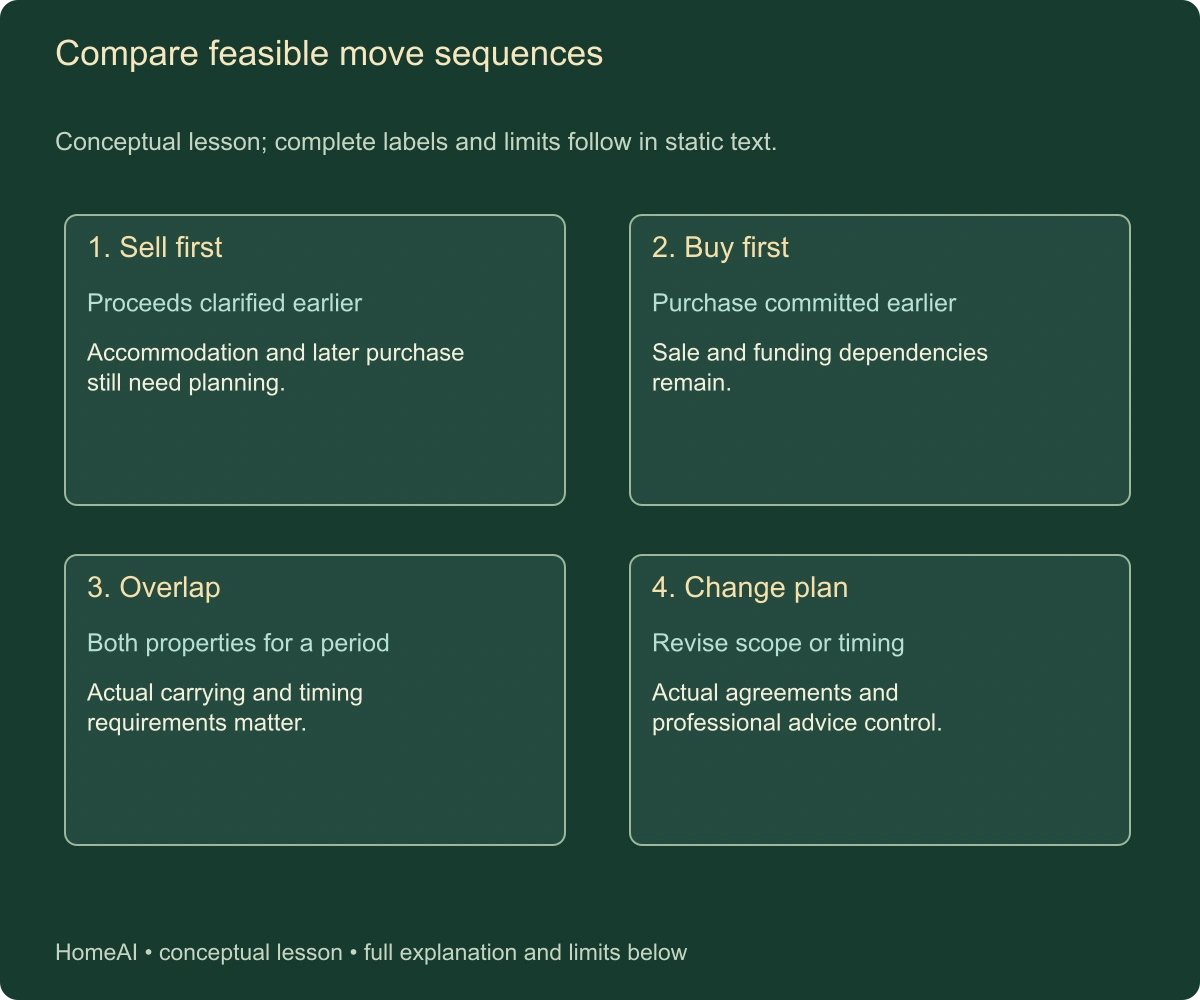
- Sell first
Proceeds clarified earlier. Accommodation and later purchase still need planning.
- Buy first
Purchase committed earlier. Sale and funding dependencies remain.
- Overlap
Both properties for a period. Actual carrying and timing requirements matter.
What does this illustration leave out?
No household recommendation or guaranteed outcome. This illustration explains an idea. It is not an installation guide.
Which actual records and qualified advice answer this distinction?
Explore this with HomeAI ↗Opens an editable question. Nothing is sent until you choose to send it.Compare feasible move sequences
Conceptual lesson; complete labels and limits follow in static text.
- Sell first
- Proceeds clarified earlier. Accommodation and later purchase still need planning.
- Buy first
- Purchase committed earlier. Sale and funding dependencies remain.
- Overlap
- Both properties for a period. Actual carrying and timing requirements matter.
- Change plan
- Revise scope or timing. Actual agreements and professional advice control.
Four alternatives have different dependencies. There is no arrow declaring one best.
What remains unknown: No household recommendation or guaranteed outcome.
A useful question: Which actual records and qualified advice answer this distinction?
What does a fictional two-home plan reveal?
Fictional Sam and Morgan plan a move. For this teaching example only, their assumed sale price is CAD720,000. An invented combined allowance of CAD370,000 covers the identified debt settlement and included selling amounts. The resulting assumed usable proceeds are CAD350,000. These are made-up Canadian-dollar values, not market prices, provider fees or a statement about any real household.
Their fictional purchase plan needs CAD390,000 of household funds in addition to the assumed long-term mortgage advance. Even after all assumed sale proceeds arrive, there is a CAD40,000 difference: CAD390,000 minus CAD350,000. Moving the sale date earlier does not eliminate that amount. Timing and sufficiency are separate questions, so the household must identify an additional confirmed source or revise the purchase plan.
Now suppose the purchase funds are required five days before the sale proceeds arrive. That introduces a timing gap in addition to the CAD40,000 difference. A hypothetical bridge proposal could address some approved temporary need, but this example invents no approval or terms. Sam and Morgan ask the lender and legal professional to reconcile the actual sources, required dates and repayment arrangements before relying on that proposal.
Finally, they test a purely hypothetical reduction of CAD20,000 in usable proceeds. The difference grows to CAD60,000 under otherwise unchanged assumptions. The example does not predict a lower sale. It shows why an approved timing arrangement and an adequate overall funding plan are both needed. Actual purchase obligations, sale documents, borrowing terms and provider quotations remain necessary before a real decision.
Fictional money and timing reconciliation
Fictional usable proceeds are CAD 350,000. The assumed household-funds need is CAD 390,000, leaving CAD 40,000. A five-day timing gap is a separate problem.
Numbers identify the parts explained below.
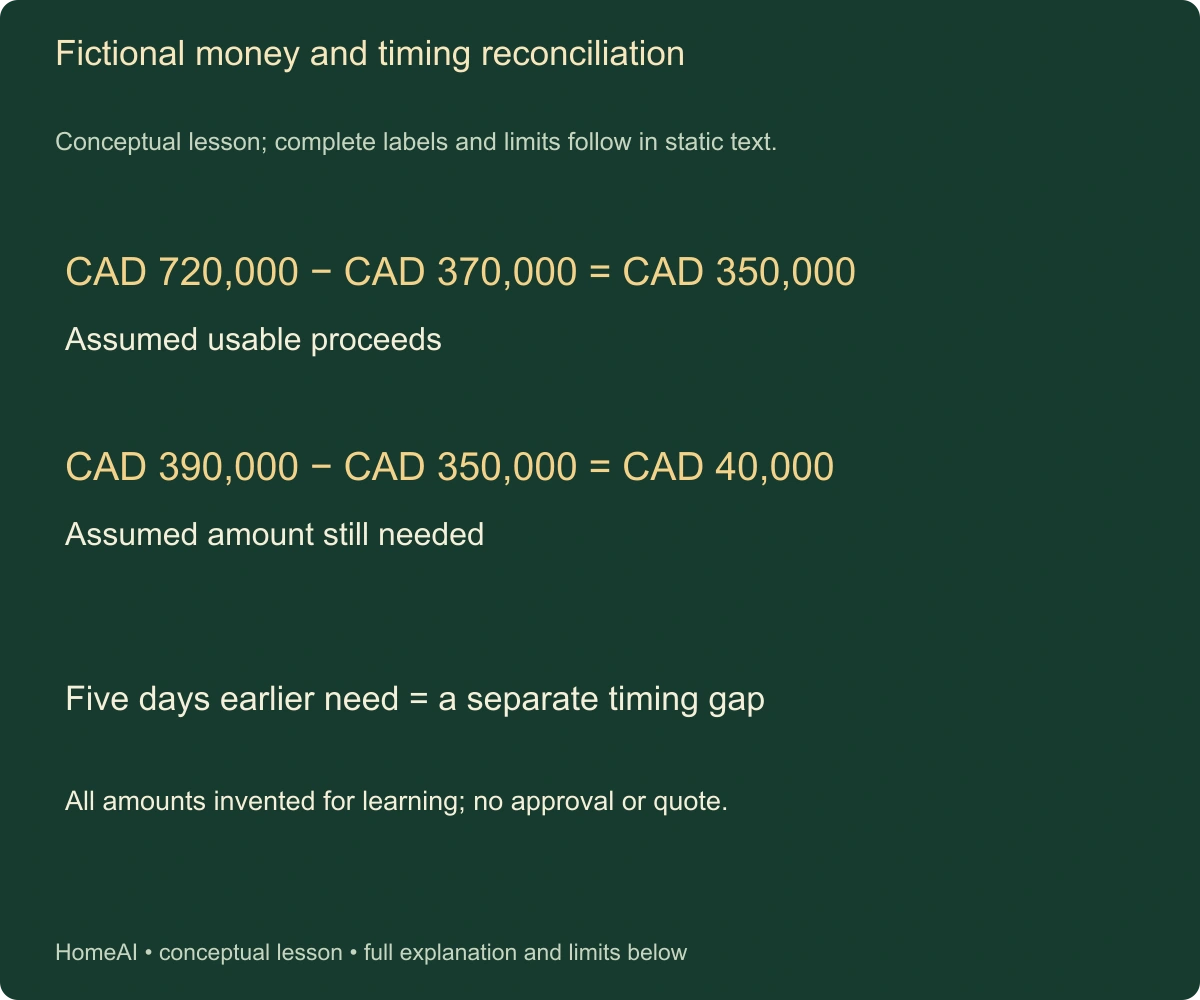
- Assumed sale
CAD 720,000. Invented teaching value.
- Included settlements
CAD 370,000. Invented combined allowance.
- Usable proceeds
CAD 350,000. 720,000 − 370,000.
What does this illustration leave out?
No actual market price, provider fee, loan approval or future outcome. This illustration explains an idea. It is not an installation guide.
Which actual records and qualified advice answer this distinction?
Explore this with HomeAI ↗Opens an editable question. Nothing is sent until you choose to send it.Fictional money and timing reconciliation
Conceptual lesson; complete labels and limits follow in static text.
- Assumed sale
- CAD 720,000. Invented teaching value.
- Included settlements
- CAD 370,000. Invented combined allowance.
- Usable proceeds
- CAD 350,000. 720,000 − 370,000.
- Purchase need
- CAD 390,000. 40,000 more than assumed proceeds.
Fictional usable proceeds are CAD 350,000. The assumed household-funds need is CAD 390,000, leaving CAD 40,000. A five-day timing gap is a separate problem.
What remains unknown: No actual market price, provider fee, loan approval or future outcome.
A useful question: Which actual records and qualified advice answer this distinction?
Which professionals answer which unresolved questions?
The transaction representative can help obtain market information, organize offers and coordinate the agreed process within their role. The lender or mortgage adviser addresses actual borrowing proposals and approval conditions. The legal professional addresses the agreements, property interests and completion requirements. A technical specialist answers the defined property-condition enquiry. Ask for the particular answer rather than expecting one professional's reassurance to cover every field.
In Quebec, a notary may have the relevant completion role; other provinces and territories have their own arrangements and practices. Federal consumer information does not supply a universal provincial contract form or registry procedure. Identify the professionals appropriate to the location and transaction, including any additional advice needed for unusual ownership, tax or estate circumstances. This guide provides no tax exemption or reporting conclusion.
The household supplies accurate facts and makes the final choice with its advisers. Report existing debts, actual agreements, changed dates and relevant property concerns promptly. If a provider's answer assumes the current home is already sold, correct that assumption before relying on the answer. A proposal can be internally clear and still be wrong for the household because its starting facts differ.
Ask each professional to state what remains outside their answer. A net-proceeds estimate may exclude a disputed amount; a financing indication may await property review; a technical report may exclude concealed conditions. These limits belong beside the result. They help the next professional use the information correctly and prevent a narrow confirmation from becoming an unsupported statement that the whole move is ready.
What should remain in the final moving record?
Retain the actual sale and purchase agreements and amendments, dated funding documents, relevant payout information and the professional completion statements. Keep the current version clearly identified. The record should explain which assumptions were replaced by final figures and which matters remain unresolved after the move. An old estimate should not be mistaken for the final amount simply because it was used to make the original plan.
Keep practical arrangements beside the transaction record: confirmed accommodation and mover details, authorized access information and the providers responsible for outstanding matters. Follow the legal professional's and providers' actual instructions for account changes and completion follow-up. Do not stop an existing payment or assume a discharge is complete merely because the household has physically moved.
Ask for the relevant confirmation that the identified borrowing and property-interest work was completed. FCAC explains that discharge involves the lender and the applicable provincial or territorial registry process. A debt payment and a released registered interest are different events. The responsible professional can explain the actual completion evidence and any further steps for the household's circumstances.
The useful final account is concrete: these transactions completed on these dates, these actual funds moved, these borrowing arrangements continue, and these people handle the remaining questions. Keep that account rather than a broad claim that buying and selling together was simple. It becomes a reliable starting point for later mortgage, insurance, property-work and ownership decisions without inventing certainty about matters never assessed.
A dated comparison also prevents double counting. If a funding amount already includes a particular settlement or moving item, keep that inclusion clear before adding a separate allowance. Ask the responsible professional to reconcile the actual statements rather than silently adjusting totals. A correct subtraction can still be misleading if its inputs describe different dates or overlap.
Keep learning about the connected parts
- Renew, switch, refinance or break: compare the actual mortgage change
- Cash required for closing: deposit, advance, adjustments and deadlines
- Before you make an offer: what to check, who to ask
Canadian context and authorities · Visual atlas · Learning labs
Practice the distinction.
What does a fictional two-home plan reveal?
Fictional Sam and Morgan plan a move. For this teaching example only, their assumed sale price is CAD720,000. An invented combined allowance of CAD370,000 covers the identified debt settlement and included selling amounts. The resulting assumed usable proceeds are CAD350,000. These are made-up Canadian-dollar values, not market prices, provider fees or a statement about any real household.
Reported observations
- Their fictional purchase plan needs CAD390,000 of household funds in addition to the assumed long-term mortgage advance. Even after all assumed sale proceeds arrive, there is a CAD40,000 difference: CAD390,000 minus CAD350,000. Moving the sale date earlier does not eliminate that amount. Timing and sufficiency are separate questions, so the household must identify an additional confirmed source or revise the purchase plan.
- Now suppose the purchase funds are required five days before the sale proceeds arrive. That introduces a timing gap in addition to the CAD40,000 difference. A hypothetical bridge proposal could address some approved temporary need, but this example invents no approval or terms. Sam and Morgan ask the lender and legal professional to reconcile the actual sources, required dates and repayment arrangements before relying on that proposal.
A useful next question
Finally, they test a purely hypothetical reduction of CAD20,000 in usable proceeds. The difference grows to CAD60,000 under otherwise unchanged assumptions. The example does not predict a lower sale. It shows why an approved timing arrangement and an adequate overall funding plan are both needed. Actual purchase obligations, sale documents, borrowing terms and provider quotations remain necessary before a real decision.
Know what the words mean.
- Sale proceeds
- Money remaining after the actual settlements and included selling amounts.
- Funding gap
- A difference between required funds and confirmed available sources.
- Timing gap
- Funds are available later than the date they are required.
- Bridge proposal
- Temporary finance under the actual provider’s approval and terms.
- Portability
- A mortgage feature whose actual transfer conditions must be confirmed.
- Payout statement
- Dated amounts required to settle identified borrowing.
- Discharge
- The applicable process to release registered mortgage security.
Questions to bring
to the conversation.
- What dated payout and selling amounts support the net proceeds available for the next purchase?
- Which purchase deposit or completion amount is required before those proceeds become usable?
- Is the gap temporary timing, insufficient total funds, or both?
- What actual firm-sale, bridge, portability and new-property approval conditions remain?
- What happens to cash, accommodation and essential property enquiries if either transaction changes?
Separate a showing observation, an existing record and a new professional assessment. Unknown means a question remains; it does not automatically mean a defect.
Use the evidence planner ↗Go to the source.
Original HomeAI explanation informed by these public references. Sources support the underlying guidance; they have not reviewed or endorsed HomeAI. Diagrams are conceptual, and calculator outputs depend on your inputs.
Primary Canadian bodies read with the recorded editions and jurisdiction limits. Generic illustrations and fictional cases establish no actual result. Actual documents, provider terms and qualified advice control.
Publication & source review
First published .
Sources reviewed .
Have a question about your home?
Start with the symptom, timing and what you have observed.
Ask HomeAI