Jump to a question in this guide
- What are the five jobs in a rainwater collection system?
- What changes when rain runs across a roof?
- How does the water reach storage without losing the drainage job?
- What does storage do, and what can its size tell me?
- Where does the rain go when the barrel is full?
- Which uses belong in the proposal?
- Why must the drinking-water supply stay separate?
- How are a barrel tap and a pumped cistern different?
- How much water could the roof provide?
- What changes in freezing weather?
- What maintenance belongs to the actual components?
- What records should a supplier or installer leave?
- Why can identical rainfall totals leave different useful reserves?
- What do low storage, unexpected running and overflow each ask?
- Which Canadian claims need a current local answer?
- How would a fictional household compare a barrel with a cistern?
- Collection, storage, delivery and overflow are different jobs.
- Roof-collected water remains nonpotable; clear appearance and a screen do not authorize drinking.
- A full store still needs an appropriate receiving route.
- Integrated backup supply requires qualified domestic-water separation and current local requirements.
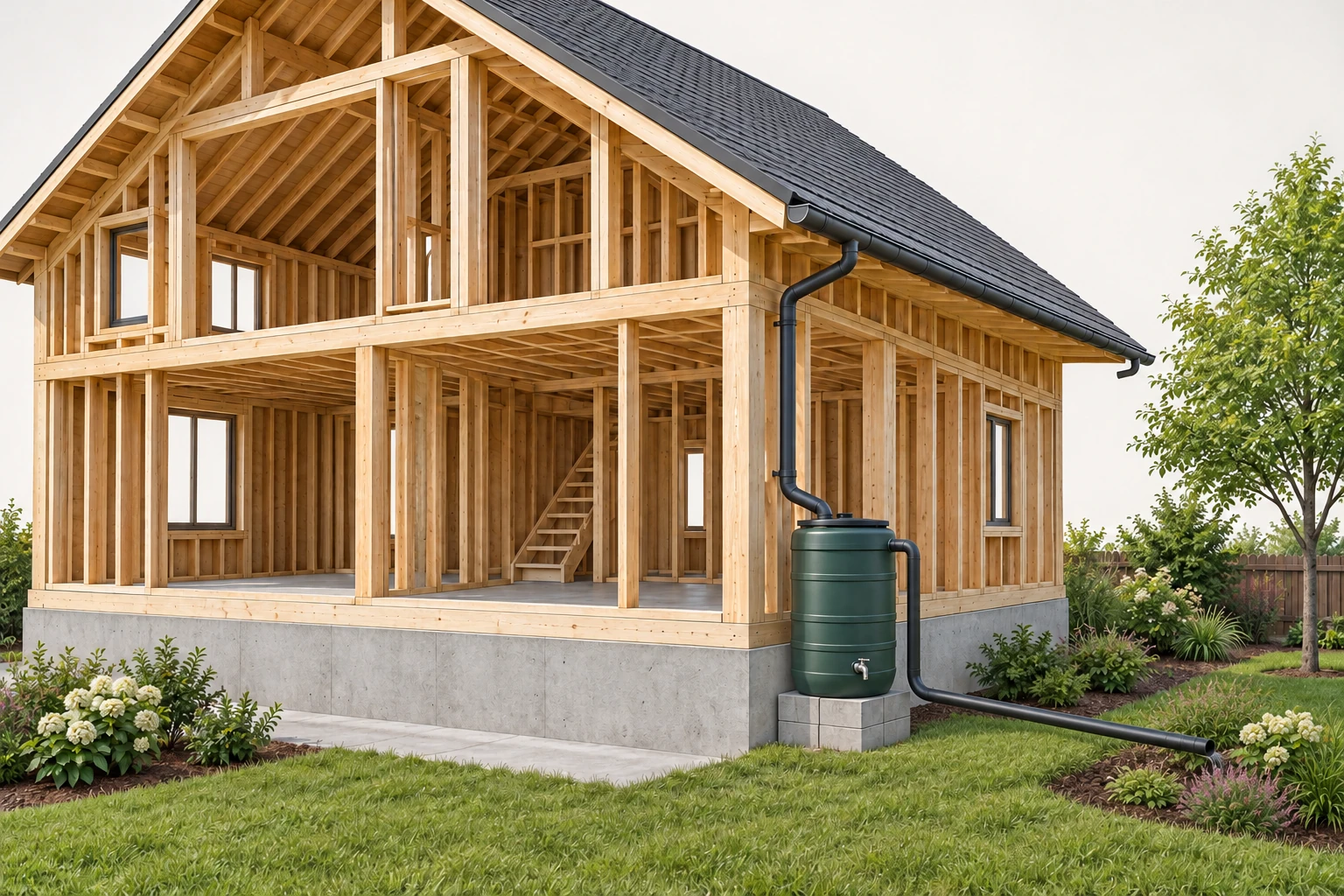
The roof/downspout feeds covered storage. A low tap serves intended use; the separate upper overflow continues outside toward a planted receiving area away from the foundation.
About this illustration
Conceptual support and receiving area; no measured clearance, route capacity, local approval or water quality. This is a conceptual teaching model, not an assessment of your home.
9 picture lessons appear beside the questions in this guide. Use them to understand the explanation, then consider what it means for your home.
What are the five jobs in a rainwater collection system?
The roof collects rainfall. Gutters and downspouts move it toward storage. A barrel or cistern holds water until an intended use needs it. An outlet or a designed pump system delivers it. Overflow carries incoming water onward when storage is full. Following those five jobs makes the system easier to understand than starting with a container size or a promised saving.
A garden barrel and an indoor nonpotable supply can share those broad jobs while having very different complexity. The barrel may serve a watering can beside the garden. The indoor system may include pumps, controls, dedicated distribution and protected backup supply. Neither should be drawn as a generic blue tank with an unexplained line connecting it to the kitchen.
Collected roof water is not drinking water. The Calgary barrel page explicitly identifies it as nonpotable, meaning unsuitable for drinking, and excludes handwashing and dishwashing. A screen, a clean-looking barrel or a clear glassful does not reverse that boundary. If a household wants another use, the starting question is the current local requirements and qualified system design for that use.
The whole-house picture connects collection, storage, intended garden use and overflow without a potable-water connection. Its exterior receiving area is conceptual. It does not establish your site’s approved drainage route, storage support or installed capacity. The exact native route figure keeps the ordinary-use outlet separate from overflow so neither disappears behind the attractive barrel.
This guide owns collection, storage, use and separation. The foundation-drainage guide explains runoff around the home; irrigation has its own delivery and planting questions. The goal here is to understand what happens when it rains, when storage fills, when stored water is used and when rainfall stops. A useful proposal explains all four conditions.
Collection, use and overflow have visible different routes
The roof/downspout feeds covered storage. A low tap serves intended use; the separate upper overflow continues outside toward a planted receiving area away from the foundation.
Numbers identify the parts explained below.
- Roof and downspout
Carry the contributing runoff toward storage.
- Covered store and low tap
Hold water between rainfall and the intended nonpotable use.
- Upper overflow
Pass excess incoming water onward through a separate route.
What does this illustration leave out?
Conceptual support and receiving area; no measured clearance, route capacity, local approval or water quality. This illustration explains an idea. It is not an installation guide.
Where does this home’s actual route end when storage is full?
Explore this with HomeAI ↗Opens an editable question. Nothing is sent until you choose to send it.Follow collection, storage, use and overflow
The roof and downspout supply storage. The use outlet serves the intended nonpotable activity; overflow gives full-storage incoming water another receiving route.
Numbers identify the parts explained below.
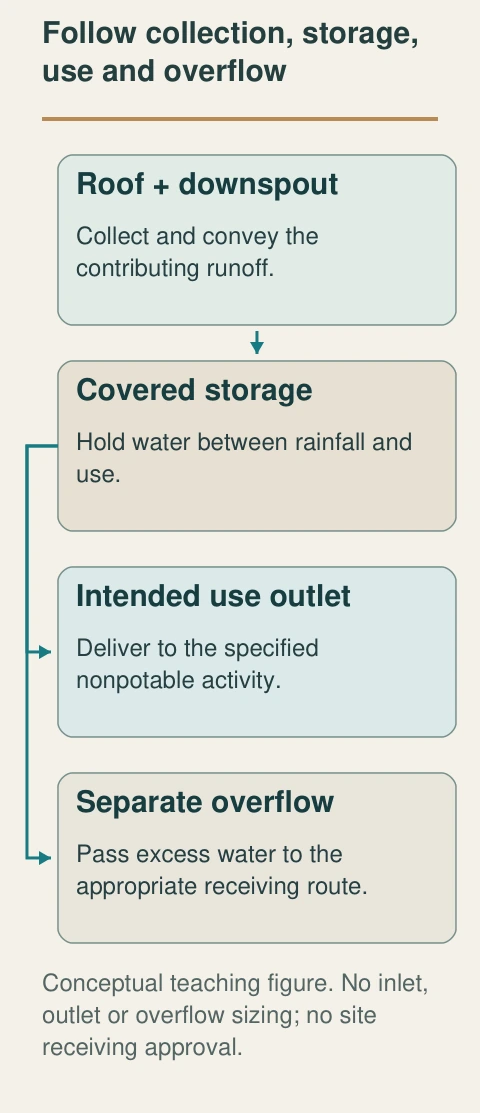
- Roof + downspout
Collect and convey the contributing runoff.
- Covered storage
Hold water between rainfall and use.
- Intended use outlet
Deliver to the specified nonpotable activity.
- Separate overflow
Pass excess water to the appropriate receiving route.
What does this illustration leave out?
No inlet, outlet or overflow sizing; no site receiving approval. This illustration explains an idea. It is not an installation guide.
Where does the actual route end during ordinary use and when storage is full?
Explore this with HomeAI ↗Opens an editable question. Nothing is sent until you choose to send it.Follow rainwater from the roof to its separate destinations
Choose any stage or play the lesson. A complete pass from stage 1 lasts 64 seconds, with eight seconds per reading stage during playback. Paused and manually selected stages remain available as long as you need. These highlights are not physical cycle times, control settings, measured performance or a test result.
A seasonal Calgary rain-barrel example. The historical Calgary system guide explains separate component jobs; it does not establish current plumbing approval. No drinking-water connection is drawn.
- Roof and gutter: Collect and convey runoff, including whatever contaminants the catchment contributes.
- Covered store: Holds collected nonpotable water; this cutaway does not invite opening or entering it.
- Garden outlet: Illustrates ornamental watering only.
- Overflow branch: Carries excess water toward an actual permitted receiving route that this schematic does not establish.
- Drinking-water boundary: No pipe connects the rain store to drinking water.
Paused at stage 1 of 8.
Keyboard: use Tab to reach a control and Enter or Space to activate it. On a stage button, Left/Right selects the previous/next stage; Home/End selects the first/last stage.
Rain reaches the roof
Rain falls on the catchment before entering a store. Roof-collected water can carry contamination; its clear appearance does not make it drinking water. This example follows outdoor ornamental watering.
Useful question: Which catchment and intended use are actually documented?
All eight reading stages
Rain reaches the roof
Rain falls on the catchment before entering a store. Roof-collected water can carry contamination; its clear appearance does not make it drinking water. This example follows outdoor ornamental watering.
Useful question: Which catchment and intended use are actually documented?
The gutter and downspout convey runoff
The gutter gathers roof runoff and the downspout carries it toward the barrel. They convey water rather than certify its quality. The drawing supplies no pipe size, slope or installation detail.
Useful question: Where does the visible downspout actually lead?
The covered barrel stores collected water
The store holds water between rainfall and use. A secure cover and stable support have different jobs from water treatment. The drawing opens the barrel visually so its contents can be understood; leave actual access and maintenance to the applicable instructions.
Useful question: What identifies the store, cover and manufacturer instructions?
A separate outlet serves ornamental watering
Stored water can leave through the garden outlet for the intended outdoor use. This example does not feed a tap used for drinking, handwashing or dishes. A larger designed system may have different distribution equipment.
Useful question: Which uses and distribution components belong to this installation?
A full store needs an overflow route
When incoming water exceeds available storage, excess water has another route. The overflow branch is distinct from the garden outlet. Its final receiving point remains outside this drawing; the site and current local requirements must establish a suitable permitted route.
Useful question: Where is overflow actually received, and who established that route?
Drinking water remains a separate system
The diagram deliberately has no drinking-water top-up pipe. Historical indoor rainwater examples include protected top-up arrangements, but those are not instructions to join a hose or pipe to this barrel. Nonpotable storage does not become potable through a filter symbol.
Useful question: Does an actual system include a connection requiring professional cross-connection review?
A seasonal barrel differs from an indoor cistern
Calgary describes manufacturer-directed cold-season care for outdoor barrels. A designed indoor nonpotable system has different storage, distribution and protection questions. The two examples cannot share an assumed winter operating plan.
Useful question: Which seasonal plan and system-specific maintenance records apply?
Record the routes and the unresolved limits
Keep the catchment, store, intended use and overflow destination as separate entries in the system record. A photo of a barrel does not establish storage capacity, permitted discharge, water quality or drinking-water protection. Do not fill or overflow it to replay this lesson.
Useful question: Which missing route or protection question needs the appropriate provider?
Use the source notes in this guide to check the named examples, adopted scope and limits.
Read the complete figure
Follow collection, storage, use and overflow
The roof and downspout supply storage. The use outlet serves the intended nonpotable activity; overflow gives full-storage incoming water another receiving route.
- Roof + downspout
- Collect and convey the contributing runoff.
- Covered storage
- Hold water between rainfall and use.
- Intended use outlet
- Deliver to the specified nonpotable activity.
- Separate overflow
- Pass excess water to the appropriate receiving route.
What remains unknown: No inlet, outlet or overflow sizing; no site receiving approval.
A useful question: Where does the actual route end during ordinary use and when storage is full?
What changes when rain runs across a roof?
A roof is a collection surface exposed to its surroundings. Roof materials, accumulated debris and bird or animal activity can affect runoff. Calgary warns that collected quality is variable and can change between fills. It is therefore misleading to begin with rain as pure water and treat the container as the only possible source of concern.
Identify the actual collection area from existing records and safe ground-level observations. Which roof sections feed the selected downspout? Are there different materials, recent roof work or visible overhanging vegetation? Do not climb onto the roof or open concealed routes to answer these questions. A qualified roof or drainage provider can resolve details that ordinary observation cannot.
An exterior view may show several downspouts without establishing how much area each serves. Roof slopes and gutter connections matter to the collection account. Keep assumed and confirmed areas separate if a supplier estimates available water. A house’s floor area should not silently become its contributing roof area, and an entire roof should not be credited to one barrel without a supported route.
Ask what the proposal does with debris and the initial runoff. A leaf screen separates larger material; a first-flush device diverts an initial portion under its own design. Those are different jobs from treatment for a specified water use. The historical Calgary guide illustrates these component roles, but its numerical design and approval language are not current instructions for a new installation.
The roof-edge image shows exposed collection parts and visible screening surfaces. It does not reveal a filter rating or prove the water’s composition. The useful next question is which actual device is proposed, what it removes or diverts, how rejected material and water are managed and who maintains it. Marketing language such as clean rain should not stand in for those answers.
The collection surface and mesh inlet do different jobs
The gutter gathers roof runoff and the downspout reaches a mesh-covered inlet in the seated barrel lid. Mesh separates larger debris; it does not make the stored water potable.
Numbers identify the parts explained below.
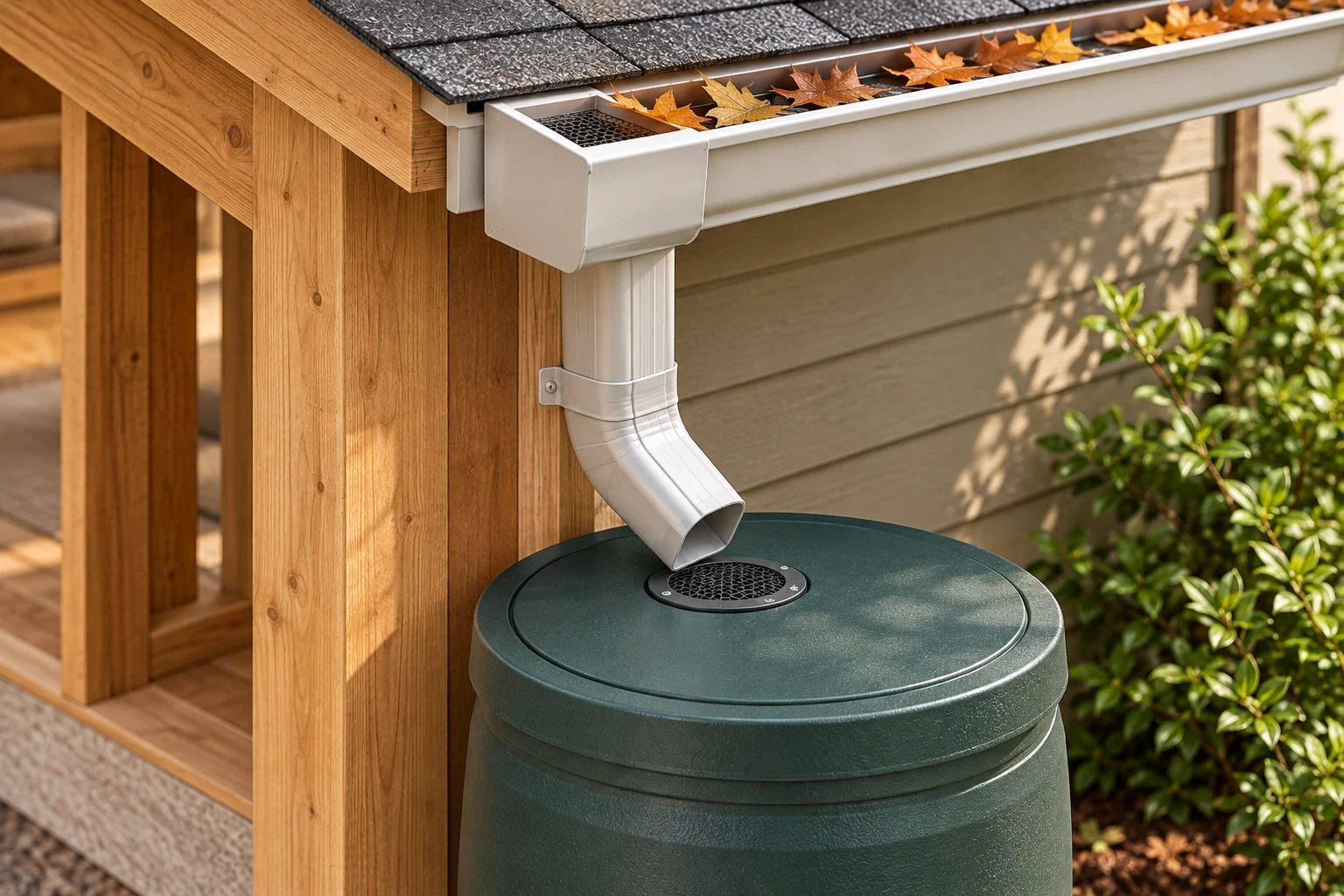
- Roof and gutter
Exposed surfaces contribute runoff and possible debris.
- Downspout
Conveys collected water toward the inlet.
- Covered mesh inlet
Allows collection while illustrating a distinct debris-screening job.
What does this illustration leave out?
No filter rating, disinfection, water-quality result or product installation approval. This illustration explains an idea. It is not an installation guide.
What does the actual device remove or divert, and who maintains it?
Explore this with HomeAI ↗Opens an editable question. Nothing is sent until you choose to send it.How does the water reach storage without losing the drainage job?
Gutters and downspouts already form part of the home’s rain-management route. Adding storage changes what happens along that route. The collection proposal should explain both the water directed into the barrel and the water that must continue onward when the barrel cannot receive it. Capturing some rainfall is not a reason to leave the original drainage destination unresolved.
A diverter is a component that changes or divides the route under its particular design. Some arrangements send water toward storage while preserving a continuation route. Others use a different inlet and overflow arrangement. Identify the actual product and connections rather than assuming every downspout attachment returns excess water automatically. A photograph of a closed fitting cannot establish its internal behaviour.
Describe any observed leakage or backup from accessible ground during ordinary conditions, without deliberately blocking a route or pouring water into it. Note the location, weather and whether storage was known to be full. These facts help a provider distinguish a collection connection, an obstructed route and another drainage issue. The observation alone does not select the defective component.
For an integrated cistern, conveyance may include buried routes or building penetrations. Those add location, freeze protection, access and enclosure questions for the qualified design. This guide supplies no pipe diameter, slope, trench detail or burial depth. Historical drawings are useful for identifying the jobs, while current local requirements and the actual site determine construction.
Ask for a route drawing that ends somewhere. A line disappearing at the wall or ground edge is an incomplete explanation when its destination matters to the decision. The professional can identify hidden portions from appropriate records and assessment. Keep the exact distinction between visible route, documented route and unconfirmed connection in the household file.
What does storage do, and what can its size tell me?
Storage separates the time of rainfall from the time of use. Water can arrive during a storm and be used later, up to the usable amount available. The container does not create water during a dry period or make every litre of its nominal volume available at its outlet. Its inlet, outlet and operating arrangement need to be understood alongside the advertised capacity.
Distinguish nominal container volume, water currently stored and useful reserve for the intended use. A large barrel can be nearly empty after garden watering. A small barrel can fill quickly during a suitable rain event. Neither observation alone establishes a seasonal saving. The benefit depends on the actual collection route, rainfall sequence, demand and overflow.
The storage image shows a covered barrel, ordinary outlet and separate overflow. These are functional relationships rather than a scale drawing. Ask the supplier which model, support, cover, access and seasonal instructions apply. A generic stand in a picture cannot establish that an existing deck, balcony or improvised platform can support the proposed arrangement.
Calgary advises stable broad support, a secure cover and keeping barrels away from children. Treat the lid and location as continuing responsibilities. A cover lying beside the barrel or a latch visible in a photograph is not proof of the actual product’s protection. Keep the manufacturer’s instructions and arrange help when the proposed support or access requires more than ordinary ground-level handling.
An indoor, buried or building-integrated cistern needs a much wider design scope than a seasonal garden barrel. Storage structure, site access, utilities, servicing and failure consequences belong in that proposal. Do not select it solely by cost per litre. No tank-entry, excavation, foundation or structural-support procedure is supplied here; those are qualified tasks.
Storage waits between rain and use
The covered barrel, lower outlet and upper route illustrate storage as a separate job from collection and delivery. A broad base and seated cover remain continuing product/site questions.
Numbers identify the parts explained below.
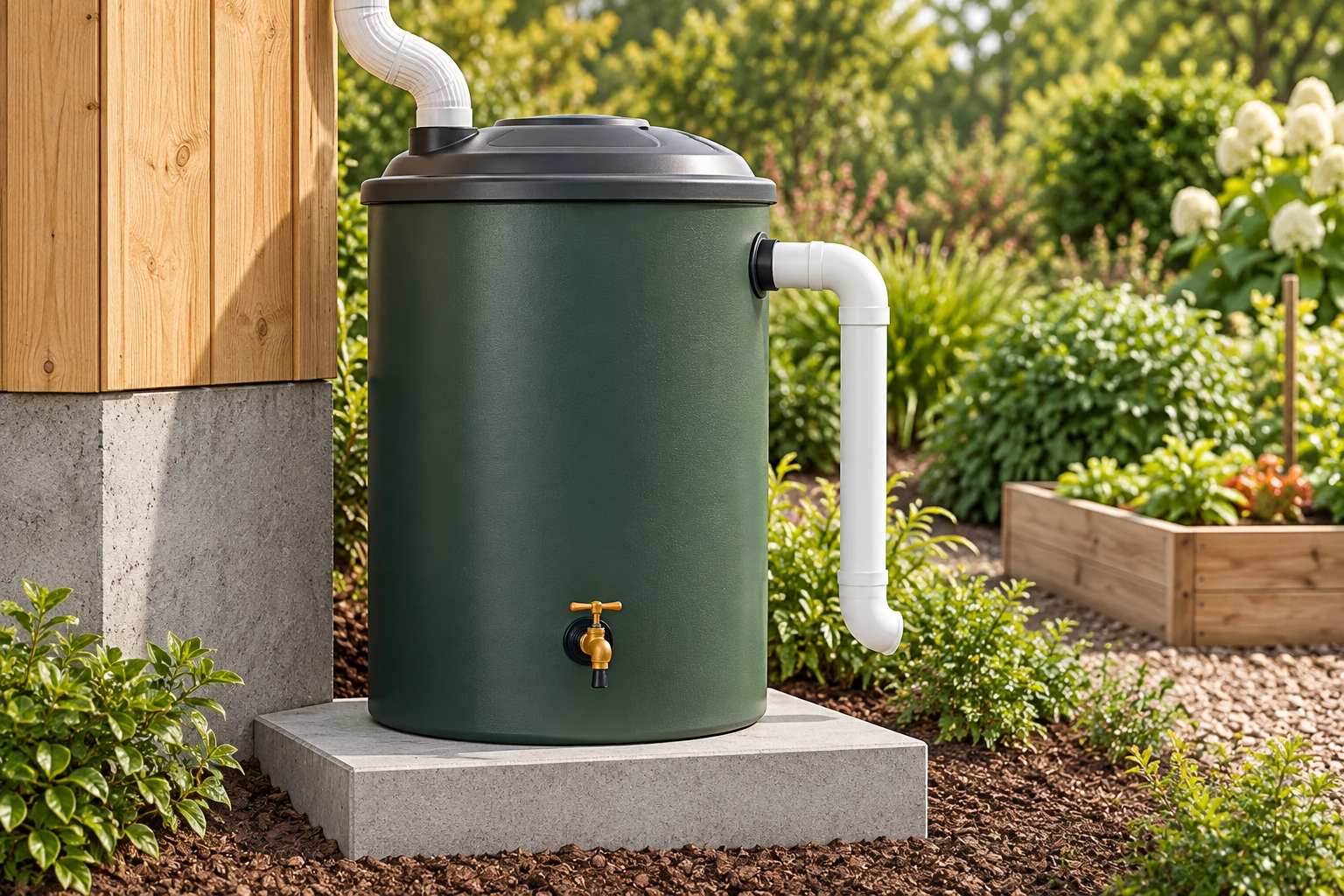
- Covered barrel
Holds water until the intended use needs it.
- Lower outlet
Serves an identified ordinary-use route.
- Support and cover
Follow actual product instructions and suitable site advice.
What does this illustration leave out?
Upper outlet is only a partial route; its complete receiving destination is not shown. No usable reserve, support design, child-resistant performance or safe installation established. This illustration explains an idea. It is not an installation guide.
Which exact model, usable reserve and continuing care apply?
Explore this with HomeAI ↗Opens an editable question. Nothing is sent until you choose to send it.Three meanings of capacity
- Nominal volumeThe container’s stated size.
- Stored water nowWhat the current operating condition contains.
- Useful reserveWhat the actual outlet and intended use can draw before the system’s limit.
No tank size or supply guarantee is calculated.
Further reading: City of Calgary · Rainwater Harvesting Guidelines.
Where does the rain go when the barrel is full?
A full container has no remaining space for new water unless water is leaving at the same time. Continued rainfall therefore needs a route that does not depend on a household being present to empty it. Overflow is an ordinary operating condition, not an exceptional finishing detail. Ask the designer to explain it before deciding where the barrel looks best.
The overflow route begins at the actual collection/storage arrangement and ends at a receiving place. Both ends matter. A hose attached to the barrel is incomplete evidence if its far end points toward the foundation, is obstructed or has an unconfirmed buried connection. The whole route should fit the site and current local drainage requirements.
The current Calgary barrel page gives a local offset example for discharge away from the house. This article does not turn it into a nationwide setback or a site design. Soil, slope, neighbouring property, winter conditions and the receiving route can change the appropriate arrangement. Request local advice instead of measuring one distance and calling the entire overflow approved.
The native full-storage figure explains the volume relationship: incoming water must be stored, used or passed onward. It deliberately contains no calculated storm rate or pipe capacity. A suitably qualified provider can address rainfall and route capacity for the actual system. A very large tank does not eliminate the need to plan what happens after it fills.
Observe the receiving area only from safe accessible ground. Report repeated pooling, erosion or unexpected discharge without entering moving water or deliberately provoking overflow. The existing foundation-drainage guide helps describe surrounding runoff. Keep the storage question connected to it: conserving water should not leave a new unexplained wet area beside the home.
A full store needs a complete receiving route
The upper overflow pipe descends outside the barrel and continues visibly toward a distant planted area. The lower tap remains separate from that full-storage route.
Numbers identify the parts explained below.
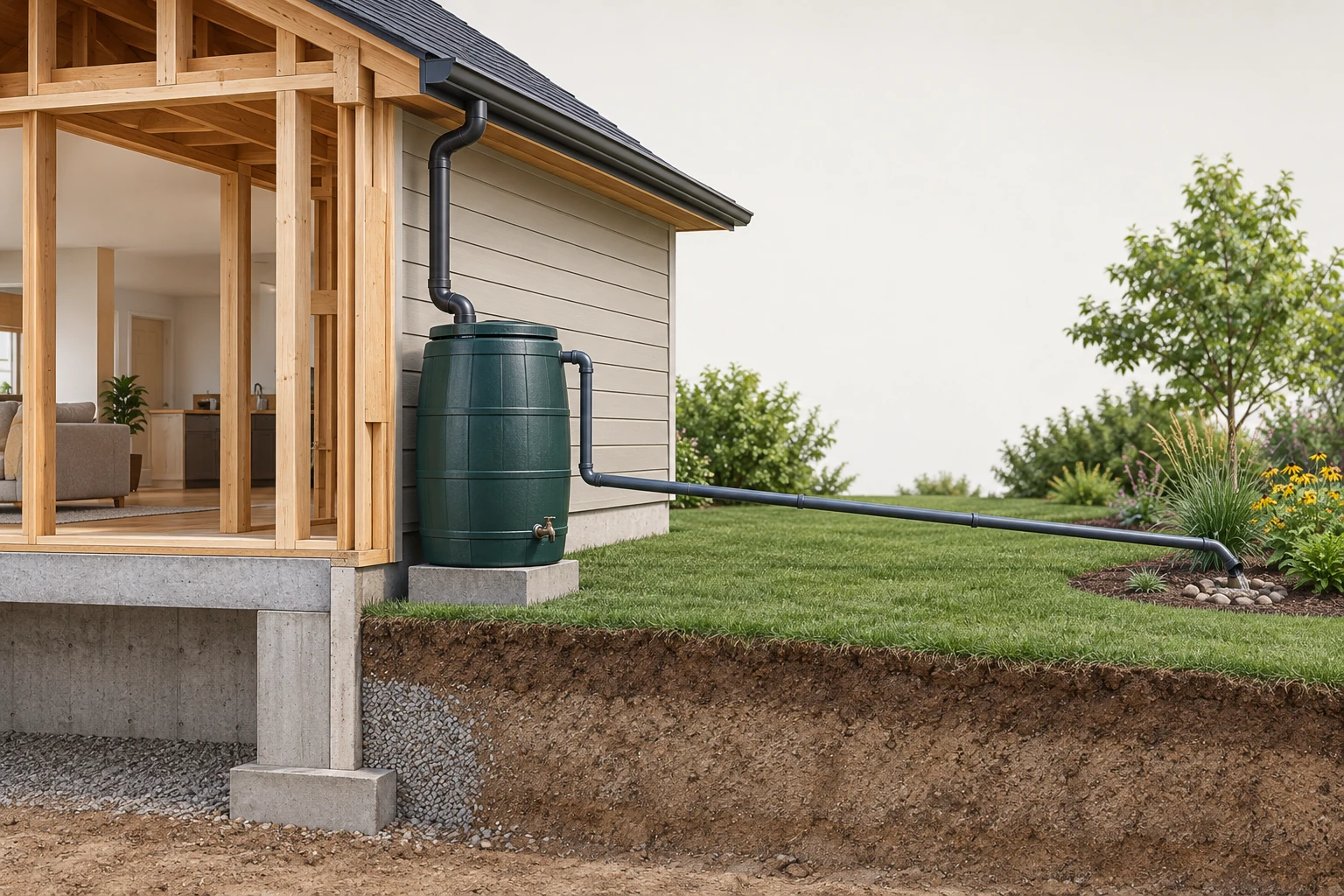
- Upper connection
Represents incoming water that cannot remain in full storage.
- Continuous outside route
Makes the destination part of the explanation.
- Receiving area
The actual site needs its own appropriate drainage assessment.
What does this illustration leave out?
No storm rate, pipe sizing, slope specification, foundation offset or site receiving approval. This illustration explains an idea. It is not an installation guide.
What happens along the entire actual route during continued rainfall?
Explore this with HomeAI ↗Opens an editable question. Nothing is sent until you choose to send it.Which uses belong in the proposal?
Start with a specific use: filling a watering can for ornamental plants, supplying a designed irrigation route or serving an approved indoor nonpotable application. Each asks different questions about quality, exposure, distribution and maintenance. Nonpotable is a restriction on use, not a single universal design that automatically authorizes every activity except drinking.
A garden plan should state who can reach the outlet and how stored water is distinguished from domestic supply. Explain the household boundary to visitors and children as appropriate. Do not use the barrel for drinking, handwashing or dishes. An attractive tap or a familiar hose connector can make an unintended use look ordinary, which is why clear identity matters.
Food crops introduce additional exposure questions. Calgary’s page discusses precautions rather than promising that rooftop collection is safe for every edible crop or person. This guide does not recommend a food-crop use or a disinfection recipe. Obtain current local public-health advice for that decision, and keep the intended exposure and actual source conditions explicit.
Indoor nonpotable use needs qualified design and current authority confirmation for the actual location. The historical Calgary handbook describes older permitted-use arrangements that are not adopted here. Do not connect a barrel to a toilet, laundry appliance or indoor tap on the strength of a historical illustration or this guide. A future idea remains a proposal until the proper scope and requirements are resolved.
The use figure keeps a watering can outside and domestic plumbing separately inside. That separation teaches the everyday boundary without pretending to draw a completed plumbing system. The useful question is whether the actual installation, labels and household instructions make the intended use just as clear. Water quality and installation acceptance remain separate deliverables.
Garden use stays separate from domestic plumbing
A watering can beside the covered barrel and ornamental bed explains a limited nonpotable use. The kitchen remains physically separate in this conceptual view.
Numbers identify the parts explained below.
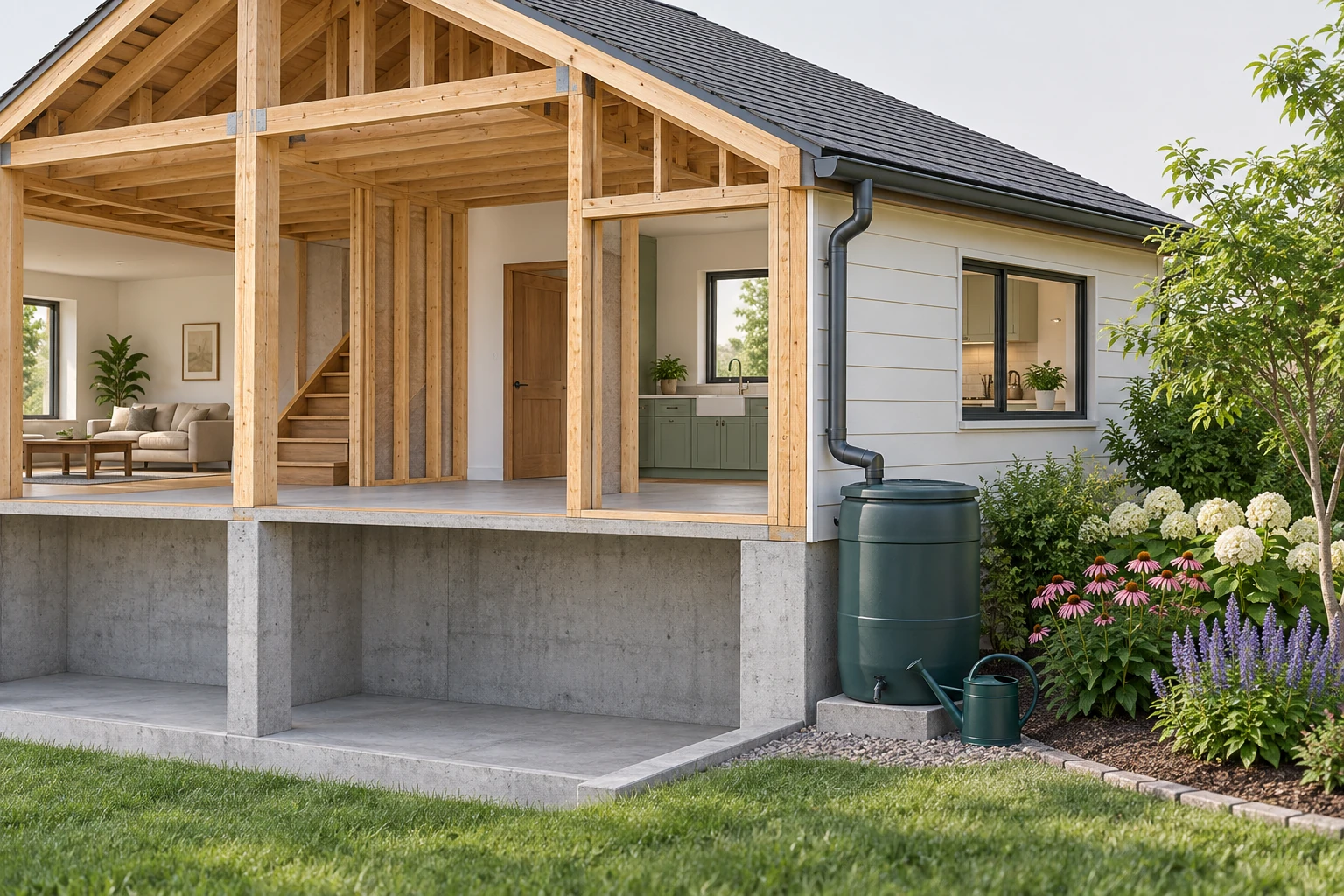
- Barrel and watering can
Connect storage to the intended garden activity.
- Ornamental plants
Illustrate a stated use rather than every possible exposure.
- Domestic kitchen
No rainwater connection is drawn or implied.
What does this illustration leave out?
No complete overflow system shown, no drinking/food-crop authorization, cross-connection test or water quality. This illustration explains an idea. It is not an installation guide.
Does the actual installation make its intended use and domestic-water boundary clear?
Explore this with HomeAI ↗Opens an editable question. Nothing is sent until you choose to send it.Why must the drinking-water supply stay separate?
The domestic drinking-water supply and a rainwater system have different water-quality purposes. A cross-connection is a connection that can allow water to move between routes intended to remain separate. The problem is not solved by assuming the mains always has greater pressure. The actual qualified design must address unintended flow under relevant conditions.
The exact native separation diagram shows two labelled networks with no joining arrow. It is a conceptual boundary, not a plumbing specification. Dedicated lines, labels and protection need to be assessed as an installed system under current local requirements. Colour by itself cannot establish where a hidden pipe goes or whether an actual cross-connection is absent.
A stored-water system that needs backup domestic water adds a protected top-up question. Top-up means replenishing or supplying the nonpotable system when stored rainwater is insufficient. The historical handbook discusses physical separation and backflow protection as distinct roles. This guide adopts no device selection, air-gap dimension, test interval or connection detail from that old code context.
Ask the qualified plumbing designer to explain how the proposed arrangement protects domestic supply, how it is identified and what inspection or testing evidence is required locally. Request the actual records after work. A drawing marked proposed and a supplier’s component brochure do not establish the condition of installed concealed connections.
Do not use a garden hose submerged in a tank, an improvised valve combination or a temporary indoor connection to add top-up. Do not open pipework or conduct a cross-connection experiment. If an existing arrangement is unclear, keep it out of improvised use and ask the appropriate provider to identify it. Missing route information should become a qualified task.
Keep two water networks distinct
Domestic supply and collected-water distribution have different purposes. Any backup top-up needs a qualified protected design; the diagram deliberately draws no connecting plumbing detail.
Numbers identify the parts explained below.
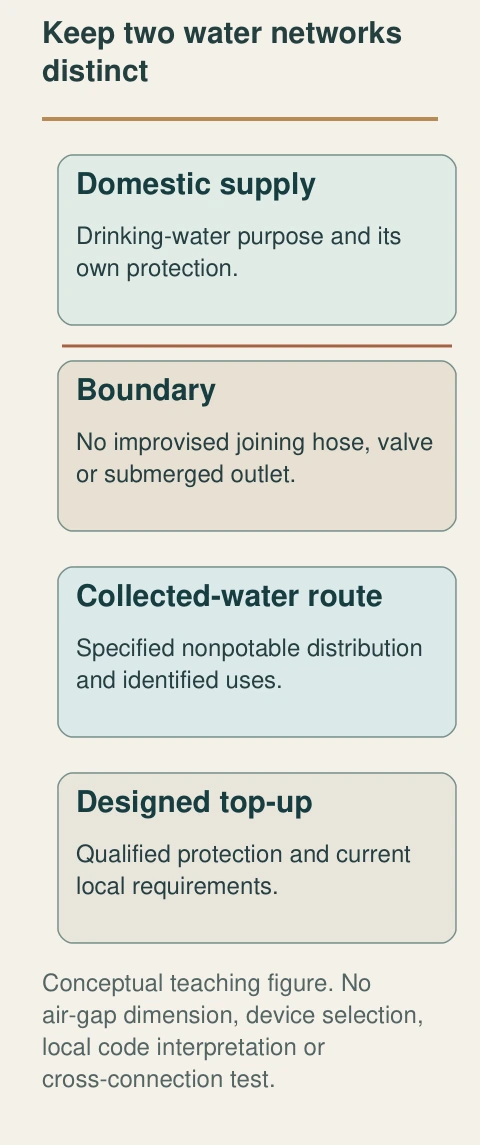
- Domestic supply
Drinking-water purpose and its own protection.
- Boundary
No improvised joining hose, valve or submerged outlet.
- Collected-water route
Specified nonpotable distribution and identified uses.
- Designed top-up
Qualified protection and current local requirements.
What does this illustration leave out?
No air-gap dimension, device selection, local code interpretation or cross-connection test. This illustration explains an idea. It is not an installation guide.
What actual design and acceptance records establish protection of the drinking-water supply?
Explore this with HomeAI ↗Opens an editable question. Nothing is sent until you choose to send it.Keep two water networks distinct
- Domestic supplyIts own drinking-water purpose and protection.
- Collected-water routeIts own intended nonpotable use and dedicated distribution.
- Protected top-upA qualified designed interface; no improvised connecting hose or valve.
Conceptual boundary, not a connection specification or current code approval.
Further reading: City of Calgary · Rainwater Harvesting Guidelines.
Read the complete figure
Keep two water networks distinct
Domestic supply and collected-water distribution have different purposes. Any backup top-up needs a qualified protected design; the diagram deliberately draws no connecting plumbing detail.
- Domestic supply
- Drinking-water purpose and its own protection.
- Boundary
- No improvised joining hose, valve or submerged outlet.
- Collected-water route
- Specified nonpotable distribution and identified uses.
- Designed top-up
- Qualified protection and current local requirements.
What remains unknown: No air-gap dimension, device selection, local code interpretation or cross-connection test.
A useful question: What actual design and acceptance records establish protection of the drinking-water supply?
How are a barrel tap and a pumped cistern different?
A simple barrel outlet can serve a nearby container under the arrangement’s available water level. A pumped cistern uses equipment to deliver water through its designed route. The pump adds energy; controls respond to the intended conditions; distribution carries the delivery to identified uses. These jobs are separate from collecting the water in the first place.
A larger store does not automatically provide stronger delivery at an outlet. Equally, a more powerful pump cannot create rainfall or make an inadequate stored reserve last indefinitely. Keep collection quantity, storage and delivered flow/pressure as different design questions. The established well-pump guide explains pump and pressure-tank roles, while this guide retains the nonpotable source and separation context.
Ask how the actual system responds to low water, power loss and a demand it cannot meet. Which controls and protective functions are present in the identified equipment? Who services them? Avoid importing an advertised dry-run feature or constant-pressure promise from another product. A closed control box in a photograph does not identify the installed operating sequence.
The provider should explain normal operation and safe fault response in familiar language before the handover is treated as complete. A recorded demonstration has a date, conditions and scope; an installation invoice is not the same evidence. Do not repeatedly reset equipment, run storage empty or defeat a control to investigate a suspected problem.
Pumps and powered controls introduce electrical responsibilities. Wet equipment, abnormal overheating or another immediate hazard calls for staying clear and arranging appropriate help. The illustration supplies no wiring, priming, pressure adjustment or service procedure. The homeowner’s useful task is to preserve actual equipment identity, symptoms and provider instructions.
How much water could the roof provide?
A simple volume relationship helps explain collection without predicting it. One millimetre of rain over one square metre corresponds geometrically to one litre of water. Multiplying an identified area by a rainfall depth gives a theoretical volume before collection losses, diversion, storage limits and demand. This is a unit relationship, not a promise of usable water.
For a clearly fictional event, imagine a contributing area of 20 square metres and 10 millimetres of rain. The geometric volume is 200 litres. The example deliberately supplies no collection-efficiency factor or local storm probability. Actual storage may already contain water, and not all theoretical runoff necessarily reaches or remains in the container.
The numeric native figure separates theoretical roof volume, collection losses and storage/use/overflow. Those branches prevent a common mistake: equating rainfall on the whole roof with water available for later watering. Its numbers are invented to teach units; the figure is not a design for a 200-litre barrel or a prediction for a Canadian address.
Seasonal estimates need a time sequence. A season with substantial total rainfall can still contain dry periods when the store is empty, or storms when much water passes onward because it is full. Demand also varies with plants, weather and household use. An annual total alone cannot determine storage size or uninterrupted supply.
Ask the supplier to identify contributing area, rainfall data, collection assumptions, demand and storage behaviour in any estimate. A saving should be expressed with its boundary: water volume, variable bill charge, or another stated measure. This guide supplies no return-on-investment forecast, rebate availability, local tariff or guaranteed percentage reduction.
Rainfall volume is only the starting point
In a fictional event, 20 m² of contributing roof times 10 mm of rain corresponds to 200 L before losses. Collection, existing storage, use and overflow determine what remains useful.
Numbers identify the parts explained below.
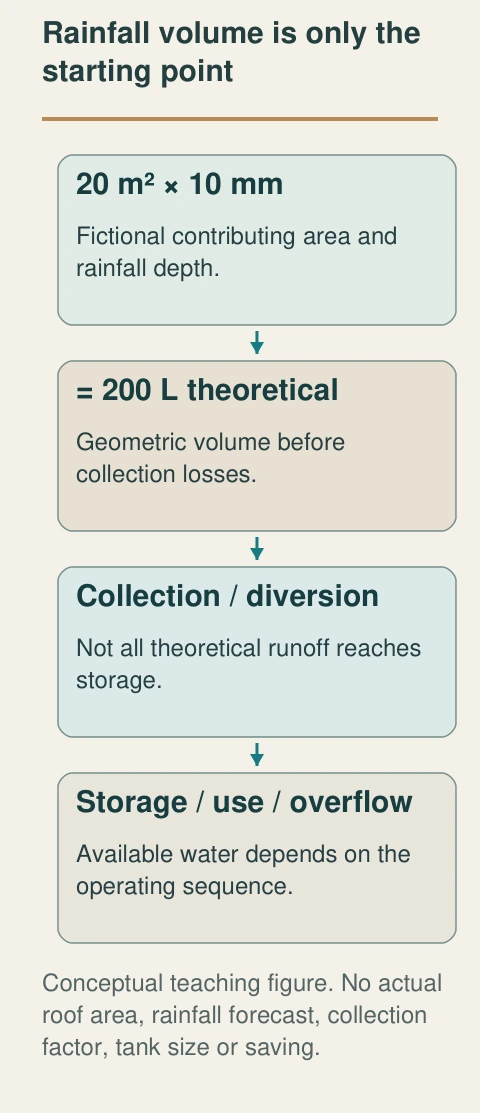
- 20 m² × 10 mm
Fictional contributing area and rainfall depth.
- = 200 L theoretical
Geometric volume before collection losses.
- Collection / diversion
Not all theoretical runoff reaches storage.
- Storage / use / overflow
Available water depends on the operating sequence.
What does this illustration leave out?
No actual roof area, rainfall forecast, collection factor, tank size or saving. This illustration explains an idea. It is not an installation guide.
Which area, rainfall sequence, losses, demand and storage assumptions support the real estimate?
Explore this with HomeAI ↗Opens an editable question. Nothing is sent until you choose to send it.A theoretical event is not an annual saving
- 20 m² × 10 mm200 L geometric rainfall volume in an invented example.
- Collection and diversionActual water arriving can differ.
- Storage, use and overflowOnly water retained and appropriately used contributes to that defined use.
Fictional arithmetic; no collection factor, rainfall forecast, sizing or tariff is supplied.
Further reading: City of Calgary · Rainwater Harvesting Guidelines.
Read the complete figure
Rainfall volume is only the starting point
In a fictional event, 20 m² of contributing roof times 10 mm of rain corresponds to 200 L before losses. Collection, existing storage, use and overflow determine what remains useful.
- 20 m² × 10 mm
- Fictional contributing area and rainfall depth.
- = 200 L theoretical
- Geometric volume before collection losses.
- Collection / diversion
- Not all theoretical runoff reaches storage.
- Storage / use / overflow
- Available water depends on the operating sequence.
What remains unknown: No actual roof area, rainfall forecast, collection factor, tank size or saving.
A useful question: Which area, rainfall sequence, losses, demand and storage assumptions support the real estimate?
What changes in freezing weather?
A seasonal outdoor barrel and a year-round designed cistern are different operating arrangements. A barrel used during warm months needs its manufacturer-directed cold-season plan. The current Calgary page emphasizes emptying and storing the barrel appropriately and restoring the downspout’s drainage route. The roof still receives weather after collection stops.
The seasonal image therefore shows two separate conceptual states: collection connected in warm weather, and the barrel stored while the roof route continues in winter. It is not a step-by-step disconnection instruction. Ask which barrel, diverter, outlet and overflow parts need attention under the actual manufacturer’s directions and local conditions.
Do not assume that a nearly empty barrel, an insulated-looking cover or a buried tank is automatically protected from freezing. The designed system has its own storage, distribution, controls and climate assumptions. A year-round proposal should explain those assumptions and what happens during a power failure or exceptional cold condition.
The historical handbook includes old local depth and insulation examples. They are withheld as present design instructions. Actual frost exposure depends on location and construction, and electrical heating additions require their own qualified scope. This guide offers no burial depth, heat-trace connection, improvised insulation detail or winter pumping procedure.
Record seasonal tasks and actual completion separately. A reminder saying winterize is not evidence that the collection route was restored. Keep the provider or manufacturer instructions beside the task, name the responsible person and retain any qualified work record. Review the arrangement when equipment or site drainage changes rather than copying last year’s assumptions indefinitely.
The roof still needs drainage after collection stops
The separate warm-season view connects collection and upper overflow. In the cold-season view, the stored barrel is disconnected while the downspout continues above ground away from the foundation.
Numbers identify the parts explained below.
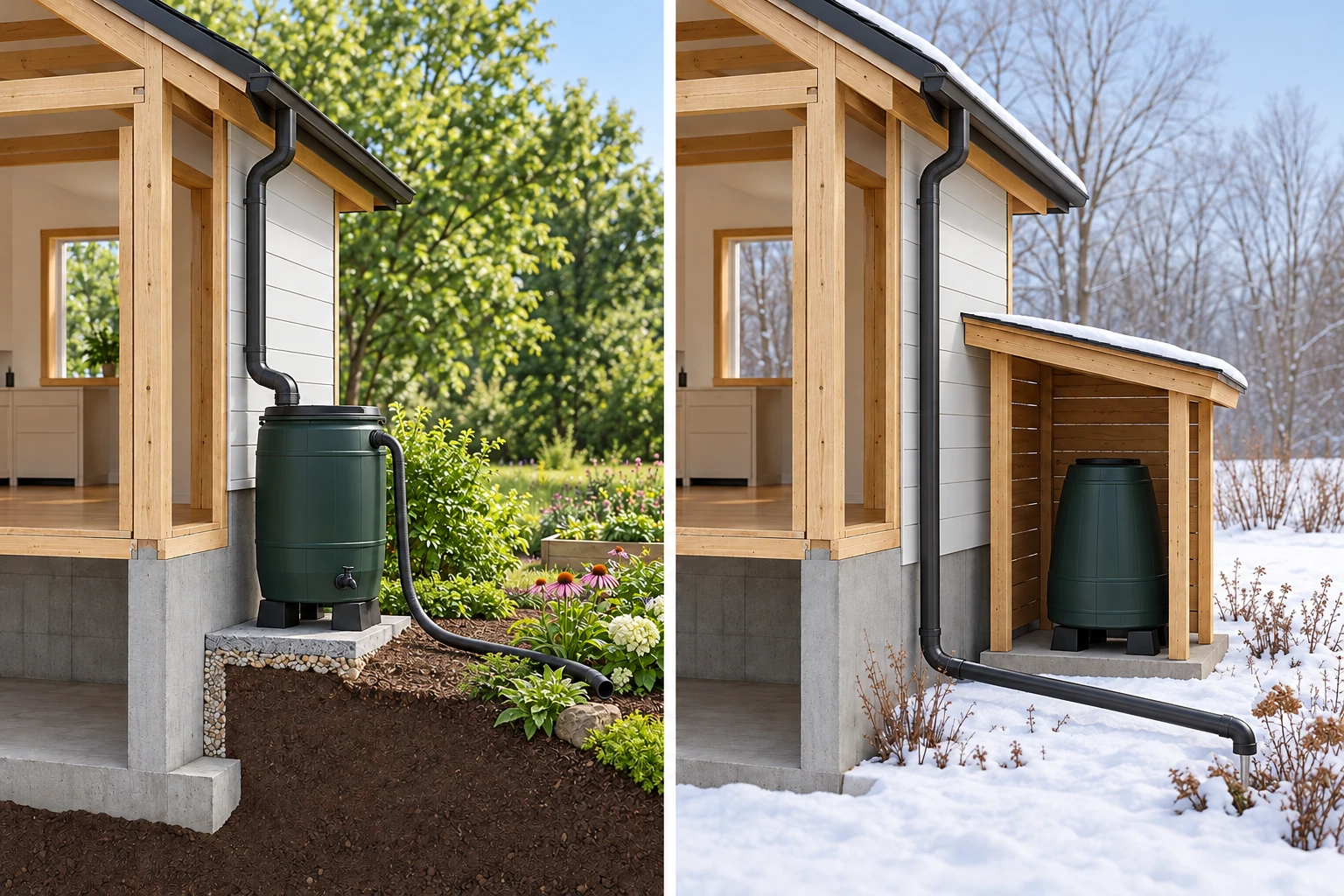
- Warm-season collection
Storage and full-storage routing remain distinct.
- Stored disconnected barrel
Actual emptying, storage orientation and care follow the model instructions.
- Continuing winter route
Stopping collection must not erase the roof’s drainage destination.
What does this illustration leave out?
Stored barrel empty status and orientation are not verified. Conceptual seasonal states, not manufacturer winterization steps or discharge approval. This illustration explains an idea. It is not an installation guide.
Which actual parts need seasonal care, and where does the restored roof route end?
Explore this with HomeAI ↗Opens an editable question. Nothing is sent until you choose to send it.What maintenance belongs to the actual components?
Break maintenance into familiar parts: collection surface, gutter/downspout, screen or diverter, store, outlet, overflow and any pump, controls, treatment or protected top-up. Each has a different job and instruction source. A single task called clean barrel can leave the full-storage route or an integrated pump system unaddressed.
Use the actual manufacturer and qualified handover instructions to assign ordinary care and specialist work. This article does not reproduce the historical handbook’s intervals, roof-hosing advice, tank entry or treatment-service recipes. Access at height, tank interiors, powered equipment and drinking-water protection require suitable qualified arrangements.
Safe accessible observations can describe a cover that appears displaced, leakage at a visible connection, debris at an accessible screen or erosion at the receiving area. Record the location and date without dismantling, climbing, entering a tank or provoking an overflow. Ask the provider which observations require stopping use or a service visit.
If treatment equipment exists, identify its purpose and maintenance separately. A leaf screen, particle filter and disinfection device have different functions. The established water-treatment guide explains those distinctions. Their presence does not authorize drinking collected rainwater or establish that current quality meets a particular intended-use requirement.
Keep requested work separate from completion and any performance assessment. A service invoice should identify the component and task; a subsequent demonstration should state what was actually observed. Where a task remains outside the owner’s safe scope, assign it to a suitable provider. Do not convert a missing maintenance record into an invitation to improvise a procedure.
What records should a supplier or installer leave?
The starting package should identify the intended use, collection area, equipment and complete water routes. For a barrel, retain the model and seasonal instructions, support and cover information, collection connection and receiving route. For an integrated system, ask for the appropriate design, actual installed connections, controls and responsibility map.
Keep proposals, completed installation records and required authority documents distinct. The relevant local professional can explain which permits, inspections or tests apply. A component’s approval mark or supplier brochure does not establish acceptance of the whole installation. Conversely, a local inspection has its own scope and should not be expanded into a drinking-water-quality guarantee.
A handover should explain what occurs during rainfall, ordinary use, full storage, low storage and power loss where applicable. Ask which functions were actually demonstrated and which were explained from documentation. A demonstration record should include the actual conditions and limits rather than promising all-season performance from one dry-day appointment.
Write down whom to contact for collection/drainage, storage structure, plumbing separation, electrical equipment and water-quality questions. One provider may coordinate the group, but the file should show the boundaries. A future household should be able to find the right person without guessing that every rainwater issue belongs to a roofer.
Review the file after roof replacement, a new collection route, changed garden use, pump work or modifications to domestic plumbing. Preserve the earlier record and add the change rather than overwriting it. This allows a later assessment to distinguish an original arrangement from a newer connection that may alter the operating question.
Why can identical rainfall totals leave different useful reserves?
A storage balance follows the sequence of arrivals and use, not just the total rain. The water available after an event depends on what was already stored, what arrived, what was used and what could not remain. This relationship explains why two gardens can experience the same total rainfall while obtaining different amounts from a small barrel.
Consider a deliberately fictional container with 100 L of usable storage, initially empty. Ignore collection losses solely to isolate the timing lesson. In sequence A, 100 L arrives, then the household appropriately uses 60 L, then another 100 L arrives. The first event fills the store. Use leaves 40 L, and the second arrival can add only 60 L before the store is full again.
The remaining 40 L of that second arrival must pass onward through the planned full-storage route in this simplified example. If the household then uses another 60 L, total useful withdrawal across the sequence is 120 L and 40 L remains. These are assumed teaching quantities, not observations from a property or a recommendation for a 100 L barrel.
Now consider sequence B with the same 200 L total arriving before either 60 L use. The usable store fills at 100 L and the other 100 L passes onward. The first 60 L withdrawal leaves 40 L, and the second requested 60 L cannot be fully met from that remaining reserve. Actual withdrawal is limited to 40 L unless another suitable source supplies the balance.
The totals are the same rain and the same requested use, but the order changes stored-water availability. The example does not prove that a larger tank is appropriate; it shows what a real sizing discussion needs to consider. Collection losses, unusable volume, demand timing and the actual overflow route would add further detail to an actual design.
This also explains why a full barrel photographed after one storm is not an annual saving record. It shows a state at a time. To estimate useful supply, the proposed method should relate collection and demand over a relevant sequence. A season-wide rainfall number without timing can conceal both empty-store periods and substantial overflow.
Ask the supplier what their estimate counts as useful water. Does it assume every litre arriving is used, unlimited storage or a daily demand that matches your household? Are periods with no rainfall or a full store represented? Keep the answers beside the estimate so a comparison between two tank sizes uses the same underlying assumptions.
Do not collect a real test sequence by deliberately draining storage, blocking overflow or improvising top-up. The arithmetic can teach the mechanism without a physical experiment. Appropriate records of ordinary use or a qualified design analysis can inform the actual decision while maintaining the intended water-use and safety boundaries.
Demand must also be real and appropriate to the stated use. A model that assumes the household empties storage every day may overstate useful withdrawal when the garden needs less water or the household is away. Water still retained in a full store has not yet displaced a specified domestic use. Ask how the estimate represents actual demand instead of assigning every incoming litre a financial benefit.
The overflow receiving route remains necessary in either fictional sequence. The arithmetic explains why excess volume exists; it does not establish the rate of a real storm or the capacity of a pipe. A route capable of receiving the example’s total volume slowly might behave differently during an actual intense arrival. Keep the qualified sizing and site-drainage questions separate from this simple storage balance.
Likewise, a future rainfall total cannot be treated as a schedule of guaranteed refills. A household relying on a designed nonpotable service needs the actual low-storage plan, including its responsibilities and protected backup where provided. A garden user may simply have less stored water available. Those two service goals should not be compared as if both promise uninterrupted supply.
Financial claims need an additional boundary. A litre used from storage might displace a specified domestic-water use, but the bill effect depends on the actual tariff and what otherwise would have happened. This guide supplies no price or payback. The balance lesson simply keeps theoretical collection, usable withdrawal and cost interpretation from becoming one unsupported promise.
What do low storage, unexpected running and overflow each ask?
A low store asks about the balance between collection, previous use and the actual usable reserve. It does not automatically mean the barrel leaks. A continuing pump asks about demand, controls, delivery and its designed operating limits. Overflow asks what incoming water can no longer remain. These three observations should be described separately even when they occur in one system.
For low storage, give the provider known rainfall and ordinary use information with its limits. A dry week and substantial garden watering can provide context without proving the complete balance. An unexplained fall in level can justify investigation, but the owner should not assume which connection leaks or enter the tank to inspect it.
For a pumped system, report the actual operating pattern, known demand and any displayed message. The designer’s intended sequence matters: a delivery pump, top-up control and overflow equipment can have different roles. A sound from a mechanical room does not identify which function is active. Existing records and qualified assessment can resolve the identity without opening equipment.
If overflow occurs, note the visible receiving route from safe ground and whether unexpected pooling or erosion is present. Overflow itself can be ordinary when a store is full. Water escaping at a connection or reaching an unintended area is a different observation that needs explanation. Do not block the outlet to see which route operates next.
An integrated top-up system adds another comparison. Rainwater availability and continued nonpotable delivery can differ when backup supply is part of the design. A toilet that still fills does not prove rainwater remains in the cistern or that the protection arrangement has been tested. The actual controls and supply records need to identify which source serves the demand.
Do not use the historical handbook’s maintenance tables as an owner troubleshooting script. Their pump, valve, electrical and tank-access details are outside the adopted scope. Ask the appropriate provider how the installed system should respond and what to do when it does not. A missed demonstration at handover should become a defined task, not a self-directed fault experiment.
The investigation can then separate causes and remedies. A storage-volume decision responds to a supported supply/demand question. A control repair responds to a supported equipment finding. A receiving-route change responds to an assessed drainage problem. Replacing the largest visible component first may leave the actual question unanswered.
Keep the first report, qualified findings and completed work together. If an event is not reproduced, preserve that limit and the next recommendation. If the intended use changes, ask whether the earlier sizing and controls still fit. A connected record makes the system easier to operate responsibly without pretending that one successful rain event verifies every operating condition.
Which Canadian claims need a current local answer?
The current Calgary barrel page is an outdoor example for Calgary. Its 2026 programme text was read, but this guide makes no claim that funds, stock, eligibility or a rebate remain available to a particular household. Check the current programme directly if it matters to a purchase, and keep financial administration separate from system suitability.
The retained Calgary harvesting PDF is historical. Its identifier and older building, plumbing and permitted-use references remain visible in the source card. Its location in a /2019 web folder does not establish a 2019 technical edition. The component relationships are useful, while old dimensions, installation rules, costs, intervals and permitted-use tables are not adopted.
Across Canada, municipal drainage, water-supply protection, accepted nonpotable uses, climate and professional requirements differ. An installation accepted in one place cannot be transplanted solely because the tank brand matches. Obtain current local guidance for the actual site and use before planning an integrated system or altering a shared building.
Condominium, rental and shared-property arrangements also need the relevant owner or management involved. A container beside an exterior wall can affect common drainage, access or support questions beyond one household’s garden. This guide does not determine legal permission, ownership or responsibility. Keep the actual authorization and technical scope in the project record.
Use the educational figures to follow the water and formulate questions. They provide neither construction drawings nor approval. The full route, separation and capacity questions belong with the actual installation and its current qualified assessment. The worked household below is invented and supplies no successful commissioning, water-quality result or verified saving.
How would a fictional household compare a barrel with a cistern?
In this invented case, Sam wants stored water for ornamental garden watering. One downspout is accessible from ground level, but its exact contributing roof area is not confirmed. A supplier offers a covered seasonal barrel. Another offers an indoor nonpotable cistern package. Sam records the intended use before comparing the container volumes.
The fictional barrel proposal identifies a covered seasonal container and its ordinary care, but its overflow line ends at an unspecified receiving area. Sam writes “full-barrel destination unresolved” next to that drawing. Because the goal is ornamental watering, the first decision is whether this limited system can collect and release water appropriately at this site—not whether an indoor package has a larger volume.
For the integrated package, Sam asks what additional use is actually intended, which current local requirements apply and who designs domestic-water protection. Pumps, controls, maintenance and power-loss behaviour are identified as additional responsibilities. The larger tank is not credited with drinking-water quality or unlimited garden supply.
Sam chooses to investigate the seasonal barrel option further because its stated use matches the garden goal. Ordering and installation remain conditional on resolving the receiving route, suitable support, secure cover and model-specific care with the appropriate provider and current local advice. Choosing which proposal to investigate is not approving the installation or claiming that the site is suitable.
If the receiving route cannot yet be supported, Sam holds that part of the project open instead of placing the barrel and hoping excess water finds a harmless path. If the goal changes to indoor use, the decision returns to a different qualified design and protection scope. The household’s intended use and the unanswered overflow question—not the largest tank—determine the next task.
After any real installation, the household would keep use and maintenance observations with their dates and conditions. A full barrel after one rain would describe that event, not prove an annual saving. A quieter pump would not prove separation. The useful result is a system whose routes and responsibilities are understandable, with each accepted finding limited to its own evidence.
Keep learning about the connected parts
- Follow rain away from your foundation
- Well pumps and pressure tanks: follow the water and the pressure cycle
- Home water filters and UV treatment: understand what each part does
- Prepare exposed plumbing for a cold spell
- Build a home-care record that the next person can understand
Canadian context and authorities · Visual atlas · Learning labs
Practice the distinction.
Sam compares a garden barrel with an integrated cistern
Fictional case: the stated goal is ornamental watering; roof contribution and the receiving route still need confirmation.
Reported observations
- The goal is ornamental watering, not an indoor water supply.
- The fictional barrel drawing leaves its full-storage receiving area unspecified.
- The integrated option adds pumping, separation and maintenance responsibilities without answering the barrel’s site question.
Compare the explanations
Expand each possibility to see the evidence needed to distinguish it. Similar symptoms can have different mechanisms.
Seasonal barrel matches the limited goal
The simpler proposal can be considered if its support, cover, routes and seasonal care fit the actual site.
Actual product instructions, local site confirmation and handover.
A broader use changes the design scope
Indoor nonpotable supply requires a distinct qualified and current local review.
Specific intended use, design, protection and required acceptance records.
A useful next question
Investigate the use-matched seasonal option, but hold ordering and installation conditional on a supported full-storage receiving route and the other site/model requirements.
No real installation, water-quality test, approval, rebate entitlement or saving is supplied.
Know what the words mean.
- Catchment
- The identified surface contributing runoff to the collection route.
- Nonpotable
- Water unsuitable for drinking; specific other uses still need their own appropriate requirements.
- Overflow
- The route for incoming water that cannot remain in storage.
- Top-up
- A designed backup supply to a nonpotable system when collected water is insufficient.
- Cross-connection
- A connection that can allow water to move between routes intended to remain separate.
Questions to bring
to the conversation.
- Which roof area actually contributes?
- Where does water go during ordinary use, full storage and winter?
- What exact use is intended?
- Which domestic-water protection and local records apply?
- Who owns the component-specific maintenance?
Separate a showing observation, an existing record and a new professional assessment. Unknown means a question remains; it does not automatically mean a defect.
Use the evidence planner ↗Go to the source.
Original HomeAI explanation informed by these public references. Sources support the underlying guidance; they have not reviewed or endorsed HomeAI. Diagrams are conceptual, and calculator outputs depend on your inputs.
Current Calgary barrel body and complete substantive historical harvesting sections were read October 13, 2026. Historical PDF pages 10–38 and introductory pages 1–6 are adopted only for named component relationships; all 55 pages/raw text retained, later appendices not claimed fully read. No historical legal/use/sizing/depth/air-gap/separation/cost/interval instruction, tank entry, roof access, disinfection, plumbing/wiring procedure, programme availability or current approval is adopted. Theoretical rainfall arithmetic is labelled fictional and excludes collection losses and operating limits. Draft authorship is separate from independent acceptance and publication.
Publication & source review
First published .
Sources reviewed .
Have a question about your home?
Start with the symptom, timing and what you have observed.
Ask HomeAI