- A laboratory result describes the tested sample and panel, not future supply capacity.
- Match the well identity, sample point, treatment and dates to this property.
- Get qualified interpretation of source protection, quantity and contaminant-specific treatment.
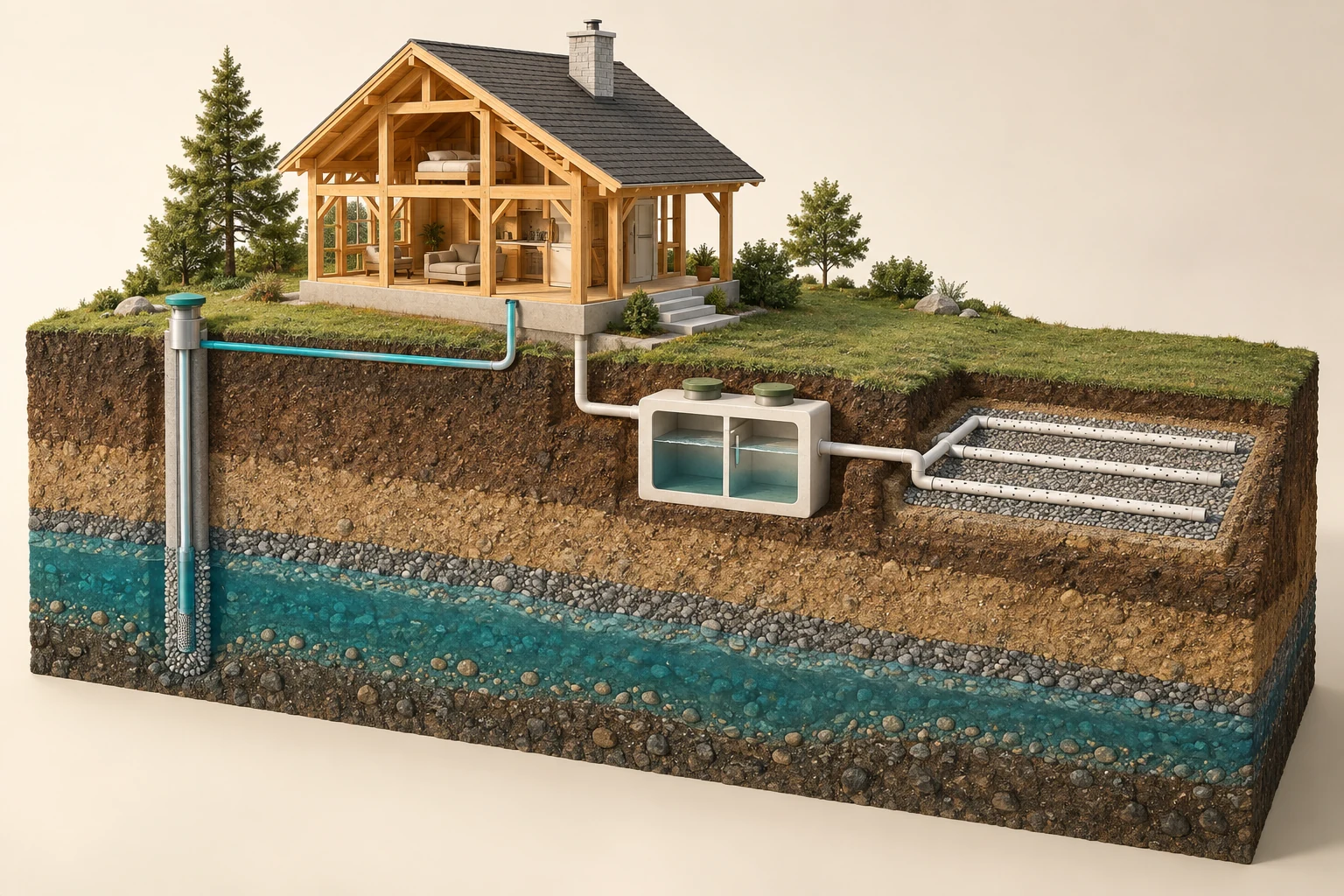
Conceptual architecture. Layout, sizes and routes are illustrative; the picture does not describe your home’s condition.
Explore this picture study ↗4 picture lessons appear beside the questions in this guide. Use them to understand the explanation, then consider what it means for your home.
Identify the actual supply before reviewing the result
A rural address does not tell you whether water comes from a private well, a shared system, a cistern or a public supply. Ask the seller to identify the source and explain the complete route to the home. Request the well location, construction or drilling record, equipment identity and any sharing or access documents. Keep the physical well and the legal arrangement distinct: seeing a well on neighbouring land does not establish who may use it, maintain it or enter the property. Obtain appropriate advice on those arrangements.
Link every document to the source it describes. A historic drilling record can be valuable even if the pump was replaced later, but it may not describe all later work. A laboratory report without a well or sample-point identity is harder to interpret. Official provincial resources can help locate records; Alberta’s water-well application is one example, not a national database. Record uncertainty when a location or identifier cannot be matched. Do not fill the gap by assuming that a nearby mapped well must serve this house.
Delivery hardware does not establish quality or sustainable supply
The teal main route crosses the room from the left well section toward the kitchen fixture. A short branch rises from that route into the base of a closed blue tank. A dial-like face and closed grey enclosure sit nearby. The house and ground are virtual cutaways.
Numbers identify the parts explained below.
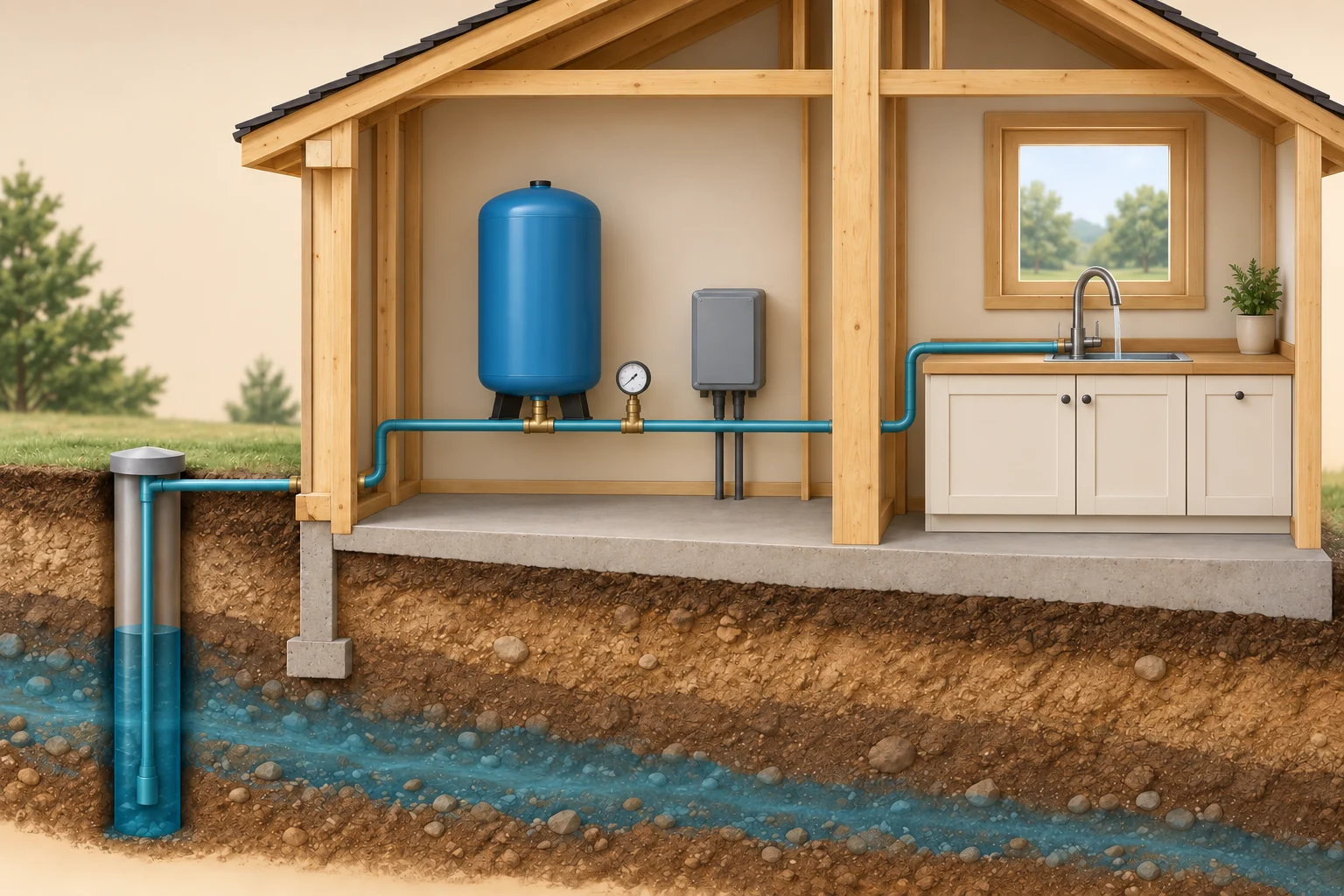
- Source-location specimen
Match the actual well identity, source and construction records to the home. This pictured well cannot establish source replenishment or water quality.
- Closed delivery equipment
The tank, dial-like face and closed control are separate equipment landmarks. Identify actual models and scoped service findings rather than reading performance from their appearance.
- Fixture landmark
Ordinary delivery at a fixture answers a narrower question than source quantity or laboratory quality. The illustration depicts no flow test or measured result.
What does this illustration leave out?
The apparent route is a teaching simplification, not a verified pressure-piping installation or actual pump connection. No model, fuel or energy state, measured pressure, seasonal yield, usable tank storage, groundwater flow, water quality or treatment performance is established. The gauge supplies no usable reading. Keep real covers closed and do not operate or adjust equipment to reproduce the scene. This illustration explains an idea. It is not an installation guide.
Which source, equipment and route records establish how this home receives water, and what separate evidence addresses water quality and supply quantity?
Explore this with HomeAI ↗Opens an editable question. Nothing is sent until you choose to send it.Separate water quality from water quantity
Quality concerns what is present in the sampled water and at what concentration. Quantity concerns whether the source and system can supply the intended demand under relevant conditions. Clear water at a tap proves neither. A short tap demonstration can show that water flowed during the visit, while a professionally planned pumping assessment can investigate a different question about supply and recovery. The pump, pressure equipment and distribution can also limit delivery, so a complaint about low pressure does not automatically identify the aquifer as the cause.
Describe the intended occupancy and uses before commissioning an assessment. A seasonal household and a year-round household with additional accommodation may have different patterns. Ask a qualified well professional what existing records support the assessment, which tests are appropriate, and which seasonal uncertainty remains. Record the duration, rate, operating conditions and interpretation of any quantity test. Avoid translating one quoted pumping rate into a permanent capacity guarantee or operating equipment aggressively to create your own informal stress test.
Know what the laboratory panel actually covers
Microbial, chemical and operational water-quality questions require appropriate testing and interpretation. A report saying bacteria were not detected does not establish that the sample was tested for every chemical of concern. Health Canada recommends regular microbial testing and separate consideration of general quality and locally relevant chemical contaminants. Its recommendations are guidance, not a single national transaction rule. Ask the local public-health or drinking-water authority and accredited laboratory which panel and timing fit this source, location and history.
Request the full report rather than a screenshot of one reassuring row. Keep units, detection limits, sample date, location and comments attached. If an unfamiliar result is highlighted, ask the laboratory or health authority what it means and what follow-up is appropriate. A taste or colour change may motivate investigation, but absence of a sensory change does not clear contamination. Likewise, a neighbour’s result belongs to their sample and supply; it cannot substitute for evidence about the well serving the property you may buy.
Make sample conditions part of the evidence
Sampling is a defined procedure. Use the laboratory’s bottles, forms and collection, storage and transport instructions through the appropriate authorized arrangement. Ask who collected the sample, which outlet was used, whether treatment was operating and whether recent maintenance affected the conditions. A sample collected after one-off treatment or from a different source may answer a narrower question than the buyer expected. Do not infer dishonesty from a missing detail; obtain the context and ask how it affects interpretation.
The distinction between raw and treated water is particularly important. Raw-water evidence can help identify what the source contains; treated-water evidence can help evaluate the output of the installed treatment under the sampled conditions. A kitchen tap may have a separate treatment device from other taps. Mark the treatment path on a simple documentary diagram, and have the qualified provider confirm it. Avoid disconnecting, bypassing or altering treatment to obtain a sample yourself unless the responsible professional has specified the procedure and permissions.
A sample report needs its actual collection point and context
A left faucet and a kitchen faucet sit at different illustrated locations around an unnamed closed cream cabinet. Two capped clear bottles, a blank sheet and a blank clipboard lie separately in front. A virtual well section appears at left.
Numbers identify the parts explained below.
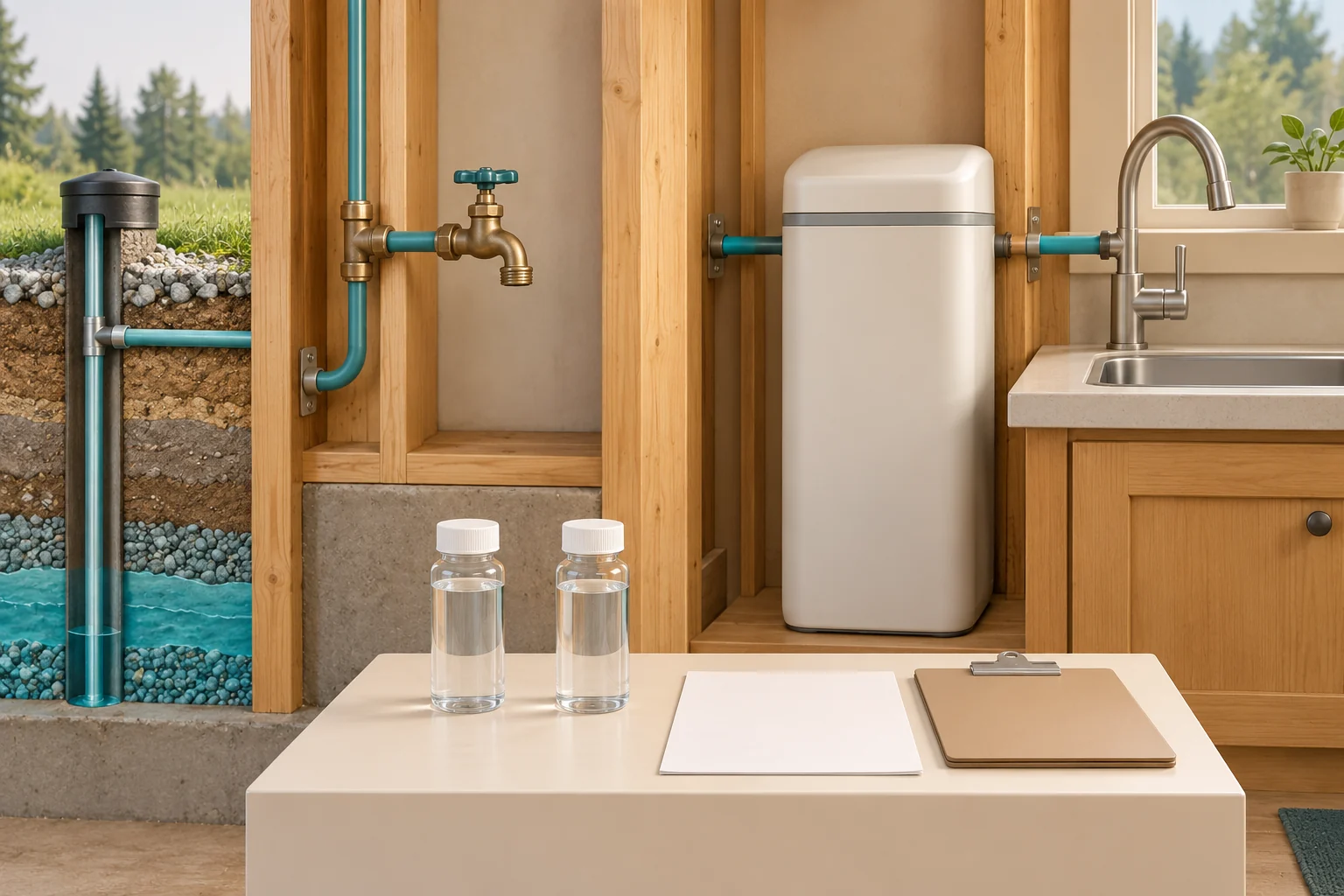
- Separate location landmarks
Ask the laboratory and provider to identify the actual collection point and relevant treatment state. Neither pictured faucet is a prescribed sampling location.
- Capped sample specimens
The bottles show no collection procedure or tested finding. Follow the actual laboratory instructions for containers, collection, identification, handling and delivery.
- Original report question
Retain the actual date, panel, method and collection context. Microbial and chemical questions are different; blank paperwork cannot answer either.
What does this illustration leave out?
No bottle has an authenticated collection point, panel, result or handling history. The cabinet does not identify actual treatment, and its illustrated position cannot establish raw or treated water at either faucet. Blank pages supply no date, method, analytes, concentrations or drinking-water clearance. These are location and record questions, not approved sampling instructions. This illustration explains an idea. It is not an installation guide.
Which actual sampling point, treatment state, collection date, laboratory panel and instructions belong to this result?
Explore this with HomeAI ↗Opens an editable question. Nothing is sent until you choose to send it.Understand treatment as a matched and maintained system
A softener, filter, disinfection unit or other treatment device does not address every contaminant. Request the equipment model, purpose, installation record, maintenance instructions, consumable changes and verification results. Ask the qualified provider what input conditions the equipment was selected for and whether the current supply falls within them. Health Canada explains that treatment must match the contaminant; this guide does not choose equipment or provide chemical disinfection instructions. A branded unit or a recent invoice alone does not establish effective treatment.
Think in terms of a complete chain: source evidence, treatment selection, installation, maintenance and checked output. If one link is missing, name the question rather than declaring the whole chain successful or failed. A service sticker may show an attendance date without showing what was measured. A replaced lamp or cartridge may be relevant maintenance without confirming every treatment objective. Have the report explain which results demonstrate performance, what remains uncertain and when the next check is appropriate for the actual equipment.
Different treatment functions need a defined target and verification
Three separate display stands expose a pleated cartridge, bead and pellet forms in paired vessels, and a tube-and-sleeve form inside a metal cylinder. Control faces and electrical connections remain closed. These interiors are virtual cutaways.
Numbers identify the parts explained below.
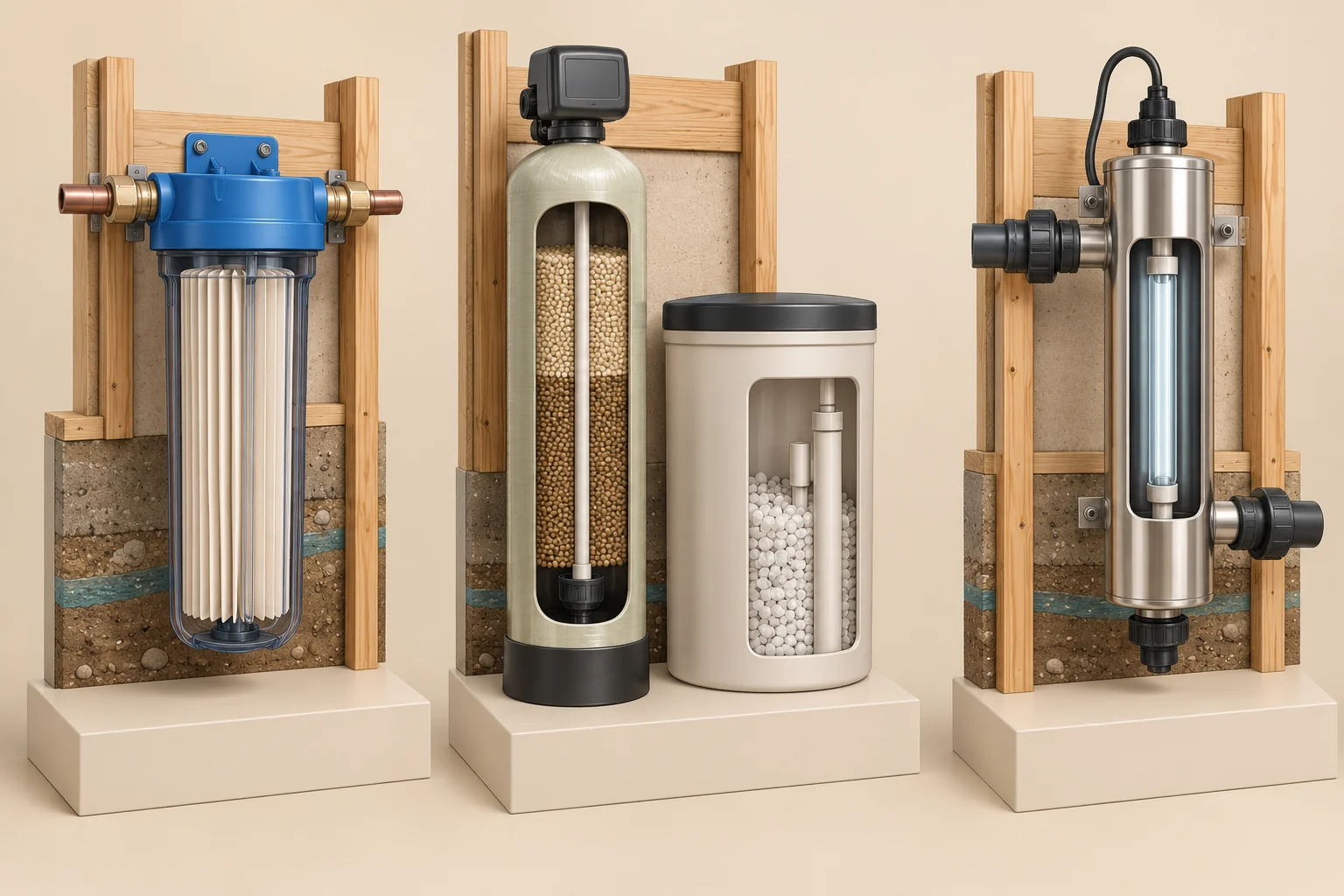
- Cartridge specimen
A pleated shape introduces a filtration question. The actual model and documented target determine what a device is intended to reduce; the picture supplies no performance claim.
- Bead and companion-vessel specimens
A softener function is different from a general drinking-water safeguard. Identify the actual equipment, relevant water characteristics and matching service plan.
- Tube-and-sleeve specimen
An ultraviolet treatment question needs the actual model, applicable input-water conditions, instructions and verification. This virtual interior establishes no delivered dose or microbial result.
What does this illustration leave out?
The forms introduce filter, softener and ultraviolet treatment questions without authenticating a product, certified target, installed sequence, operating condition or successful treatment. There is no connected treatment train or blank record in this picture. No contaminant, removal result, disinfection result or approved installation is shown. Do not open real housings, expose a lamp or change valves to reproduce the display. This illustration explains an idea. It is not an installation guide.
What documented target, incoming-water conditions, actual model, service requirements and verification evidence apply to each installed treatment device?
Explore this with HomeAI ↗Opens an editable question. Nothing is sent until you choose to send it.Ask about the well and its surroundings without disturbing them
From safe accessible locations, note whether the identified wellhead is protected and whether surface water appears able to collect nearby. Record relevant land-use changes, flooding, fire, drought, fuel storage or service work reported by the seller. These are prompts for the well professional and health authority to evaluate, not proof of a contaminant. Do not remove the cap, lean over an opening, enter a pit or access pump wiring. Hidden wells and confined spaces require an appropriate professional access plan.
Ask how the source is protected and where the water and wastewater systems are located relative to one another. A visual yard tour cannot establish subsurface flow or appropriate separation under local requirements. Site plans, construction information and professional findings can help narrow those questions. If the well has been affected by an emergency or a result indicates unsafe water, follow current public-health advice and use the appropriate safe alternative; a sale deadline is not a reason to keep using uncertain water or improvise a remedy.
The visible wellhead and concealed protection need separate evidence
A closed cap and casing stand above grass. The virtual soil section exposes grey strips beside the casing and a teal band lower in the rock. A house sits in the background.
Numbers identify the parts explained below.
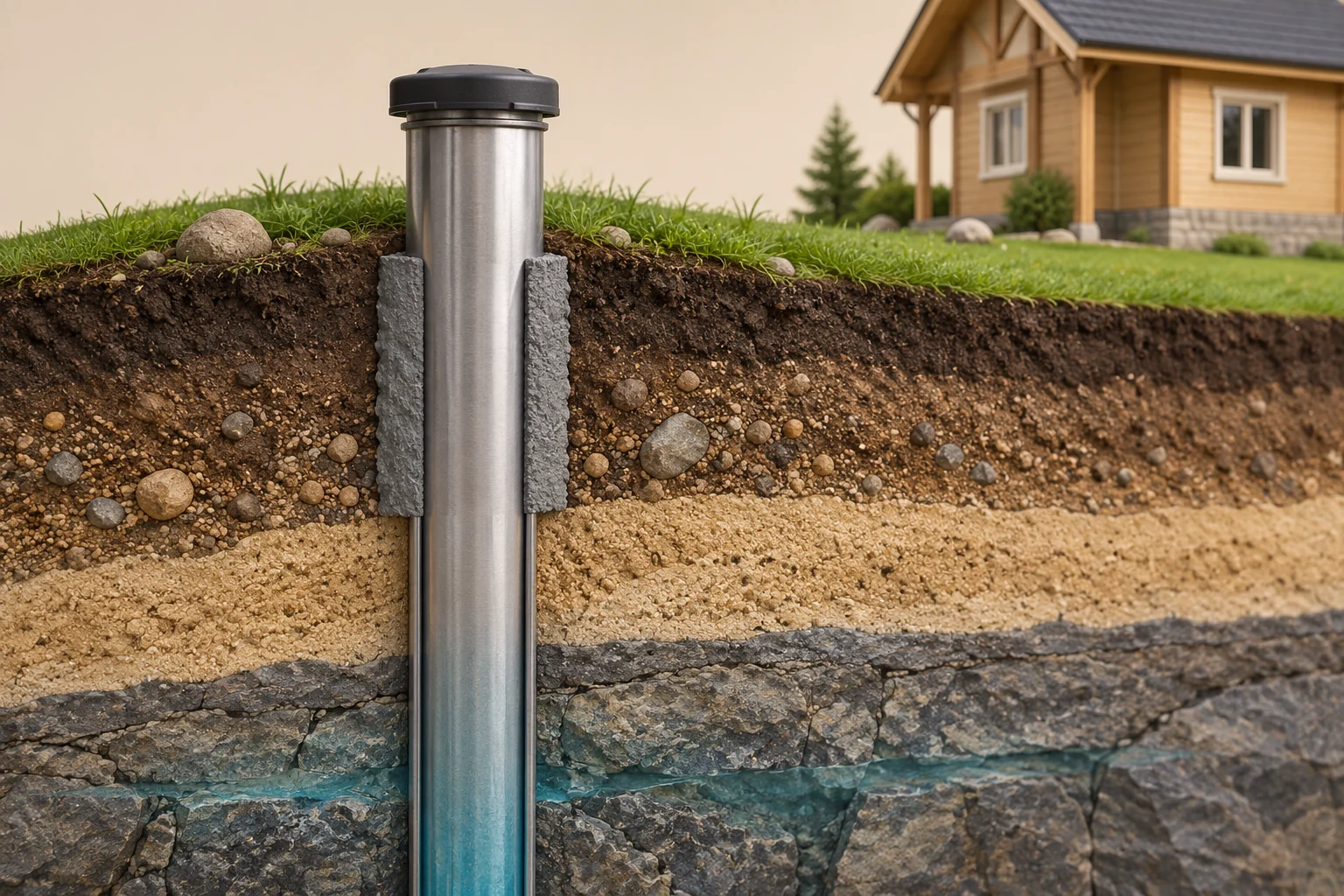
- Closed cap and accessible casing
Record accessible exterior condition from safe ground. Do not remove the cap, lean over an opening or enter a pit to match the picture.
- Concealed interface specimen
Health Canada distinguishes casing and annular-seal protection. This grey display supplies no finding about the real buried seal; request construction records and qualified findings.
- Surface and surroundings
Keep the actual location, pooling timing and nearby changes in the record. This pictured grass and ground supply no contamination or drainage clearance.
What does this illustration leave out?
The grey strips introduce a concealed-seal question without authenticating an annular seal, its material or integrity. Teal colouring establishes no groundwater direction, contamination or sample result. Actual construction, buried condition, surface drainage, local requirements and appropriate separation remain unknown. The section is an illustration, not an opened well, installation detail or setback plan. This illustration explains an idea. It is not an installation guide.
Which accessible wellhead changes and original construction records should I show a qualified local well professional without removing a cap or entering a pit?
Explore this with HomeAI ↗Opens an editable question. Nothing is sent until you choose to send it.Write the inspection and testing scope before the deadline
Agree on the assessment question, permissions, tests, sample responsibility, interpretation and written deliverables. Ask whether the general home inspection includes any well assessment or whether a separate qualified provider is needed. Clarify access to records, treatment equipment and the actual well location. A contractor should explain what the visit cannot establish, including seasonal supply uncertainty and concealed construction. Schedule laboratory and specialist turnaround within the transaction timetable rather than assuming every result will arrive before the decision.
Financing, insurance and contractual questions are separate from the technical work. Ask the relevant lender, insurer and legal professional what evidence they require for this property and intended use. Do not promise that a passing panel guarantees financing or that missing records automatically make the property unacceptable. The technical report should remain intact when shared with those parties; a short summary should not omit qualifications, excluded contaminants or a recommendation for follow-up. Use their written responses to understand the actual remaining decision conditions.
Carry a complete water dossier into ownership
The useful handover includes source identity, full laboratory reports, quantity assessments, construction and service records, equipment manuals and unresolved actions. Sellers can make the property easier to understand by preserving original dates and scope rather than summarizing every result as good. Buyers should distinguish existing evidence from new work arranged for the purchase. Keep any planned treatment correction separate from proof that it was completed and verified. A change of ownership does not reset the physical history of the well.
If you proceed, ask the appropriate local authority and provider for a maintenance and sampling plan suited to the system. Regional schedules and programs differ, so do not silently substitute one province’s routine for another’s. Update the dossier after service, unusual events and testing. HomeAI can help compare report fields and formulate questions, but it cannot declare water potable, calculate sustainable yield from a listing or certify the system remotely. The goal is a traceable supply record and a qualified answer to each consequential unknown.
Include the actual treatment model and sample-point identity in any follow-up request so the next professional does not need to reconstruct them from photographs. If evidence arrives after an initial discussion, update the question and keep the old version dated rather than erasing the earlier uncertainty. The record should make clear whether the new document answered quality, quantity, equipment condition or access. That distinction remains useful when a later owner investigates a different symptom.
Keep learning about the connected parts
Practice the distinction.
A reassuring report with an unanswered question
A fictional listing supplies a recent bacteria result and a receipt for a softener.
Reported observations
- The laboratory sample point is not identified.
- No quantity assessment is supplied.
Compare the explanations
Expand each possibility to see the evidence needed to distinguish it. Similar symptoms can have different mechanisms.
Limited quality evidence
The bacteria result may be useful without addressing chemical contaminants or treatment input.
Full report, sample context and locally appropriate panel.
Separate supply question
The household’s intended demand has not been assessed by those documents.
Matched well records and a qualified quantity assessment if needed.
A useful next question
Clarify the sample and supply questions before commissioning or interpreting further work.
Missing evidence does not prove contamination, inadequate yield or a seller misstatement.
Know what the words mean.
- Aquifer
- Permeable geological material that stores groundwater and can yield a useful supply to wells or springs. A regional aquifer description does not establish one well’s supply or water quality.
- Raw water
- Water before the treatment stage being evaluated.
- Drawdown
- The reduction in water level during pumping, interpreted with rate, duration and recovery data.
- Test panel
- The defined group of analytes included in a laboratory request.
Questions to bring
to the conversation.
- Which well supplies the home, and do its records match the location?
- Was each sample raw water, treated water or a specific tap?
- Which microbial and chemical questions did the panel answer?
- What evidence addresses supply and recovery under the intended demand?
Separate a showing observation, an existing record and a new professional assessment. Unknown means a question remains; it does not automatically mean a defect.
Use the evidence planner ↗Go to the source.
Original HomeAI explanation informed by these public references. Sources support the underlying guidance; they have not reviewed or endorsed HomeAI. Diagrams are conceptual, and calculator outputs depend on your inputs.
Publication & source review
First published .
- Environment and Climate Change Canada · Groundwater and aquifers
- Health Canada · Test your well water
- Health Canada · Treat your well water
- Government of Alberta · Aquifer pump tests
- Government of Alberta · Alberta water wells web application
- Government of Alberta · Groundwater and water wells
- Government of Nova Scotia · Private wells
- Government of Prince Edward Island · Testing of drinking water
- Government of Yukon · Get your drinking water tested
- Health Canada · Wellhead protection and concealed well components
Where this reference applies
Jurisdiction: Canada; general health guidance
Edition: Page details 2024-08-02
Source reviewed: 2026-10-05 · America/Edmonton
Visible wellhead conditions and surrounding land differ from concealed casing/seal condition. The conceptual figure does not establish this property’s water quality or local construction requirements.
- Agriculture and Agri-Food Canada · Well components and supply records
Where this reference applies
Jurisdiction: Canada; dated agricultural and rural-well context
Edition: Date modified 2016-11-04
Source reviewed: 2026-10-05 · America/Edmonton
Component identity, pumping history and water-quality records answer separate questions. Provincial requirements and a qualified local assessment govern actual work; the dated procedural instructions are not a homeowner work plan.
- CCOHS · Confined-space hazards and professional access
Where this reference applies
Jurisdiction: Canada; workplace confined-space context
Edition: Fact sheet last revised 2025-03-12
Source reviewed: 2026-10-05 · America/Edmonton
Wells and tanks can have serious atmosphere, access and rescue hazards. Observe only from safe accessible ground; this guide supplies no entry, gas-testing or rescue procedure.
Have a question about your home?
Start with the symptom, timing and what you have observed.
Ask HomeAI